

More news on this day
An early-morning avalanche derailed a regional passenger train in the Swiss Alps near Goppenstein on February 16, injuring five people and triggering hours of travel disruption across the canton of Valais as authorities scrambled to secure a key mountain corridor and update avalanche and transport alerts.
What Happened on the Goppenstein Line
The derailment occurred shortly after 7 a.m. local time on Monday, February 16, on the picturesque but exposed section of track between Goppenstein and Hohtenn in the upper Valais. The train, operated by regional railway company BLS, was running along the Lötschberg axis, a vital north south link that connects the Bernese Oberland with the Rhone Valley and onward routes to Italy.
According to Valais cantonal police, 29 passengers were on board when at least one carriage left the rails after an avalanche swept across or immediately above the line. Initial findings suggest a snow slide struck the alignment in the so-called Stockgrabe or Stockgalerie sector, a stretch protected by galleries but still vulnerable in periods of extreme snowfall and wind-drifted snow.
Five people suffered injuries in the incident. One passenger was flown or transported by road to hospital in Sion for further treatment, while four others were treated at the scene by emergency medical teams and did not require admission. All remaining passengers were safely evacuated from the derailed train and brought to shelter as conditions in the area remained unstable.
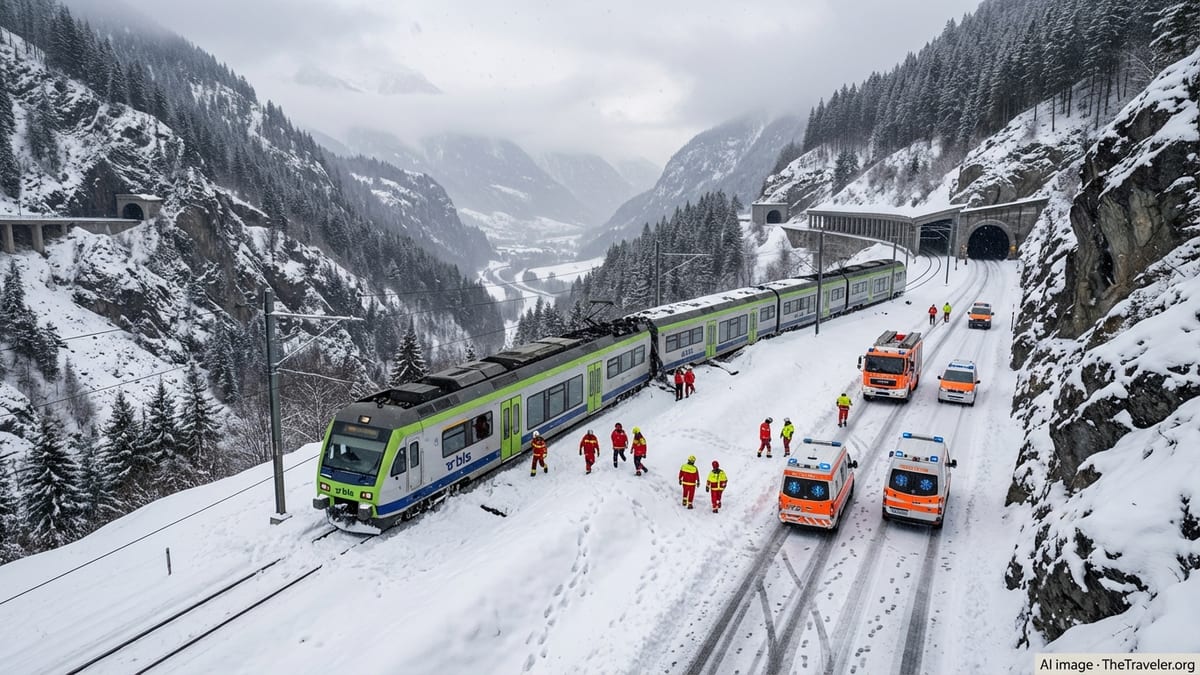
Images released by police from the scene showed at least one carriage tilted off the track amid deep snow, with rescue personnel working around the train. Authorities stressed that, despite the dramatic nature of the derailment, the outcome could have been far worse given the exposure of the route and the avalanche conditions prevailing across the region.
Emergency Response in Challenging Alpine Conditions
Emergency services were mobilised within minutes of the first alert, with a complex rescue operation unfolding in difficult terrain and active snowfall. Valais cantonal police coordinated the response, supported by local fire brigades, ambulance services, a rescue helicopter and specialist mountain rescue teams accustomed to operating in harsh winter conditions.
Railway emergency units, including dedicated fire and rescue trains, were dispatched to access the site via the rail corridor as far as safety allowed. These specialised trains carry heavy recovery and cutting equipment, enabling teams to stabilise carriages, clear debris and ensure that no passengers remain trapped. At the same time, medical staff set up triage points close to the scene to rapidly assess the condition of everyone on board.
Authorities reported that evacuation from the derailed train proceeded in an orderly fashion despite the shock and anxiety among passengers. Many were tourists or commuters heading towards Brig and other Valais destinations at the height of the winter sports season. Wrapped in emergency blankets and escorted by responders, evacuees were led through deep snow to safer ground before being taken to temporary reception points.
Rescue officials emphasised that the high avalanche danger forced them to monitor surrounding slopes constantly throughout the operation. Additional snow slides remained a concern as fresh accumulations continued to build above the valley. Safety spotters and avalanche specialists were deployed to watch the terrain while recovery and medical teams worked below.
Travel Chaos Across the Valais Rail Network
The derailment immediately severed a critical section of the Frutigen Brig railway line, which carries both regional RegioExpress services and long-distance passenger and freight traffic through the Lötschberg corridor. Swiss Federal Railways and BLS announced an interruption of rail traffic between Goppenstein and Brig, with the closure expected to last at least through the night following the accident and potentially into the following morning as inspections and repairs continue.
Replacement bus services were arranged to connect affected communities on the south side of the Lötschberg tunnel, but heavy snowfall and avalanche risk also weighed on road operations. Motorists using the nearby Lötschberg car shuttle and access roads into the Lötschental valley have already faced repeated closures in recent days due to earlier avalanches and snow clearance work, making contingency planning more complex than usual.
For much of Monday, travellers heading between the Bernese Oberland and Valais faced extended journey times, multiple transfers and crowding on available services. Rail operators urged passengers to check schedules frequently, anticipate delays and avoid non-essential journeys along the axis while the investigation and clean-up continued. International connections towards Italy via the Simplon route were also indirectly affected by the reduced capacity and re-routed services.
Tourism businesses across upper Valais, including hotels and ski resorts, reported cancellations and rebookings as guests adjusted arrival and departure plans. While Switzerland’s rail network is known for its resilience and redundancy, the combination of a physical derailment and extreme weather significantly constrained options in this key alpine corridor.
Why Avalanche Risk Is So High Right Now
The derailment came as large parts of the Swiss Alps, including Valais, were under elevated avalanche warnings following days of heavy snowfall and strong winds. Forecasters from the Swiss Institute for Snow and Avalanche Research had issued level four alerts on a five point scale for much of the region, warning that both natural and human triggered avalanches were likely on many steep slopes.
Successive storms had deposited thick layers of new, wind drifted snow on top of older, weaker snowpacks. This layering creates unstable slabs that can fracture and slide with minimal prompting, especially on lee slopes and near ridgelines. In some sectors, avalanche experts warned of the potential for large, destructive avalanches capable of reaching transportation corridors, forest edges and infrastructure lower in the valleys.
Authorities pointed out that a previous avalanche had already struck near Goppenstein just a few days earlier, burying part of the main road linking the Lötschental valley to the Rhone plain. That event caused no injuries but forced hours-long closures for road traffic and the Lötschberg car shuttle. The repeat incident on the rail line underlines how persistently dangerous the snow conditions have become in this particular corner of the Alps.
Across the wider alpine region, from France to Italy and Austria, a spate of deadly avalanches in recent days has further highlighted the scale of the hazard. Mountain safety services have responded by tightening access restrictions, closing off high-risk slopes and urging both residents and visitors to take warnings seriously, whether they are on skis, in vehicles or on board trains.
Latest Valais Travel Alerts and Disruption Expectations
As of Tuesday morning, transport authorities in Valais and national rail operators were maintaining a cautious stance on reopening the damaged rail section. The line between Goppenstein and Brig remains closed while engineers assess the state of the track, overhead power supply, protective galleries and signalling equipment. Only after detailed inspections and snow clearance can a phased resumption of services be considered.
Passengers planning to cross the Lötschberg route are being advised to consult national timetable information before departure and to be prepared for last minute changes. Replacement buses on the south side of the tunnel are expected to continue operating, but their schedules can be affected by additional snowfall, road closures or fresh avalanche activity. Travellers with tight connections to long distance or international trains are urged to build in substantial extra time.
Within Valais itself, cantonal authorities have activated or extended numerous avalanche related restrictions. Several mountain passes and local access roads are either closed or subject to convoy systems and temporary shutdowns whenever avalanche control work is underway. Ski resorts have closed off exposed off piste sectors and some high alpine lifts while stabilisation measures, such as controlled releases with explosives, are carried out.
Officials stress that the situation remains dynamic. Avalanche bulletins are being updated at least twice daily, reflecting changing wind patterns, temperature shifts and new snowfall. Visitors are encouraged to monitor local radio and official information channels in addition to national bulletins, since valley specific risks can vary significantly even over short distances.
Guidance for Rail Passengers, Drivers and Winter Tourists
For travellers already in the region, the derailment and avalanche alerts are a reminder to approach all journeys with heightened caution and flexibility. Rail passengers are advised to reserve seats where possible on alternative routes, watch for platform and on board announcements, and keep essential items including warm clothing, water and power banks accessible in case of prolonged delays.
Drivers in Valais and neighbouring alpine cantons should expect rapidly changing conditions. Snow chains may be mandatory on certain stretches, and sudden closures can occur when avalanche risk peaks. Motorists are urged not to attempt to bypass barriers or ignore closure signs, a behaviour that can place both themselves and rescue crews at risk. In areas where convoys are operating under police control, patience is vital as authorities manage flows to keep people moving without overloading vulnerable sections.
Winter sports visitors are being asked to strictly respect ski area closures, boundary ropes and guidance from ski patrols. Even experienced off piste skiers and snowboarders are encouraged to reconsider plans that involve steep, uncontrolled terrain while level four avalanche warnings are in place. Guided tours may be rerouted to lower angle terrain, forested slopes or resort based itineraries that offer safer alternatives during this high risk period.
Tourism offices and hotel operators across the region are sharing updated travel information with guests, helping them replan excursions, adjust check in times and, in some cases, extend stays where onward travel is temporarily disrupted. While the derailment has created anxiety among some visitors, local authorities emphasise that most infrastructure remains operational and that precautions are designed precisely to prevent more serious incidents.
How Authorities Are Securing the Lötschberg Corridor
In the wake of the derailment, rail engineers, geotechnical experts and avalanche specialists have converged on the Lötschberg corridor to review the effectiveness of existing protections and determine whether additional measures are required in the short and medium term. Much of the route is already shielded by avalanche galleries, reinforced embankments and snow fences that are standard features on alpine railways.
Initial efforts focus on clearing snow and debris from the affected section, recovering the derailed rolling stock and verifying that the track geometry has not been permanently compromised. Overhead lines must be checked for damage or misalignment, and signalling systems recalibrated once repairs are complete. Only after static and dynamic tests confirm the integrity of the infrastructure will trains be allowed to pass the site again, likely at reduced speeds in the first instance.
At the same time, safety managers are reviewing operational protocols that apply during periods of high avalanche risk. These include thresholds for speed reductions, temporary line closures, enhanced patrols by track inspectors and real time coordination with avalanche forecasting services. Authorities will examine whether warning levels in the lead up to the incident should have triggered additional protective actions and how best to refine decision making criteria for future storms.
Beyond the immediate response, the incident may accelerate longer term investments in further protective structures on the most exposed stretches of the Goppenstein Hohtenn line. Options range from extending snow galleries to reinforcing cuttings and installing additional monitoring equipment capable of detecting slope movements and snow slides before they reach the tracks.
What This Means for Future Alpine Travel
While serious rail accidents remain rare in Switzerland, the Goppenstein derailment highlights how climate and weather related hazards are challenging even the most robust transport systems. Periods of intense snowfall, rapidly fluctuating temperatures and strong winds are becoming more frequent in parts of the Alps, contributing to complex and sometimes unstable snowpacks throughout the winter season.
For travellers, this translates into a need to factor environmental risks into trip planning more systematically. Choosing flexible tickets, allowing extra time for transfers and building contingency days into longer itineraries can help absorb disruptions when nature intervenes. Travel insurance policies that explicitly cover weather related delays and alternative transport costs are also gaining importance for those heading into mountain regions during the core winter months.
At the same time, Swiss authorities and operators are keen to stress that the country’s rail network remains one of the safest and most reliable in the world. Comprehensive investigations into incidents such as the Goppenstein derailment are standard practice, typically resulting in detailed recommendations that feed back into infrastructure design, operating rules and staff training.
For now, anyone planning to cross the Swiss Alps via Valais in the coming days should remain closely attuned to official avalanche bulletins and transport updates. With the snowpack still under considerable stress, and with the investigation into the derailment only just beginning, a cautious approach offers the best path to enjoying the region’s winter landscapes while minimising exposure to its current risks.