

More news on this day
A passenger train derailed high in the Swiss Alps after an avalanche swept across the line near the village of Goppenstein, injuring five people and disrupting a key mountain route at the height of the winter travel season.
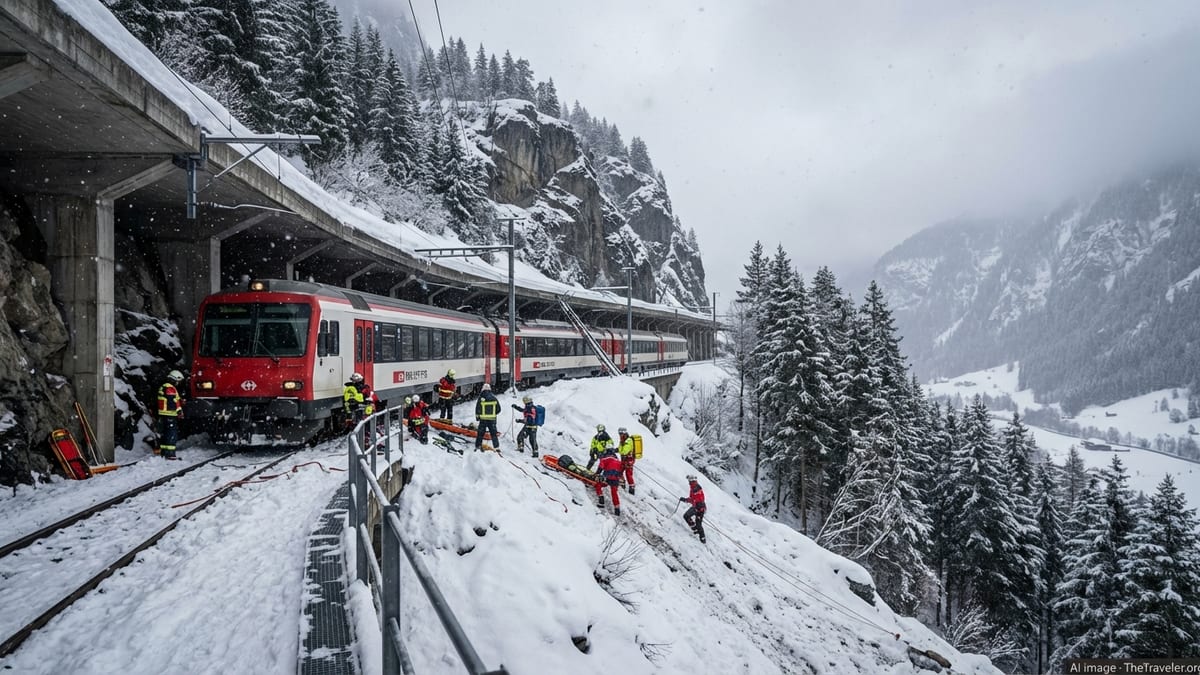
Early-Morning Crash on a Scenic Alpine Route
The derailment occurred shortly after 7 a.m. on Monday 16 February 2026 in the canton of Valais, on the steep section between Goppenstein and Hohtenn on the Lötschberg axis, one of Switzerland’s strategic north south corridors. The regional RegioExpress service, operated by Bern Lötschberg Simplon (BLS), had left the town of Spiez at 6:12 a.m., bound for Brig on the southern side of the Alps.
According to police and railway officials, several carriages were forced off the tracks in the Stockgraben or “Stockgalerie” sector, a partially protected gallery cut into the mountainside above the Rhône valley. Photos released by local authorities showed cars leaning at sharp angles against snow banks and tunnel walls, surrounded by fresh avalanche debris and emergency personnel in high-visibility gear.
Valais cantonal police said initial findings suggest a snow slide crossed the line shortly before the train passed. Investigators are working on two main scenarios: that the train struck dense avalanche debris already covering the track, or that the slide undermined or shifted the rails in the moments before the convoy arrived.
While the precise sequence of events remains under investigation, the timing of the accident coincided with intense snowfall and high winds that had already placed much of southwestern Switzerland under elevated avalanche alert.
Injuries, Evacuations and a Complex Mountain Rescue
There were 29 passengers and several crew members on board, according to police statements and company reports. Five people were injured, including one passenger who was airlifted to hospital in Sion for further treatment. The other four suffered less serious injuries and were treated at the scene by medical teams before being released.
All remaining passengers were evacuated from the train in a multi-pronged rescue effort that underscored both the challenges and sophistication of emergency response in the Alps. Two ambulances, a rescue helicopter, mountain rescue specialists, and two dedicated fire and rescue trains were dispatched to the remote site, which is accessible only via rail and a narrow mountain road.
Rescuers had to work in confined galleries and along exposed embankments while managing the ongoing risk of further snow movements above the line. The area had already experienced a non-fatal avalanche event a few days earlier, temporarily blocking road traffic and the adjacent car shuttle service, and snow conditions remained unstable.
Authorities cordoned off the crash zone as investigators from the public prosecutor’s office, federal transport regulators and BLS safety experts began documenting damage to rolling stock, track, overhead power lines and avalanche protection structures.
Rail Disruptions at the Heart of a Winter Travel Season
The derailment forced an immediate halt to rail traffic between Goppenstein and Brig on the Lötschberg route, a critical link that carries both regional passengers and long-distance travelers heading toward major resorts and the Italian border. Swiss Federal Railways reported that services through the affected section would remain suspended at least into the following day, with replacement bus transport organized where road conditions permitted.
The disruption came during a busy stretch of the winter season, when tourists, commuters and freight all converge on the Alpine corridors. The Lötschberg axis is particularly important for connecting the Bernese Oberland with Valais and onward to popular destinations such as Zermatt and the Simplon Pass. Even a short interruption can ripple through timetables, connecting services and cargo logistics across the country.
Travelers already en route in Switzerland on Monday faced delays, missed connections and re-routings through alternative tunnels or over longer, slower mountain roads. Tourism operators and hoteliers in the wider Valais region reported a spike in calls from guests concerned about reaching or leaving ski resorts as weather-related warnings multiplied.
For international visitors accustomed to Switzerland’s reputation for clockwork punctuality, the images of a derailed train in deep snow served as a reminder that even Europe’s most lauded rail network must contend with the raw forces of the high mountains.
Exceptionally High Avalanche Risk Across the Alps
The accident unfolded against a backdrop of extraordinary avalanche danger across much of the Alpine arc. In the days leading up to the derailment, meteorological agencies and avalanche research institutes in Switzerland, France and Italy had warned of a rare confluence of heavy snowfall, strong winds and a weak underlying snowpack.
Authorities in Valais had already raised the avalanche hazard level to 4 on a 5-point scale before the crash, indicating a high likelihood of both natural and human-triggered avalanches. On Tuesday 17 February, Switzerland’s federal avalanche service went further for some southwest regions, including parts of Valais, briefly issuing the maximum Level 5 rating in response to continuing storms and fresh accumulations.
Elsewhere in the Alps, fatal avalanches were claiming lives over the same weekend. Off-piste skiers were killed in France’s Val d’Isère and Italy’s Courmayeur areas, and Italian mountain rescue services reported a sharp rise in avalanche-related deaths this season compared with recent averages. The cluster of incidents has intensified debate over how climate variability, changing snow patterns and the growing popularity of high-mountain activities are reshaping risk profiles.
Experts note that the combination of deep new snow on top of weaker layers, plus wind-loaded slopes and temperature swings, can create highly unstable conditions not only for skiers but also for infrastructure, including roads, railways and power lines that traverse avalanche-prone terrain.
Switzerland’s Rail Safety Record Under Scrutiny
Switzerland’s railway system is widely regarded as one of the safest and most reliable in the world, carrying more passengers per capita than any other European network. Major derailments with injuries are rare, and incidents involving avalanches are rarer still. However, Monday’s crash is not the first time severe weather has challenged rail safety in recent years.
In 2023, two regional trains derailed within minutes of each other during a windstorm north of Bern, injuring more than a dozen passengers. Those incidents, while unrelated to snow, prompted a fresh review of how extreme weather events are factored into operational protocols, speed restrictions and infrastructure reinforcement.
Rail engineers point out that mountain lines such as the Lötschberg corridor already incorporate an array of controls, from snow sheds and avalanche galleries to early warning systems, trackside sensors and seasonal speed limits during storms. Many sections are built in tunnels to shield them from rockfall and snow slides, but exposed stretches remain unavoidable in such terrain.
The public prosecutor’s investigation in Valais will assess whether existing protection structures and monitoring systems performed as designed, and whether additional safeguards such as extended closure zones, reinforced galleries or enhanced real-time avalanche detection technologies are warranted.
Winter Travel Guidance for Visitors to the Swiss Alps
The derailment is likely to feature prominently in upcoming safety communications by tourism boards, rail operators and mountain resorts, all eager to reassure visitors while emphasizing the need for vigilance during adverse weather. Officials stress that overall rail travel in Switzerland remains extremely safe, but they also encourage travelers to adapt their habits when conditions deteriorate.
For those planning winter journeys through the Alps, authorities recommend checking weather and avalanche bulletins, monitoring rail operator alerts, and allowing extra time in itineraries for potential route changes or slower speeds. On days with high avalanche warnings, travelers may find that certain sections are temporarily closed preemptively, with replacement buses or alternative rail paths arranged on lower, less exposed lines.
Passengers are also reminded to heed on-board announcements, stay seated when advised, and be prepared for short-notice operational decisions such as unscheduled stops or evacuations. Travel insurance policies that include disruption coverage and medical assistance are increasingly promoted, particularly for visitors heading to higher-risk zones or remote resorts.
Tourism officials hope that clear communication about relative risks, combined with robust infrastructure planning, will allow the region to maintain its appeal without downplaying the realities of mountain weather in an era of more frequent extremes.
Climate Pressures and Evolving Transport Risks
Scientists caution against attributing any single avalanche or derailment directly to climate change, yet many note that long-term trends are altering the character of Alpine winters in ways that affect transport safety. Warmer average temperatures, more frequent rain-on-snow events and erratic storm patterns can undermine snowpack stability, increase wet-snow avalanche potential and complicate forecasting.
At the same time, year-round and increasingly intensive use of Alpine transport corridors is expanding the window of exposure. More freight moves through the mountains in winter, and tourism seasons are blurring as visitors seek both snow and off-season mountain experiences. This means railway lines, roads and cableways are carrying more people at precisely the times when weather volatility is greatest.
Infrastructure operators across Switzerland and neighboring countries are investing in additional avalanche barriers, remote sensing equipment, and digital models that simulate snow movement and loading on critical structures. Pilot projects use radar, lidar and acoustic sensors to detect snow slides in real time and automatically trigger alarms, speed restrictions or closures.
Monday’s derailment near Goppenstein is expected to feed into these broader adaptation efforts, serving as a case study on how a modern, well-maintained line can still be caught in the wrong place at the wrong moment when mountain conditions suddenly shift.
Balancing Scenic Journeys With Mountain Realities
The Lötschberg route, like many Swiss lines, is both a vital transport artery and a tourism attraction in its own right, famous for sweeping views of deep valleys, snow-laden forests and jagged peaks. Images of the derailed train sitting at an awkward angle against rock and snow have jarred with the postcard-perfect image so often associated with Swiss rail journeys.
Travel professionals say the key challenge now is to preserve the allure of scenic winter rail trips while integrating a more nuanced narrative about risk. That includes highlighting the extensive safety measures that already exist, from trained mountain rescue teams to layers of avalanche defense, and explaining why temporary closures or slower timetables are sometimes the safest option.
For many visitors, the events near Goppenstein may simply reinforce a basic truth of mountain travel: that nature sets the final terms. As investigations continue and the line gradually reopens, operators, authorities and travelers alike are being reminded that the beauty of the high Alps and the vulnerabilities of the terrain are inseparable parts of the same landscape.