

More news on this day
Avelo Airlines is accelerating its growth with a broad expansion that brings roughly 30 destinations and routes into its network, as the Houston-based ultra-low-cost carrier extends its schedule through mid-November 2026 and doubles down on East Coast and leisure-focused flying. For budget-conscious travelers, the move means more nonstop options, deeper access to Florida and the Caribbean, and additional connections from secondary airports that are often easier and cheaper to use than big hubs.
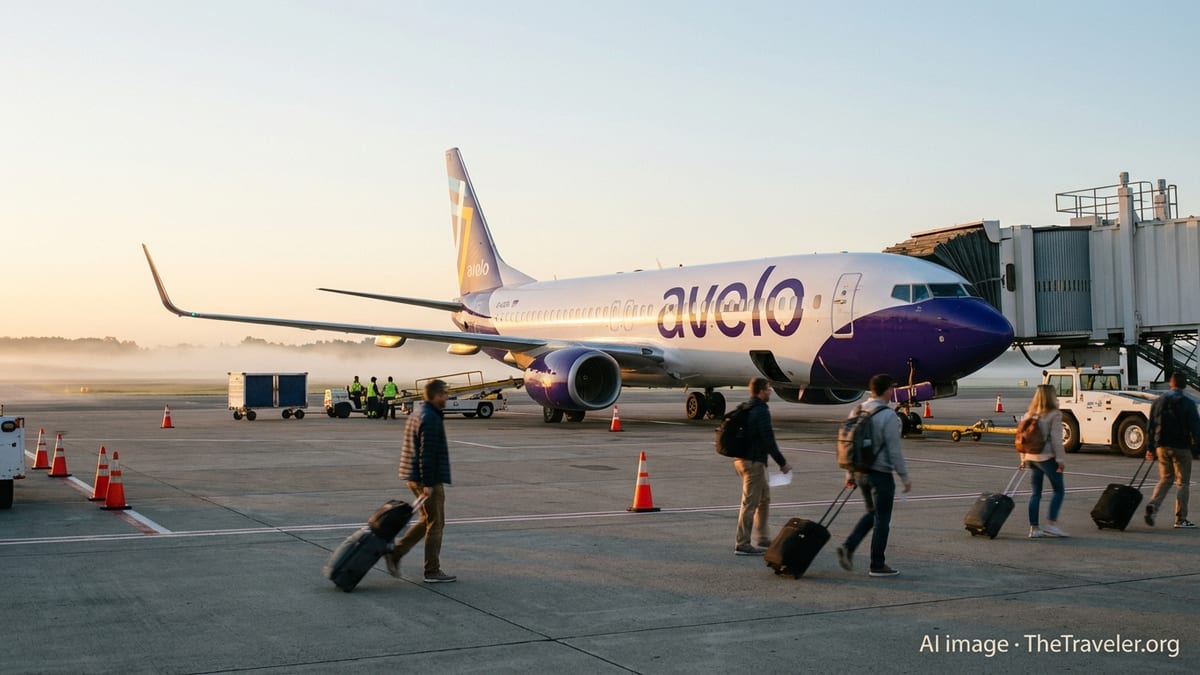
How Avelo’s Network Is Changing in 2025 and 2026
The latest expansion centers on Avelo extending its booking window through November 17, 2026, opening advance sales for fall travel to more than 30 destinations across the United States and the Caribbean. The carrier is leaning into its role as a point-to-point leisure airline, focusing on routes that connect smaller or secondary airports with high-demand vacation markets rather than building a traditional hub-and-spoke system.
Much of the growth is concentrated in the eastern half of the country after Avelo’s decision to wind down all West Coast service in late 2025 and early 2026. That strategic retreat freed aircraft and crews for use in newer focus cities such as Wilmington, Delaware; Lakeland in Central Florida; New Haven, Connecticut; and emerging bases in the Carolinas and the Midwest. The new schedules reflect that shift, with a dense pattern of short- and medium-haul flights that can be turned quickly and sold at low fares.
The airline has also been adding aircraft at key bases to support more routes and frequencies. In Central Florida, Avelo is deploying additional Boeing 737s in Lakeland, while a third aircraft is earmarked for Wilmington in 2026. These incremental aircraft allow the carrier to layer new routes on top of existing ones, creating a larger menu of nonstop options from each base without requiring connections.
For travelers, the headline is simple: more choice at smaller airports that often have shorter security lines, easier parking, and less congestion, paired with introductory fares that typically undercut legacy competitors on comparable city pairs.
New City Pairs and Where the 30 Routes Are Concentrated
The newest wave of expansion includes new flights linking Chicago, Detroit, and Central Florida, with service timed to ramp up from February 2026. From the Chicago area, Avelo is launching routes that plug the city directly into its Florida network, positioning itself as an alternative to larger carriers for Midwest travelers heading south for sunshine and theme parks.
Wilmington, Delaware, is another major beneficiary. Avelo is adding routes from Wilmington to Atlanta and Chicago, with service scheduled several times a week, turning the small airport into a surprisingly well-connected gateway. When combined with existing service, Wilmington is slated to offer well over a dozen nonstop options, giving residents of the mid-Atlantic an alternative to driving to Philadelphia or Baltimore for low-cost flights.
On the leisure front, the airline has steadily built up service to Florida, the Caribbean, and key Northeast cities. Recent route announcements have tied New England and the Mid-Atlantic more tightly to Orlando, Tampa Bay, and other Florida markets, while international flying has expanded to destinations such as Punta Cana, Montego Bay, Cancun, and San Juan. Additional growth into Nassau in the Bahamas and other island gateways further rounds out the network of roughly 30 destinations now on offer.
Avelo is also pushing deeper into regional connectivity. Routes such as New Haven to Portland, Maine, and a growing slate of flights from Concord in the Charlotte region into the Northeast, Florida, and Puerto Rico are designed to capture travelers who previously had limited low-cost options from their local airports.
Focus on Secondary Airports and Leisure Travelers
A core element of Avelo’s strategy is its focus on secondary and regional airports that are often overlooked by major carriers. Tweed-New Haven, Wilmington, Concord-Padgett near Charlotte, and Lakeland in Central Florida are central to the airline’s map. By building point-to-point service from these airports, Avelo aims to tap into substantial local demand while avoiding the higher costs and congestion associated with larger hubs.
This approach pairs naturally with its focus on leisure and visiting-friends-and-relatives traffic. Many of the new and existing routes connect smaller hometown airports directly to beach destinations, cruise gateways, and popular sunbelt cities. Typical schedules include two to four flights per week on each route, enough to support long weekend trips or weeklong vacations without requiring daily service.
For travelers, the trade-off is clear. They may not find the same frequency or extensive network of connections that legacy carriers offer, but they gain nonstop flights from closer-to-home airports, often at lower prices. For families, students, and cost-conscious vacationers, skipping a long drive to a big hub and avoiding connections can be as valuable as the savings on the ticket itself.
The airline’s use of a single aircraft family, the Boeing Next-Generation 737, also supports its low-cost model. Standardized fleets make maintenance, crew training, and scheduling simpler and cheaper, allowing Avelo to keep operating costs down and pass some of those savings on in the form of lower fares or bundled value offers.
What Travelers Need to Know About Fares, Schedules and Service
As with most ultra-low-cost carriers, Avelo’s business model is built around low base fares, with optional extras available for a fee. Introductory one-way fares on new routes have typically been advertised from the upper $30 range on shorter hops, with higher but still competitive pricing on longer or international sectors. Travelers should expect to pay additional charges for checked and carry-on bags, advance seat assignments, and other ancillary services.
Because many of the new and existing routes operate just a few times per week, schedule awareness is critical. Flights may run primarily on long-weekend-friendly patterns, such as Thursday to Sunday or Monday to Friday, rather than daily. That structure works well for vacationers planning around specific dates, but it means flexibility is limited if a traveler needs to change flights or recover from a cancellation.
Avelo has emphasized its operational reliability as a selling point, highlighting strong on-time performance and relatively low cancellation rates in 2025. Still, weather disruptions and air traffic control constraints can affect any carrier, and travelers on less frequent routes may face longer rebooking windows if something goes wrong. Purchasing travel insurance or using credit cards that include trip-interruption coverage can provide an extra layer of protection.
On board, the experience is intentionally simple. Cabins are arranged in a single class with choices between standard seating and roomier options at higher prices. Food and beverages are typically buy-on-board, and the airline’s focus is on getting customers from point A to point B with minimal frills rather than offering premium cabins or extensive inflight entertainment.
How the Expansion Fits Into Avelo’s Turbulent Year
The rapid network growth comes after a turbulent period for Avelo, including the decision to exit all remaining West Coast flying and to walk away from a controversial role operating government deportation flights under a charter arrangement. Those moves prompted intense public scrutiny and forced the airline to refocus its strategy, close some bases, and reshape its route map around markets where demand and economics were more favorable.
By concentrating resources on East Coast, Florida, and Caribbean leisure markets, Avelo is betting that a tighter, more coherent network of about 30 destinations will prove more sustainable than its earlier, more widely dispersed approach. Consolidating into profitable routes served from a smaller set of bases also supports better aircraft utilization and simpler operations.
For travelers, the result is a network that looks different from just a year ago, with fewer options in the western United States but many more choices for those living along the East Coast and in parts of the Midwest and South. The airline’s ability to sustain this growth will depend on maintaining strong load factors, controlling costs, and continuing to offer fares that remain meaningfully lower than those of larger competitors.
As the extended schedule through November 2026 opens up for booking, early demand on the newest routes will offer an early test of whether Avelo’s 30-destination strategy can deliver the balance of affordability, convenience, and reliability that budget travelers are seeking.