

More news on this day
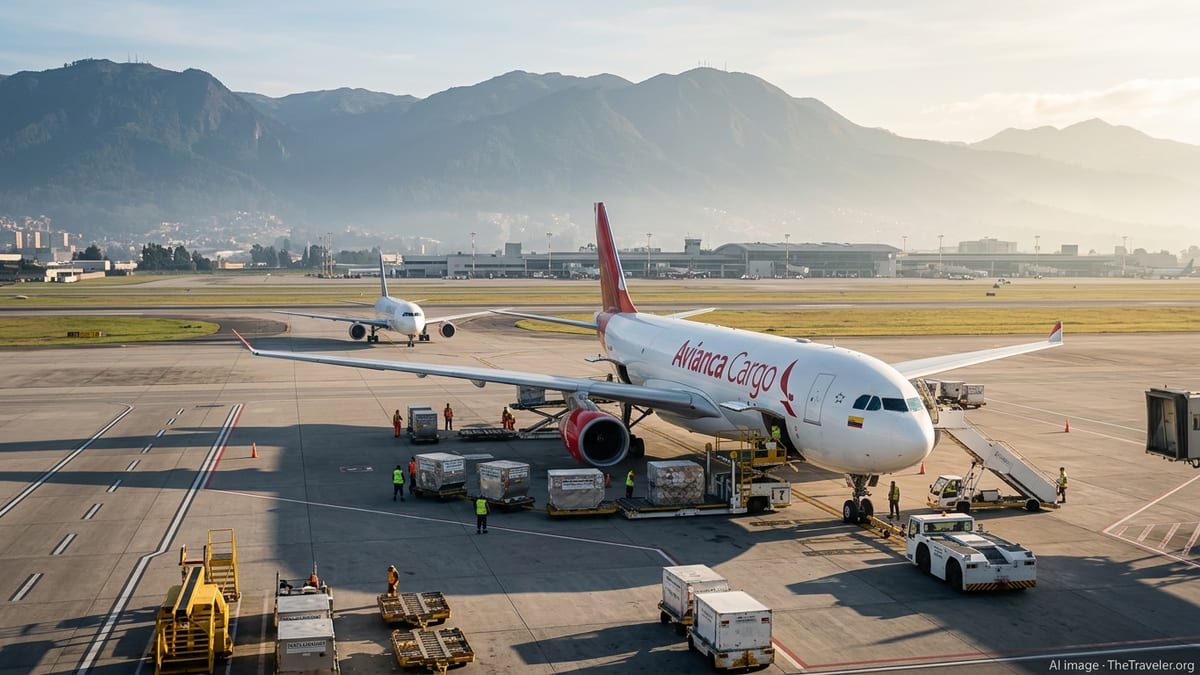
Avianca Cargo has activated a new dedicated freighter link between Bogotá and Caracas, positioning the Colombian capital as a reinforced cargo hub for Venezuela, Latin America and the broader Andean region at a time of rising regional trade and recovering air connectivity.
Get the latest news straight to your inbox!
Strategic Freighter Corridor Between Bogotá and Caracas
The launch of the all-cargo Bogotá–Caracas operation marks a significant upgrade from relying mainly on belly space in passenger aircraft to a scheduled, purpose-built freighter service. By assigning widebody freighters to the route, Avianca Cargo adds substantial, predictable capacity for shippers moving goods between the two capitals.
Industry data indicate that the service is being flown with Airbus A330-200F aircraft, each capable of carrying around 60 tons of cargo per flight, a considerable boost for what had been a constrained corridor. The metal-neutral nature of dedicated freighters also gives forwarders and exporters greater flexibility on load planning, transit times and special cargo requirements.
The corridor links Venezuela’s main gateway, Caracas, with Bogotá’s El Dorado International Airport, one of Latin America’s busiest cargo hubs. From there, Avianca Cargo can distribute freight onward across Colombia and to a wide network of Latin American, North American and European destinations, providing new routing opportunities for Venezuelan exporters and importers.
The move comes as airlines gradually rebuild connectivity between Colombia and Venezuela following several years of disruption. While passenger flights have been the most visible part of that recovery, the introduction of a dedicated freighter underscores the importance of cargo flows in normalizing economic ties between the neighboring countries.
Boost for Andean and Latin American Supply Chains
The new freighter service is expected to play an outsized role in reinforcing supply chains across the Andean region, where air cargo provides a vital lifeline for time-sensitive and high-value goods. Bogotá already acts as a key consolidation and redistribution center for shipments originating in markets such as Ecuador, Peru and Central America bound for the wider region.
By integrating Caracas into this network with its own freighter capacity, Avianca Cargo gives producers and logistics providers in Venezuela access to more efficient connections. Commodities such as pharmaceuticals, automotive components, perishables and e-commerce parcels can now be routed via Bogotá with shorter transit times and fewer handovers.
Regional analysts note that the Andean economies have been recovering export volumes in sectors that rely heavily on air freight, including fresh produce, flowers and certain industrial goods. Additional freighter frequencies into Bogotá, combined with a dedicated Caracas link, are likely to support that momentum by improving reliability and allowing shippers to plan ahead for seasonal peaks.
For Latin America more broadly, the upgraded corridor contributes to a denser network of South-South connections that do not depend solely on traditional hubs in North America or Europe. That shift aligns with a wider industry trend of airlines developing intra-regional freighter routes to respond to nearshoring, regional trade agreements and the rise of cross-border e-commerce within the continent.
New Opportunities for Venezuelan and Colombian Trade
The Bogotá–Caracas freighter operation is being framed by industry observers as a practical tool to help unlock pent-up trade demand between Venezuela and Colombia. After years of limited connectivity, exporters in both countries have faced higher logistics costs, longer transit times and restricted access to key consumer markets.
With dedicated cargo capacity now available, Venezuelan producers of pharmaceuticals, agricultural goods and light manufacturing have a more direct lane into the Colombian market and, via Bogotá, to third countries. At the same time, Colombian exporters of foodstuffs, industrial supplies and consumer goods gain a more stable option for reaching buyers in Venezuela.
Air freight plays a critical role for these flows because of infrastructure gaps and border complexities affecting some overland routes. The controlled environment of an all-cargo aircraft, with specialized handling for temperature-sensitive and high-value shipments, is particularly attractive for sectors such as healthcare, technology and premium food products.
Forwarders in both countries are expected to leverage the new service to develop door-to-door solutions that combine air and road transport, warehousing and customs brokerage. As these integrated services mature, they could further reduce end-to-end transit times and increase the competitiveness of Venezuelan and Colombian exports throughout Latin America and beyond.
Bogotá’s Growing Role as a Cargo Mega-Hub
The new Bogotá–Caracas freighter link also reinforces Bogotá’s status as one of the leading cargo hubs in Latin America. El Dorado International has been investing in modern terminals, cold-chain facilities and digital processes, while carriers such as Avianca Cargo expand dedicated freighter fleets and refine their route strategies.
By positioning Bogotá as the anchor point for the Caracas operation, Avianca Cargo is effectively deepening the Colombian capital’s role as a gateway for the Andean region. The hub already supports dense flows of cut flowers, fresh produce and other perishables to North America and Europe, as well as inbound cargo serving Colombia’s manufacturing and retail sectors.
Dedicated freighter services into Bogotá from cities across Latin America and Europe allow the airline to balance flows in both directions, optimizing aircraft utilization and strengthening schedule resilience. The addition of Caracas to that network gives the carrier another spoke that can feed into global trade lanes, including flights to major distribution centers in the United States and key hubs in Western Europe.
Aviation specialists suggest that the freighter expansion is consistent with Avianca Cargo’s broader strategy of combining widebody belly capacity with targeted all-cargo operations. This hybrid approach enables the carrier to capture high-yield shipments, support export-led sectors and maintain flexibility as demand patterns shift across the region.
Competitive Landscape in the Andean Air Cargo Market
The introduction of a dedicated Bogotá–Caracas freighter comes amid intensifying competition in Latin American cargo markets. Regional groups and global integrators have been reinforcing their presence, adding widebody aircraft and launching new services focused on high-growth corridors.
Within the Andean region, carriers are racing to secure key niches, from perishables and pharmaceuticals to express and e-commerce logistics. By securing an early and visible position on the Caracas route with dedicated freighter capacity, Avianca Cargo improves its ability to retain strategic customers and attract new volumes that might otherwise be routed through competing hubs.
Industry watchers point out that the move could also encourage infrastructure and regulatory improvements, as airports and authorities in both Colombia and Venezuela respond to growing cargo demand. Investments in warehouse capacity, inspection facilities and digital customs systems would further enhance the competitiveness of the corridor.
As regional supply chains continue to evolve, the Bogotá–Caracas freighter service signals that airlines increasingly view the Andean corridor as a central pillar of their Latin American strategies. For shippers, the development offers tangible new options for reaching markets efficiently, while for Bogotá and Caracas it underscores their renewed relevance as cargo gateways in a reshaped regional aviation landscape.