

More news on this day
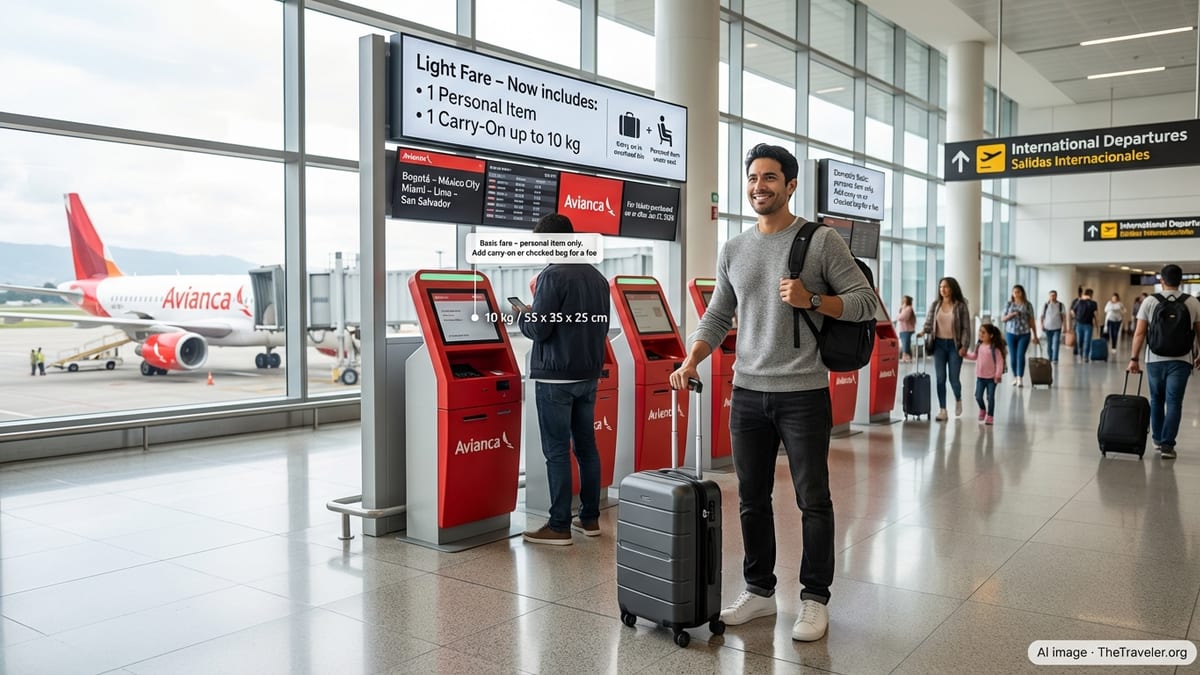
Avianca passengers traveling across the Americas just received a quietly significant upgrade. The Colombian carrier has overhauled parts of its baggage policy, reinstating one free carry on bag for its lowest international fare while keeping a stripped back option on domestic routes.
For travelers who had grown used to paying extra for almost every bag beyond a laptop or small backpack, the change could translate into real savings, especially on longer itineraries.
More News
- TSA Rolls Out $45 ConfirmID Fee for Travelers Without REAL ID at Security
- Flying Blue Launches February 25% Promo Rewards on Transatlantic and Regional Routes
- United Fast-Tracks Starlink Wi‑Fi Across Fleet, Free for MileagePlus Members
What Exactly Has Changed in Avianca’s Baggage Policy
The key shift centers on Avianca’s Light fare, the airline’s most affordable option on international routes in the Americas. For tickets purchased on or after January 27, 2026, Light fares on these flights now include both a personal item and one carry on bag of up to 10 kilograms as part of the base price. Previously, the lowest branded fares on many international routes in the region often limited passengers to a personal item only, with carry on bags sold as an add on and checked bags almost always extra.
The new conditions apply to international flights operated by Avianca within the Americas. The carry on allowance is clearly defined: one piece weighing up to 10 kilograms, with maximum dimensions of 55 by 35 by 25 centimeters including wheels and handles. That bag must fit in the overhead bin. Alongside it, every passenger can still bring one personal item that fits under the seat in front, such as a handbag, small backpack, diaper bag, or laptop bag, up to 45 by 35 by 20 centimeters.
On domestic flights within Colombia, Ecuador, and Guatemala, Avianca is keeping its Basic fare structure in place. Those domestic Basic tickets continue to include only one personal item as standard. Travelers on those routes who want to bring a full size carry on or checked bag will still need to pay extra or book into a higher fare family such as Classic or Flex.
The airline stresses that baggage conditions are tied to the purchase date and fare type. Tickets bought before January 27, 2026, remain under the old rules, and the updated Light fare baggage bundle is only guaranteed on qualifying international itineraries within the Americas where Light is offered.
How the New Allowance Can Put Money Back in Your Pocket
For many budget conscious travelers, the biggest impact of Avianca’s new baggage policy will be financial. By bundling a 10 kilogram carry on into Light fares on international routes in the Americas, the airline potentially saves passengers from paying separate ancillary fees that could run to tens of dollars per segment. Under Avianca’s current structure, carry on bags for customers on its most stripped down Basic fares can be a notable cost when bought as extras.
Official fee tables show how quickly those extras add up when they are not included. On some international routes, purchasing carry on baggage separately for a Basic fare can start from around 55 to 70 US dollars when bought in advance, depending on the region, and more if purchased during online check in or at the airport. Those amounts are in addition to any checked baggage fees, which vary by region but can also be substantial. For travelers who were previously forced into buying these add ons simply to bring a standard cabin bag, moving that allowance into the Light fare fundamentally changes the fare comparison math.
Now, a traveler booking a Light fare between North America and Central or South America does not need to factor in an extra carry on fee, as long as the bag meets the 10 kilogram and size limits. That can make Light considerably more attractive relative to both Basic and some competing low cost carriers that still charge separately for cabin bags above a small personal item. When multiplied across a family or several legs of a trip, the savings from Avianca’s new policy can be significant.
The updated structure also nudges passengers toward booking directly into Light for international itineraries across the Americas rather than starting with cheaper bare bones domestic style Basic fares and paying for carry on separately. That may simplify choices for consumers: the headline fare now better reflects what most international passengers reasonably expect to travel with.
What Remains the Same: Personal Items and Checked Bags
While the highlight is the Light fare’s new carry on inclusion, much of Avianca’s broader baggage framework remains unchanged. Every fare still includes one personal item at no extra cost. That item can be a small backpack, handbag, laptop sleeve, or similar and must fit under the seat in front. If it exceeds the prescribed 45 by 35 by 20 centimeter limit or does not fit in Avianca’s airport size checkers, it risks being treated as extra baggage with associated fees.
Checked baggage rules are also consistent with previous guidelines. For most Economy passengers on fares that include checked bags, the standard allowance is one piece weighing up to 23 kilograms with total linear dimensions not exceeding 158 centimeters. Business class travelers, now under Business Classic and Business Flex structures, can check two bags of up to 32 kilograms each, subject to route specific restrictions. On flights to and from Europe, for instance, individual pieces cannot exceed 70 pounds even if excess weight fees are paid.
Passengers on higher fare families such as Classic and Flex continue to receive both a carry on and at least one checked bag included in the base price on most routes. Elite members in Avianca’s Lifemiles program and Star Alliance Gold customers may be entitled to additional checked baggage benefits, although those extras do not extend to the most basic fare types like Basic and Light in some cases. Sports equipment can in many instances be counted as a checked bag under certain fare types, as long as it meets packing and size standards.
For international long haul markets such as Europe and some routes in Brazil and the Americas, Avianca’s older naming convention of Light for what was previously sold as Basic remains in effect, with those fares including a personal item and carry on but charging separately for checked bags and services like seat selection and airport check in. The new 2026 adjustment repositions Light on international routes in the Americas within that broader structure by restoring a bundled carry on allowance where it had often been an extra.
How to Maximize Savings Under the New Rules
To get the most out of Avianca’s updated baggage policy, travelers need to understand where the new carry on inclusion applies and how to pack accordingly. The built in carry on benefits only Light fares on international flights across the Americas purchased on or after January 27, 2026. Domestic itineraries inside Colombia, Ecuador, and Guatemala booked under the Basic fare remain limited to a personal item unless you pay for more.
Passengers should pay close attention to dimensions and weight. The free carry on in Light, Classic, Flex, and Business is capped at 10 kilograms and must not exceed 55 by 35 by 25 centimeters. Oversized or overweight cabin bags may be forced into the hold and charged as checked baggage or even additional baggage if they also exceed checked limits. Likewise, personal items are strictly defined by size, and miscellaneous extras like food bags, large thermoses, or shopping that do not fit inside the permitted bag can be classified as additional pieces with associated fees.
Buying optional baggage in advance can still yield savings when a checked bag is truly needed. Fee grids show that adding carry on or checked bags at the time of booking on Avianca’s own channels is often cheaper than waiting until online check in or the airport, where prices increase. For travelers who booked Basic before the new cut off or who are flying domestically under the Basic fare, securing baggage online well before departure remains one of the easiest ways to avoid surprise costs at the check in counter.
Another tip: if overhead bin space is tight, Avianca may check compliant carry on bags into the hold at no extra cost. That can be a benefit for travelers happy to see their cabin bag tagged, but it also underscores the importance of keeping essential items and valuables in the personal item that remains under the seat. Power banks, loose lithium batteries, and some electronics must legally stay out of checked bags and in the cabin under international safety regulations.
Why Avianca Is Making This Move Now
Avianca’s updated baggage policy forms part of a broader refresh of its value proposition as competition in Latin American aviation heats up. Over the past few years, the airline has increasingly adopted an unbundled, low cost style fare structure, with Basic and Light tickets offering rock bottom upfront prices while charging for many extras. That approach met resistance from some travelers used to traditional full service inclusions, especially on longer international journeys.
By reinstating a free cabin bag for its most affordable international fares in the Americas, Avianca seems to be seeking a middle ground. The change allows it to maintain a tiered fare system with optional ancillaries while restoring a baseline baggage allowance that better matches what many passengers expect. It could also help Avianca distinguish its Light fare from ultra low cost rivals that still limit passengers strictly to a small personal item, while retaining flexibility to price checked baggage and other amenities separately.
The airline has been investing in improvements beyond baggage, rolling out an expanded Business Class offering across its network, upgrading lounges, and gradually introducing onboard Wi Fi. Against that backdrop, the Light fare update acts as a tangible, easy to understand perk for economy travelers who might otherwise focus solely on sticker price. For families, backpackers, and small business travelers traversing the region, knowing a cabin bag is once again included may tip the scales when comparing options.
The timing also aligns with a gradual rebound in travel demand across the Americas and shifting expectations as passengers recalibrate what they consider fair value. Airlines in the region are under pressure to balance profitability with customer satisfaction, and baggage policies are one of the most visible levers available.
Key Restrictions, Gray Areas, and Pitfalls to Avoid
Despite the more generous allowance on Light fares, Avianca’s baggage policy retains several constraints that travelers should keep firmly in mind. First, everything is governed by the fare and the ticket purchase date. A Light fare does not automatically guarantee the same baggage setup on every route or for every period. Passengers need to confirm the specific attributes attached to their fare at the moment of booking, particularly if they are buying tickets through third party platforms where baggage details may be less prominently displayed.
Second, mixed itineraries that include partner airlines or multiple fare types can complicate baggage rules. If another airline operates a segment, its own carry on and checked baggage rules may apply for that leg, even if Avianca’s website was used to purchase the ticket. In such cases, baggage allowances, fees, and size limits can vary between segments, requiring closer scrutiny of each airline’s policy to avoid unexpected charges during connections.
Third, enforcement at the airport is stricter than many travelers assume. Staff may measure and weigh both personal items and carry on bags at check in or the gate. Items that do not fit the sizers, or extra pieces such as separate shopping bags or food containers, may be tagged and charged as additional baggage. Passengers who rely on stretching the rules with oversized backpacks or multiple small bags risk eroding any savings they hoped to gain from the new policy.
Finally, safety regulations still strictly control what can go in checked versus cabin baggage. Lithium batteries, vapes, power banks, certain electronics, and containers of liquids above 100 milliliters in the cabin remain tightly regulated. Failing to comply can lead to confiscation of items or delays at security, regardless of what the airline’s own baggage allowances state.
FAQ
Q1. What is the main change in Avianca’s baggage policy for 2026?
The biggest update is that Light fares on international flights across the Americas now include one personal item and one carry on bag of up to 10 kilograms in the base price for tickets purchased on or after January 27, 2026.
Q2. Does the new carry on allowance apply to domestic flights?
No. On domestic routes within Colombia, Ecuador, and Guatemala, the Basic fare remains unchanged and still includes only one personal item as standard, with additional baggage requiring an upgrade or extra payment.
Q3. How big can my free carry on bag be on Avianca?
Your included carry on bag can weigh up to 10 kilograms and must not exceed 55 by 35 by 25 centimeters including wheels and handles, and it must fit in the aircraft’s overhead bin.
Q4. What counts as a personal item and what are its limits?
A personal item can be a small backpack, purse, laptop bag, diaper bag, or similar, with maximum dimensions of 45 by 35 by 20 centimeters so it can be stored under the seat in front of you.
Q5. Will I pay extra if my personal item or carry on is too big or heavy?
Yes. If your personal item or carry on exceeds Avianca’s size or weight limits, it may be checked as regular or additional baggage, and you can be charged according to the route and point of purchase.
Q6. Are checked bags included with Light fares under the new policy?
No. Light fares on international flights in the Americas now include a personal item and a carry on bag, but checked baggage generally remains an optional extra that must be purchased unless you choose a higher fare family that includes it.
Q7. How can I save money when adding extra baggage on Avianca?
You typically pay less by adding baggage during booking on Avianca’s own channels than by waiting until online check in or the airport, where fees for carry on and checked bags are higher.
Q8. What happens if the overhead bins are full and I have a carry on?
If there is no space in the overhead bins, Avianca may check compliant carry on bags into the hold at no additional cost, but you should keep valuables, documents, and items with lithium batteries in your personal item in the cabin.
Q9. Do elite frequent flyers get extra baggage on top of the new allowance?
Many Lifemiles Elite and Star Alliance Gold members receive additional checked baggage benefits on eligible fares, although these perks generally do not apply to the most restrictive fare types like Basic and sometimes Light, so it is important to verify the rules for your specific ticket.
Q10. How do I know which baggage rules apply if my trip includes partner airlines?
On itineraries involving other carriers, the baggage policy of the airline operating each flight segment may apply, so you should check the conditions for every airline involved rather than assuming Avianca’s rules cover the entire journey.