

More news on this day
Asia’s aviation sector has been plunged into crisis as the escalating US–Iran conflict shutters key Middle Eastern airspace, sends airline shares tumbling across the region and throws global travel networks into disarray.
Markets Punish Asian Carriers As Conflict Escalates
Asian airline stocks slid sharply at the start of the week after US and Israeli strikes on Iran triggered sweeping airspace closures across West Asia and reignited fears over fuel costs. In Monday trading, shares in Hong Kong’s Cathay Pacific, Singapore Airlines, Japan Airlines and Australia’s Qantas all fell more than 5 percent at one stage, wiping billions of dollars from the sector’s market value in a matter of hours.
Qantas was among the hardest hit, with its stock dropping as much as 10 percent to its lowest level in 10 months before recovering some of the losses later in the session, according to local market reports. The selloff reflects investor anxiety over a double blow of sharply higher oil prices and large scale disruption on some of the world’s most lucrative long haul routes between Asia, Europe and North America.
Analysts say the rout is being driven by uncertainty over how long the crisis will last rather than by immediate damage to fleets or infrastructure in Asia itself. With the 2026 Strait of Hormuz crisis still unfolding and Iran vowing further retaliation, fund managers are bracing for a prolonged period of volatility in airline earnings, particularly for carriers most exposed to Europe and Middle East traffic.
Tourism and travel related stocks across Asia have also come under pressure, from airport operators and hotel chains to online travel agencies that rely heavily on outbound demand from India, Southeast Asia and China. The broader selloff underlines how quickly a security flashpoint in the Gulf can send shockwaves through Asia’s interconnected travel economy.
Middle East Airspace Shutdown Hits Asia–Europe Lifeline
The immediate operational shock has come from the near shutdown of key Middle Eastern air corridors after Iran, Israel, Iraq, Qatar, the United Arab Emirates, Kuwait, Bahrain and several neighbors imposed full or partial airspace closures. Major hubs in Dubai, Abu Dhabi and Doha have seen large portions of their schedules suspended, with data from flight tracking services pointing to thousands of cancellations and delays since the weekend.
For Asian carriers, those hubs serve as crucial waypoints linking cities such as Mumbai, Delhi, Bangkok, Singapore, Jakarta, Sydney and Tokyo with Europe and North America. With Iranian and Iraqi overflight options also effectively off limits, airlines have been forced to divert aircraft along longer southern tracks or via Central Asia, adding significant time and cost. Industry analysts note that the loss of these corridors comes on top of existing restrictions over Russia, further narrowing safe and efficient paths between Asia and Europe.
Aviation analytics firms report that nearly a quarter of all flights scheduled to land in Middle Eastern countries on Saturday were cancelled, with more than 1,800 services scrapped when outbound flights are included. By Sunday, over 19,000 flights worldwide had been delayed and thousands cancelled, a large share of them on routes connecting Asia to Europe, Africa and North America.
Operationally, the crisis has scrambled fleet planning and crew rostering. Airlines are juggling aircraft rotations as long haul sectors stretch by one to three hours due to detours, pushing some services close to their duty time limits and increasing the risk of rolling disruptions in the days ahead.
Indian and Asian Carriers Count Mounting Costs
Indian airlines have emerged among the most heavily affected in Asia, reflecting the country’s deep air links with Gulf hubs and onward connectivity to Europe and North America. India’s aviation ministry and local media report hundreds of cancellations over the past several days as carriers ranging from IndiGo and Air India to Akasa Air and SpiceJet suspend or rework services to the Gulf and beyond.
Industry estimates suggest Indian operators alone may face revenue losses in the hundreds of crores of rupees if the conflict continues to constrain West Asian airspace. Domestic carriers have scrapped or diverted flights to key destinations such as Dubai, Doha, Abu Dhabi, Jeddah and Kuwait, while some long haul services to London and Canada have been reconfigured to avoid conflict zones, lengthening journeys and increasing fuel burn.
Across the wider region, Southeast Asian and Northeast Asian airlines are also bracing for a financial hit. Carriers like Singapore Airlines and Japan Airlines have rerouted services that previously transited Middle Eastern skies, while some Gulf bound flights have been temporarily suspended. For Asia’s full service airlines, which rely on premium traffic and connecting flows, the combination of schedule uncertainty, higher operating costs and potential demand weakness represents a significant near term risk.
Low cost carriers with thinner margins and fewer wide body aircraft may find it harder to absorb the shock. Their business models depend on high aircraft utilization and tight turnarounds, both of which are challenged when flight times lengthen and crews must be repositioned around evolving restrictions.
Travelers Stranded As Global Networks Unravel
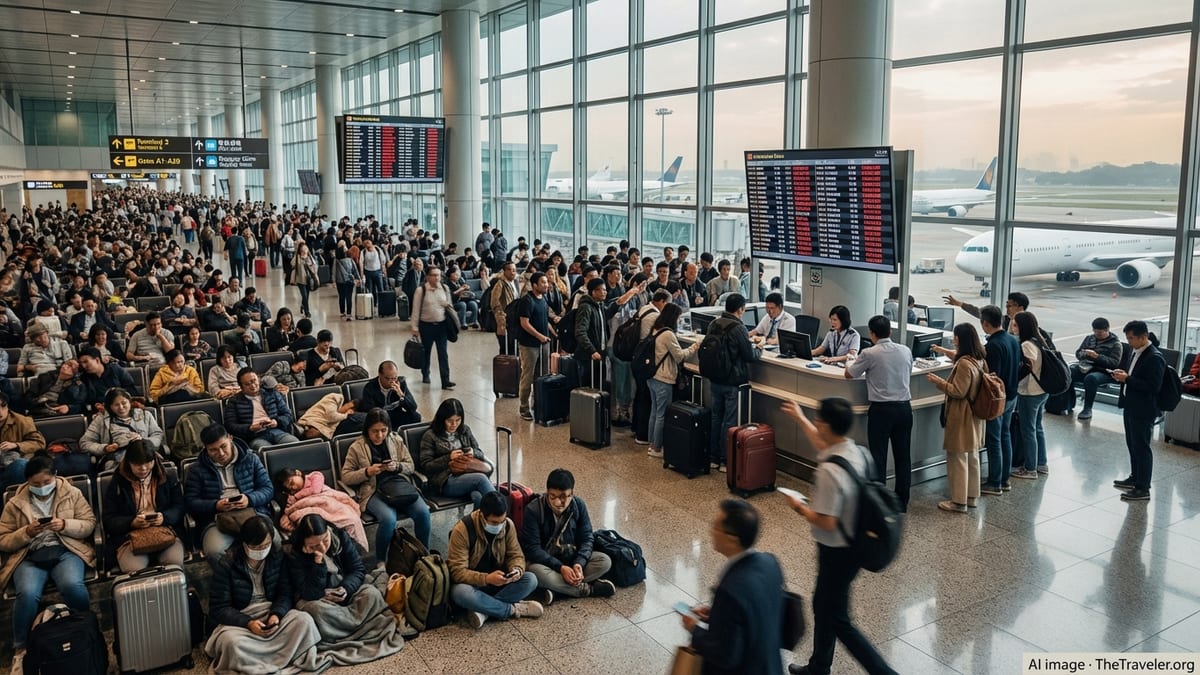
The market turmoil is being mirrored on the ground by scenes of disruption at airports across Asia, the Middle East and Europe. Hundreds of thousands of passengers have found themselves stranded or rerouted at short notice as airlines scramble to adjust to new security advisories and airspace notices. Queues have stretched through terminals in cities from Dubai and Doha to Mumbai, Singapore and Sydney, with many travelers reporting limited information and long waits for rebooking.
In India, major airports including Hyderabad, Delhi and Mumbai have seen waves of cancellations to Gulf destinations, with local authorities placing terminals on heightened operational alert and deploying additional staff to manage crowds. Similar pressure has been reported at hub airports in Southeast Asia, where connecting passengers bound for Europe and North America are struggling to find alternative routings that avoid the conflict zone.
Global carriers are offering fee waivers, flexible rebooking policies and in some cases full refunds, but capacity on alternative routes is tight. With many airlines already operating near peak load factors at the start of the spring travel season, seats on detoured flights via safer corridors are limited, driving up fares on some city pairs and stretching airline call centers and digital systems.
Travel agents say corporate clients are quickly reassessing itineraries for business travel to and through the region, while leisure travelers face difficult choices between postponing trips and accepting complex, multi stop journeys. For Asia’s tourism dependent economies, any sustained slump in confidence could reverberate through hotels, tour operators and local transport providers far from the immediate conflict.
Uncertain Outlook for Asia’s Recovery Hopes
The aviation crisis has landed at a delicate moment for Asia’s airlines, many of which were pinning their 2026 forecasts on a continued recovery in long haul travel after the pandemic and earlier geopolitical shocks. Before the latest conflict, forward bookings on several Europe and Middle East routes were strengthening, and carriers had announced capacity additions and new destinations to capture resurgent demand.
Now, executives and analysts warn that the region’s recovery trajectory is once again at risk. Elevated oil prices, longer routings and operational complexity threaten to erode margins just as balance sheets were starting to repair. If airspace closures persist or widen, airlines may be forced to trim capacity, retire older aircraft sooner than planned or postpone fleet expansion to conserve cash.
For travelers, the key questions are how long restrictions will last and whether the conflict will spread, prompting even broader closures. Aviation safety experts note that airlines and regulators are likely to take a conservative approach in the near term, keeping aircraft clear of any perceived risk zone even if formal restrictions are eased. That suggests disruption on some Asia–Europe and Asia–Middle East routes could continue well beyond the immediate headlines.
Regional governments, meanwhile, are monitoring potential knock on effects on trade, tourism and employment. With the Strait of Hormuz crisis already rattling global energy markets and shipping lanes, Asia’s exposure to the conflict runs both through the skies and across the sea, amplifying the stakes of a confrontation centered thousands of kilometers away.