

More news on this day
Azerbaijan is rapidly emerging as a pivotal air bridge between Europe and Asia, with Baku’s Heydar Aliyev International Airport gaining new significance as flights between Berlin, Rome, Istanbul, Tehran and Dubai increasingly funnel through the South Caucasus.
Get the latest news straight to your inbox!
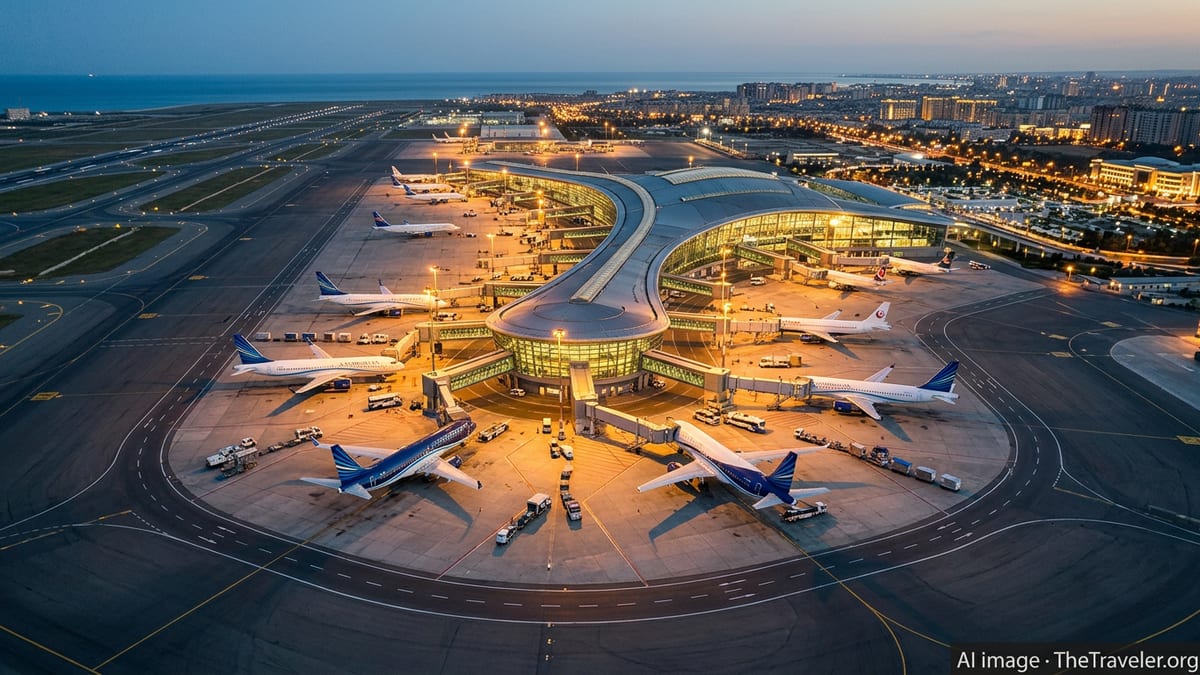
A Strategic Air Corridor at the Crossroads of Continents
Azerbaijan’s geography has long placed it on the historic trade routes between Europe and Asia, and that advantage is now being felt in the skies. Publicly available aviation analyses describe a growing reliance on the Baku Flight Information Region as airlines reconfigure Europe–Asia routes around multiple conflict zones and restricted airspace across parts of the Middle East and Russia. As traffic shifts north and west, Azerbaijan’s airspace and main hub in Baku are becoming critical links in a narrow corridor that keeps intercontinental traffic flowing.
Recent conflict-zone advisories in the region have encouraged many carriers to favor safer northern bypasses, routing traffic via Turkey, the South Caucasus and Central Asia. Under these patterns, long-haul flights connecting major European cities with the Gulf and broader Asia are more likely to cross or skirt Azerbaijani airspace. This has turned what was once a regional crossroads into a key segment of global aviation infrastructure.
For travelers, the result is a quietly rising profile for Baku as both a transit point and a destination. Routes connecting European capitals such as Berlin and Rome to hubs like Istanbul and Dubai are intersecting with Baku’s growing network, amplifying the city’s role as a stopover between Western Europe, the Middle East and Central and East Asia.
Baku Airport’s Rapid Growth and Expanding Network
Heydar Aliyev International Airport, located just outside Baku, has reported some of the fastest passenger growth in its history in recent reporting periods. Official airport statistics for 2024 show a record annual passenger volume of around 7.5 million, underscoring a sustained rebound from the pandemic years and a rapid expansion of its transfer traffic. Separate reporting on the first quarter of 2024 highlighted an 82 percent jump in transfer passengers, a clear indication that Baku is attracting more travelers who use the airport as a connection point rather than a final destination.
The airport now hosts around 40 airlines serving destinations across Europe, the Middle East and Asia, according to national transit and infrastructure documentation. This network increasingly includes major European cities, with scheduled links from Baku to Berlin and growing connections to Central and Eastern Europe, such as Bratislava, Bucharest and Warsaw. These routes complement well-established services to hubs like Istanbul and Dubai, and a strengthening schedule with Iranian cities including Tehran, building a mesh of links that routes travelers through Baku on multi-leg journeys.
Azerbaijan’s national carrier, together with regional and low-cost operators, is pursuing an explicit strategy of network expansion. Aviation industry reports note that fleet growth and new route launches are designed to deepen Baku’s position as a national and regional transit hub, with additional frequencies and destinations in Europe and the Middle East making the airport more attractive for one-stop itineraries.
Connecting Berlin, Rome, Istanbul, Tehran and Dubai Through Baku
The emerging pattern of air services highlights how Baku is knitting together key cities across Europe and the Middle East. Direct flights between Baku and Berlin connect the South Caucasus with one of Europe’s largest aviation markets, while services to Rome tap into Southern Europe’s tourism and business demand. When paired with dense schedules to Istanbul, one of the world’s busiest transfer hubs, these routes allow travelers to move between Germany, Italy, Turkey and beyond with Baku as a convenient intermediate stop.
Southward, frequent flights between Baku and Dubai plug Azerbaijan directly into the global networks of Gulf carriers and the broader flows of passengers between Europe, Asia and Africa. For travelers originating in Berlin or Rome, itineraries that combine a Baku leg with onward connections to Dubai or other Gulf destinations offer alternative options to traditional Western European hubs.
On the eastern and southern front, growing air links between Baku and Iran, including Tehran and other cities, are gradually tightening connectivity between European capitals and the Iranian market through the South Caucasus. Travel data and published schedules show that passengers can increasingly rely on single-carrier or interline connections between Berlin or Rome and Tehran with a change of planes in Baku, rather than routing exclusively through traditional hubs in the Gulf or Western Europe.
For Istanbul, the picture is more complex but equally significant. While Istanbul itself is a global mega-hub, its proximity to Baku and overlapping catchment areas mean that travelers in the wider region can compare routings via either city when flying between Europe and the Middle East or Central Asia. Baku’s competitive edge lies in shorter travel times on certain east–west combinations and, for some markets, more favorable schedules or fares.
Why This Route Matters for Global Travelers
The consolidation of Azerbaijan’s role in Europe–Asia air traffic carries practical implications for passengers. One is resilience. As security advisories reshape which airspace airlines consider acceptable, having a reliable corridor through the South Caucasus gives travelers an alternative to routes that may face sudden disruptions or detours. Baku’s position inside that corridor, with a growing hub airport and expanding airline networks, enhances the overall stability of long-distance travel between Europe and Asia.
Another advantage lies in connectivity and choice. With more direct links from Baku to European capitals and Middle Eastern hubs, travelers can mix and match carriers and itineraries that suit their timing and budget. This is particularly relevant for passengers from secondary European or Asian cities, who may find that a one-stop trip through Baku is more efficient than connections through overcrowded Western European hubs.
Infrastructure investments are reinforcing these trends. Airport development plans, sustainability reports and regional transport strategies point to continued upgrades of Baku’s runways, terminals and air traffic management systems, along with future rail links from the city center to the airport. These improvements are aimed at handling higher passenger loads and shortening transfer times, two key factors for travelers weighing new routing options.
Visa policies and transit procedures also support Baku’s role as a hub. International travelers using Baku solely as a transfer point can remain within the airport’s transit area without entering Azerbaijan, while a growing number of nationalities benefit from simplified e-visa procedures if they choose to turn a connection into a short city break. This combination of operational efficiency and relatively straightforward entry rules enhances the appeal of scheduling a stop in Baku.
Aviation at the Heart of a Wider Eurasian Transit Strategy
Baku’s airport hub is part of a broader Azerbaijani ambition to position the country as a central node along the so-called Middle Corridor, the multimodal route linking China and Central Asia with Europe via the Caspian Sea and the South Caucasus. Rail links such as the Baku–Tbilisi–Kars line, along with the modern port facilities at Alat on the Caspian, already handle rising volumes of east–west freight. Air connectivity, centered on Baku’s airport, provides the high-speed layer to this network, moving time-sensitive passengers and cargo across the same geography.
Government-backed transit brochures and regional think-tank analyses describe a vision in which air, rail, road and maritime infrastructure work together, allowing goods and travelers to switch modes as needed. In this context, direct flights between Baku and cities such as Berlin, Rome, Istanbul, Tehran and Dubai are not isolated routes but links in a larger chain that underpins trade, tourism and diplomatic engagement between Europe and Asia.
Cargo carriers based in Azerbaijan already make extensive use of the country’s location to serve more than 40 destinations across the Middle East, India, Asia, Europe and North America, with a high share of their east–west volumes transiting through Baku. As passenger airlines replicate this model on the commercial side, travelers are likely to see even more itineraries in global booking systems that route them through Azerbaijan.
As airspace restrictions and evolving trade patterns continue to reshape global aviation, Baku’s rise as a connector city illustrates how geography, infrastructure and policy can combine to shift the map of long-haul travel. For passengers linking Berlin, Rome, Istanbul, Tehran and Dubai, the route through Azerbaijan is fast becoming not just an alternative, but an essential option.