

More news on this day
Escalating tensions between Iran and the United States are rippling across global tourism, with industry analysts warning of up to fifty six billion dollars in lost visitor spending in the wider Middle East and Gulf. As airlines reroute around closed airspace and travelers rethink itineraries, a new map of favored destinations is emerging in real time, propelling countries such as Azerbaijan into the same conversation as established hotspots like the United Arab Emirates, Italy, Turkey, Greece and Thailand.
Gulf Turmoil Rewrites the Global Tourism Map
The latest escalation of the Iran US and Israel confrontation has triggered sweeping airspace closures and security alerts across the Middle East, disrupting one of the world’s busiest aviation corridors. Industry estimates suggest the region now faces a loss of between thirty four and fifty six billion dollars in visitor spending, equivalent to tens of millions fewer international arrivals than earlier forecasts. This sudden reversal follows several years in which Gulf hubs were at the forefront of the global tourism rebound.
Major transit airports that once connected Europe and North America to Asia and Africa are seeing long delays, last minute cancellations and complex diversions as carriers avoid conflict zones. Travel advisers report that many leisure and business trips into the Gulf have been postponed or rebooked elsewhere, with some operators comparing the shock to the tourism slump that followed the first Gulf War. The uncertainty is reshaping how and where travelers choose to spend both time and money.
The disruption is not limited to point to point travel in the Middle East. With key transfer hubs constrained, long haul itineraries to destinations as varied as Bangkok, Phuket, the Greek islands, Istanbul and southern Italy are being reconfigured. Longer flying times, higher operating costs and mounting insurance premiums are all feeding into fares, prompting cost conscious travelers and tour operators to look for stable, well connected alternatives on the fringes of the crisis zone.
Azerbaijan Steps Forward as an Alternative Hub
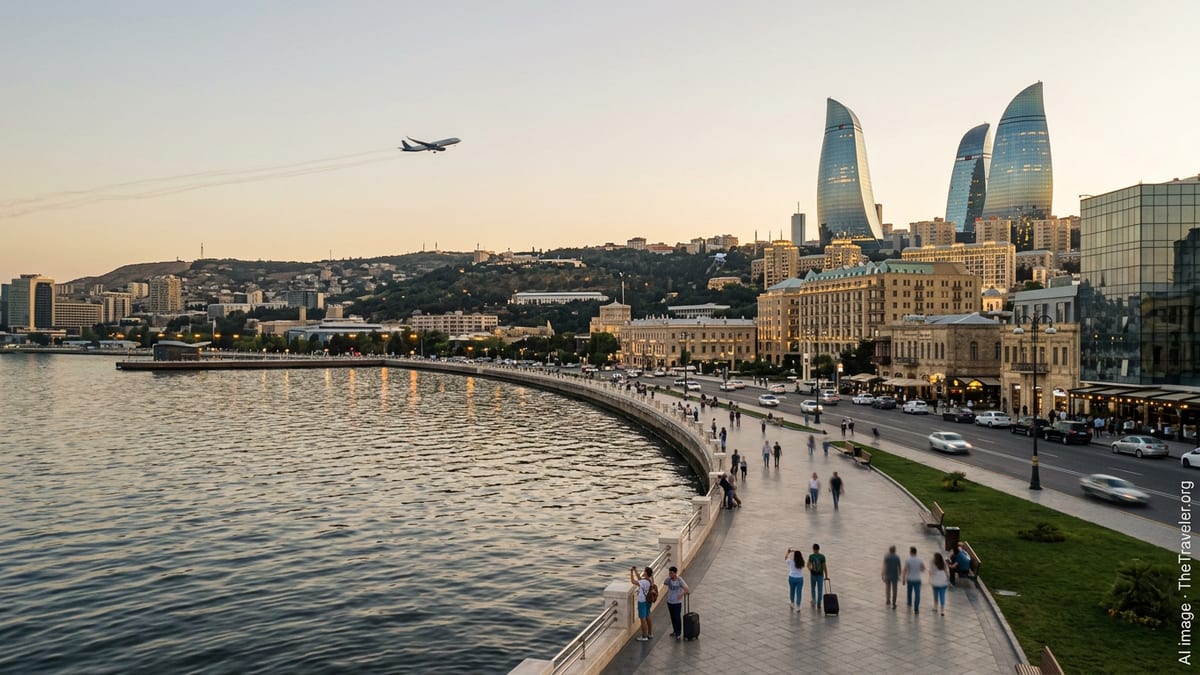
Against this backdrop, Azerbaijan is rapidly positioning itself as one of Eurasia’s most dynamic emerging destinations. The country welcomed more than two and a half million foreign visitors in 2025, with official figures showing inbound tourism growth outpacing many regional peers in 2024 and early 2025. International organizations such as the World Travel and Tourism Council forecast strong double digit expansion for the sector, reflecting rising investment in hotels, airports and visitor infrastructure.
Air connectivity is central to this strategy. Baku’s Heydar Aliyev International Airport has expanded its network of direct services to Europe, the Middle East and Asia, with Azerbaijan Airlines adding seasonal and year round routes that are now gaining new relevance as carriers seek alternatives to airspace affected by the Iran conflict. While not immune to regional risk, Azerbaijan offers routing advantages across the Caspian and Caucasus corridors that avoid the most volatile zones to the south.
On the demand side, Azerbaijan has already emerged as a favored stop for travelers from Gulf Cooperation Council states, supported by simplified e visa procedures, Arabic friendly services and a growing inventory of luxury and mid scale hotels. Visitor numbers from Saudi Arabia, the United Arab Emirates, Kuwait and Oman have climbed sharply in recent years, and tourism authorities expect that some of the trips being diverted from traditional Gulf city breaks could now be captured by Baku, the Caspian coast and mountain resorts.
Beyond the region, Azerbaijan is also benefiting from broader shifts in traveler preferences highlighted in recent global trend reports, which point to rising interest in authentic cultural experiences, nature based escapes and lesser known city destinations. From the medieval streets and modern skyline of Baku to the wine routes and hiking trails of the Caucasus, the country is marketing itself as a fresh alternative within easy reach of Europe, the Middle East and parts of Asia.
Established Favorites Pivot Amid Route and Demand Shocks
The upheaval is reverberating across more established tourism powerhouses such as the United Arab Emirates, Italy, Turkey, Greece and Thailand, all of which ranked among the world’s top destinations before the current crisis. The UAE, long reliant on its role as both a leisure destination and a global aviation hub, is contending with temporary airspace restrictions and a slowdown in Gulf wide demand even as it tries to hold on to high spending visitors through aggressive marketing and flexible booking policies.
In Europe, Italy, Turkey and Greece remain in strong demand for 2026 peak season, but tour operators are quietly revising their air arrangements. With overflight patterns shifting and some long haul feed from the Gulf under pressure, carriers are redeploying capacity from disrupted Middle Eastern routes into Mediterranean city pairs and secondary airports. This is cushioning headline arrival numbers, yet industry executives caution that any prolonged rise in fuel costs or insurance premiums could dent profits for airlines and package operators alike.
In Southeast Asia, Thailand is again one of the world’s most visited countries, drawing millions to Bangkok, Phuket, Chiang Mai and the islands. However, its tourism ecosystem is feeling the effects of a more fragile long haul market. Flights that once relied on Middle Eastern hubs for European and North American connections are now being redirected or re timed via alternative gateways, adding complexity for airlines and travelers just as the sector hoped for a period of stability after the pandemic and earlier Red Sea shipping disruptions.
Collectively, these destinations are working to reassure visitors that they remain safe and accessible even as the crisis in and around Iran unfolds. Enhanced security communication, clearer refund policies and collaboration with global distribution systems are all being deployed to maintain confidence. Yet for many travelers, the ease of reaching a destination without flying close to an active conflict zone is becoming a decisive factor in destination choice.
Flight Rerouting Reshapes Hospitality and Investment Decisions
The rerouting of flight corridors around Iran and adjacent airspace is having a profound impact on the economics of global aviation and tourism. Longer routings via Central Asia, the Caucasus or North Africa can add hours to journeys between Europe and Asia, with knock on effects for crew scheduling, airport slot availability and aircraft utilization. Airlines facing higher fuel and operational costs are reassessing which destinations remain commercially viable in the short to medium term.
For hotel owners and tourism investors, these shifts are prompting a re evaluation of risk and return across the region. Properties in Gulf cities that once relied heavily on transit stopovers and short luxury breaks are seeing softer forward bookings, while interest grows in markets perceived as adjacent but less exposed, including Azerbaijan, parts of Central and Eastern Europe and secondary cities in Turkey and Greece. Analysts note that capital is flowing toward destinations that combine reliable connectivity with a diversified base of leisure, business and meetings demand.
Regional tourism boards are responding with targeted campaigns designed to capture demand displaced from the Gulf. Azerbaijan, for instance, is rolling out a state program for tourism development focused on easing market access, enhancing digital services and promoting new thematic routes ranging from wellness travel to cultural festivals. Similar efforts in Italy, Greece and Thailand are emphasizing off season travel, lesser known regions and experiences that match the global shift toward more purposeful, experiential trips.
How long the current pattern persists will depend largely on the trajectory of the Iran US confrontation and any further airspace or security measures that follow. For now, the crisis has accelerated an existing trend: a gradual diversification of global tourism away from a handful of dominant hubs toward a wider constellation of emerging destinations, with Azerbaijan among the clearest beneficiaries of this sudden redrawing of the travel map.