

More news on this day
Azores Airlines will launch a new direct route between Terceira in the Azores and Madeira Island on 7 May 2026, a long-awaited air link expected to streamline travel across Portugal’s Atlantic archipelagos and unlock fresh tourism opportunities for both destinations.
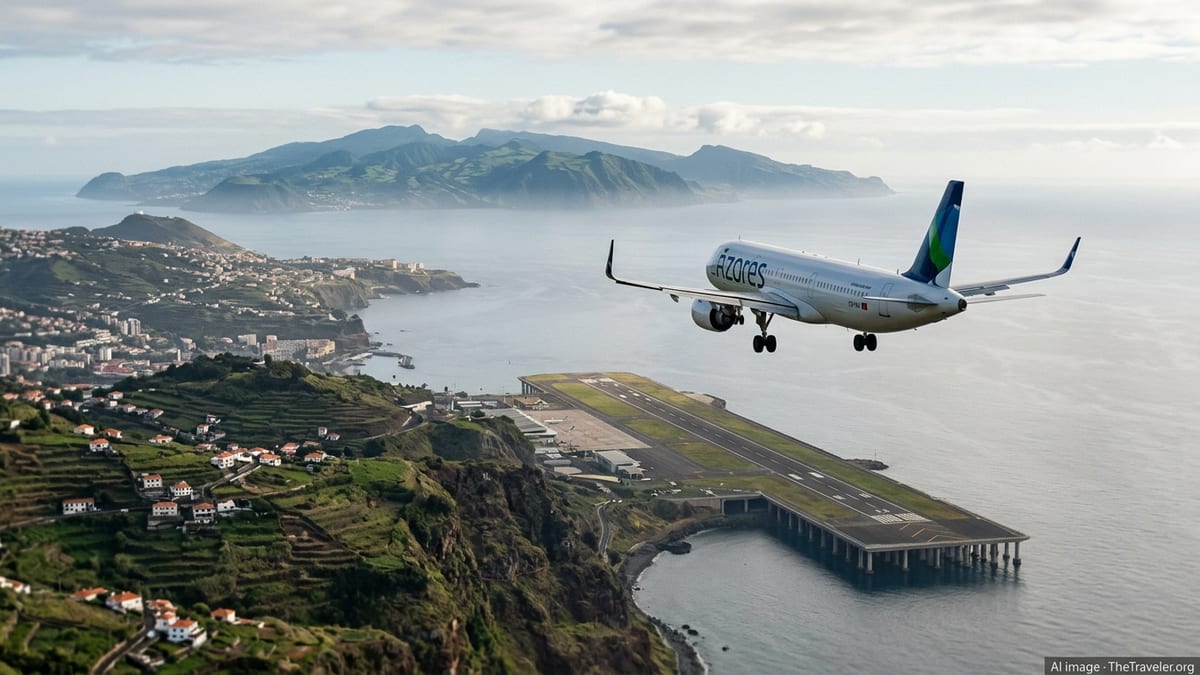
New Archipelago Link Starts in May 2026
The new nonstop service will connect Lajes Airport on Terceira with Funchal Airport in Madeira, providing the first regular direct air bridge between the two autonomous regions. Announced at the BTL tourism fair in Lisbon and confirmed by Azores Airlines at the end of February, the route is scheduled to debut on 7 May 2026 with one weekly rotation.
According to information released by the airline and regional authorities, flights will initially operate once a week on Thursdays, with the outbound leg from Terceira and the return sector from Madeira the following day. During the peak summer period, from June through September, the frequency will double to two weekly flights, adding a Monday departure and Tuesday return to match expected seasonal demand.
The operation will be carried out by Azores Airlines, the international arm of the SATA Group, which already serves Madeira from Ponta Delgada in São Miguel. The new Terceira connection slots into the carrier’s broader 2026 summer schedule, which emphasizes better connectivity between island communities and mainland Portugal.
Capacity and aircraft type have not been formally detailed, but the route is expected to be operated by single-aisle jets configured for short- and medium-haul sectors, in line with Azores Airlines’ existing regional network.
Public Service Obligations Drive Connectivity
The Terceira–Madeira link is being introduced within the framework of updated public service obligations, the state-backed mechanism used by Portugal to guarantee essential air services on routes deemed vital for territorial cohesion but not always commercially attractive on their own. The latest PSO revision explicitly incorporates this new inter-archipelago connection into the portfolio of subsidised services.
Authorities have argued that bringing Terceira and Madeira into a regular direct schedule is a matter of accessibility as much as economics. Until now, passengers typically needed to route through Lisbon or São Miguel, adding time, cost and complexity to journeys between the two island groups. The PSO framework is designed to correct such gaps, ensuring that residents, students, workers and visitors can move between regions with greater ease.
Recent budget allocations for PSO-supported routes between the mainland, the Azores and Madeira underline the Portuguese government’s intention to maintain strong internal air links. By weaving the Terceira–Madeira sector into that fabric, policy makers and the airline alike are betting that better mobility will feed directly into stronger tourism flows and year-round economic activity.
For Azores Airlines, the move also consolidates its position as a key connector within Portuguese airspace, complementing its transatlantic services and reinforcing its role as a bridge between smaller Atlantic islands and major European gateways.
Tourism Stakeholders Eye Growth Opportunities
Tourism operators in both archipelagos are already positioning the new route as a catalyst for multi-island itineraries that combine the volcanic landscapes of Terceira with Madeira’s laurel forests, levada trails and urban culture in Funchal. Travel agencies in Portugal and key European markets are expected to package the direct flight into twin-center holidays, short breaks and themed tours.
Industry representatives in the Azores note that Terceira, long overshadowed by São Miguel in terms of visitor numbers, stands to gain particular visibility. Easier access from Madeira could open fresh segments such as cruise passengers extending their stay, or hikers and nature lovers keen to experience contrasting Atlantic islands within a single trip. The direct route also simplifies logistics for events, sports competitions and cultural exchanges that draw participants from both regions.
On Madeira’s side, hotels and local tourism boards see a chance to tap into Azorean demand during shoulder months, when occupancy can dip between major holiday peaks. Direct air links tend to encourage shorter, more spontaneous trips, and the expectation is that residents of Terceira will be more inclined to book long weekends in Funchal once they can avoid a mainland transfer.
Both regional governments have repeatedly emphasised the strategic importance of aviation for island economies, where tourism is a leading employer and a major source of tax revenue. The Terceira–Madeira service fits squarely into those priorities, broadening the base of visitors and smoothing seasonal fluctuations that often challenge small, peripheral destinations.
Shorter Journeys and Stronger Regional Ties
For travellers, the most immediate benefit of the new route will be time savings. Instead of relying on connections through Lisbon or Ponta Delgada, passengers will be able to fly directly between Terceira and Madeira in a single hop, reducing overall journey times and the risk of missed connections. That convenience is especially significant for residents travelling for medical appointments, education, business or family reasons.
Direct flights can also have a soft-power effect on how regions perceive one another. Tourism officials in both archipelagos have noted that despite cultural affinities and shared Portuguese heritage, Azoreans and Madeirans often know mainland Portugal better than they know each other’s islands. A regular nonstop link makes weekend visits more feasible and could gradually encourage deeper cultural and commercial ties.
Local businesses stand to benefit from streamlined travel as well. From wine exporters and agricultural cooperatives to tech startups and conference organizers, a reliable air bridge expands the practical catchment area for clients, partners and events. In the longer term, improved connectivity can support diversification beyond tourism, reinforcing arguments for further infrastructure investment.
Azores Airlines has indicated that, if demand develops as expected, the Terceira–Madeira route could see adjustments in frequency or season length in future schedules. For now, the launch of weekly and then twice-weekly services marks a significant step in knitting together Portugal’s Atlantic territories with more direct, passenger-friendly links.
Competitive Landscape and Future Expansion
The decision to base the new connection on public service obligations reflects the delicate balance between commercial viability and public interest on thin island routes. While the Portuguese domestic market is competitive on trunk sectors such as Lisbon to the Azores and Madeira, smaller cross-archipelago links require a more managed approach to ensure year-round continuity.
By seizing the opportunity to operate the Terceira–Madeira flights, Azores Airlines strengthens its network position at a time when airlines across Europe are rethinking seasonal patterns and capacity deployment. Industry analysts suggest that once the route is established and demand becomes more predictable, it could encourage additional competition or partnerships, particularly during the busy summer months.
The airline has been gradually refining its route map across the North Atlantic and within Portugal, using its Azores bases as hubs connecting Europe and North America. The Terceira–Madeira service adds a new spoke to that system, enabling smoother through-connections for passengers who might combine a visit to both archipelagos with long-haul travel.
As the May 2026 launch date approaches, booking availability and final timetable details are expected to be closely watched by residents, tourism businesses and international tour operators alike. If the new route performs strongly, it could pave the way for further inter-island links and more integrated marketing of Portugal’s Atlantic islands as a single, diverse destination.