

More news on this day
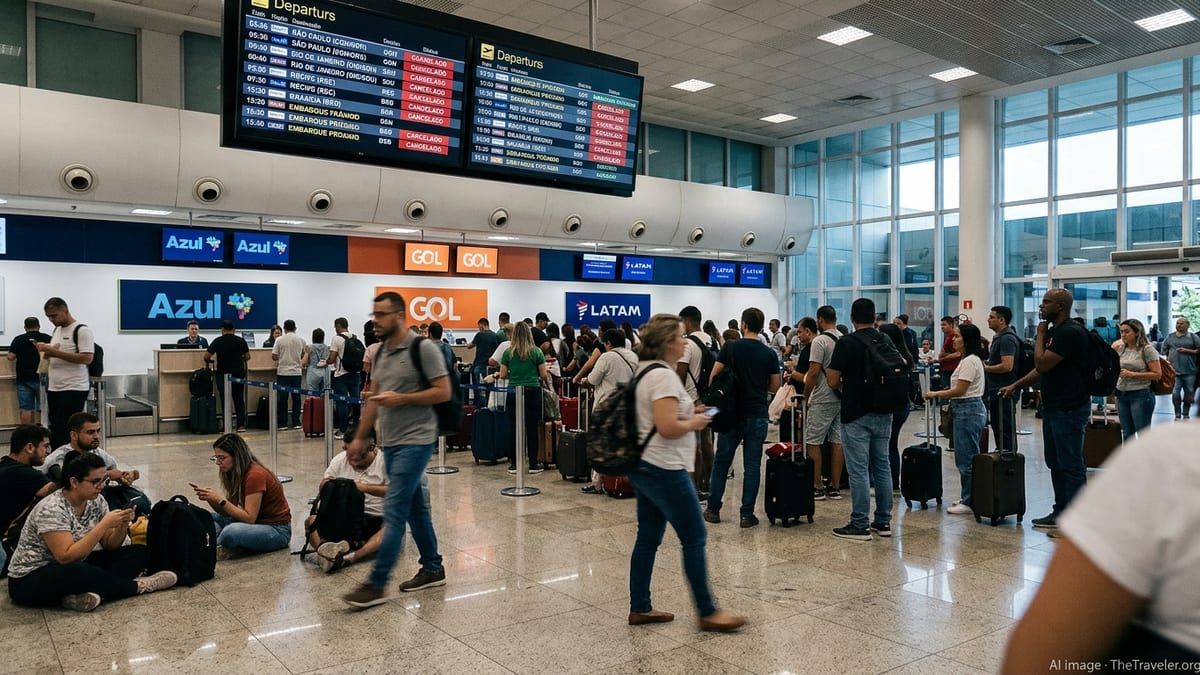
Travelers across Brazil are facing fresh disruption as Azul, Gol and Latam cancel and reschedule more than a dozen flights on key domestic routes linking São Paulo, Rio de Janeiro, Recife Guararapes, Brasília and other major hubs, according to real-time airport boards and local media reports on Saturday, March 21, 2026.
Get the latest news straight to your inbox!
Disruptions Concentrated on Brazil’s Busiest Corridors
Published coverage and live airport information indicate that the latest wave of cancellations is concentrated on Brazil’s most heavily used city pairs, including the Rio de Janeiro–São Paulo air bridge, connections between the São Paulo area and Recife’s Guararapes International Airport, and services to the federal capital Brasília. Flights operated by Azul, Gol and Latam are among those affected, with cancellations and significant retimings reported at Congonhas and Guarulhos in São Paulo, Santos Dumont in Rio, and at other major terminals.
The Rio–São Paulo air bridge, one of the busiest domestic shuttle routes in the world, typically offers frequent daily departures between Santos Dumont and Congonhas, largely operated by these three carriers. When multiple services on this corridor are canceled or heavily delayed, knock-on effects quickly spread to connecting flights serving Brazil’s Northeast, South and Center-West regions.
According to Brazilian aviation data and local news coverage, Recife’s Guararapes and Brasília’s main airport are functioning as critical nodes in this disruption pattern. Many travelers use these hubs to connect onward to secondary cities, so cancellations on trunk routes from São Paulo and Rio have cascaded into missed connections, forced overnights and rebookings across airline networks.
The scale of the current disruption is smaller than the systemwide meltdowns sometimes seen during severe weather or labor disputes, but the clustering of cancellations on such important corridors means that even a few dozen affected flights can strand thousands of passengers over the course of a busy travel day.
Impact on Passengers in São Paulo, Rio and Beyond
Travelers departing from São Paulo’s main airports report crowded customer service lines, full later flights and limited same-day alternatives on popular routes. Congonhas, which handles a high volume of business-focused shuttle flights, is particularly sensitive to short-notice cancellations, since many travelers rely on tight same-day schedules and expect multiple back-up options.
In Rio de Janeiro, passengers at Santos Dumont have faced gate changes and rolling updates on departure boards as airlines adjust operations. Some services are being consolidated onto remaining flights, while others are being re-routed via alternative airports such as Rio’s Galeão or São Paulo’s Guarulhos, creating longer travel times and complex itineraries for passengers who had originally booked simple point-to-point trips.
Downline airports such as Recife Guararapes, Brasília, Belo Horizonte and Salvador are also seeing the effects. Reports indicate that some travelers are arriving many hours later than planned or are being re-accommodated on flights the following day when same-day inventory is exhausted. In certain cases, passengers have had to accept routings that include additional connections or longer ground transfers to reach final destinations.
For international visitors using Brazil’s domestic network to connect from gateways like São Paulo and Rio to beaches in the Northeast or eco-destinations in the Amazon and Pantanal, the disruption is particularly stressful. Missed onward connections can jeopardize prepaid tours, hotel stays and regional flights that operate less frequently.
Operational Pressures Behind the Cancellations
Public information available from airline timetables, airport slot data and recent industry analysis suggests that carriers are facing a mix of operational pressures. Tight aircraft utilization, maintenance scheduling, crew availability and ongoing adjustments to route networks are all potential contributors when multiple cancellations appear on the same day across competing airlines.
Brazil’s major carriers have been rebalancing capacity between hubs in recent years, with Azul focusing heavily on Campinas and secondary markets, Latam strengthening its presence at São Paulo’s Guarulhos, and Gol reinforcing Rio’s Galeão for some long-haul services. These shifts require delicate coordination of aircraft and crews. When an aircraft or crew rotation is disrupted early in the day, it can quickly affect subsequent departures in São Paulo, Rio and other key cities.
Weather and air traffic control constraints can also trigger cascading delays and cancellations, particularly at airports surrounded by dense urban development such as Congonhas and Santos Dumont. While current reports do not point to a single clear cause for the latest disruptions, the pattern of scattered cancellations across Azul, Gol and Latam suggests a combination of local operational issues and broader schedule adjustments rather than a single isolated incident.
Regulatory restrictions in place at airports such as Santos Dumont, which limit certain types of operations and route lengths, further constrain the flexibility airlines have when reassigning aircraft or rerouting flights during irregular operations.
What Travelers Need to Do Right Now
Given the concentration of cancellations on trunk routes, publicly available guidance from airlines and consumer groups emphasizes one consistent message for passengers traveling today or in the coming days: verify flight status before leaving for the airport. Real-time checks via airline apps, airport departure boards and trusted third-party tracking tools can reveal last-minute changes that may not yet be reflected in older confirmation emails.
Travelers connecting between domestic and international flights in São Paulo, Rio, Recife or Brasília are advised to allow extra buffer time between segments. In the current environment, tight connections that may have worked during more stable periods carry higher risk, especially when changing airports within the same metro area or when relying on separate tickets across different carriers.
Reports from recent disruption episodes in Brazil highlight the importance of keeping boarding passes, cancellation notifications and any written information from airlines. These documents can be relevant when seeking refunds, rebooking assistance or compensation in line with Brazilian consumer protection regulations governing flight delays and cancellations.
Passengers who experience long delays or overnight stays may benefit from asking directly, through official digital channels or at airport counters, about meal vouchers, hotel accommodations or alternative routings. Availability of such support can vary by airline, ticket type and reason for disruption, but recent cases in the country show that travelers who document their situation and persistently request options often secure better outcomes.
Outlook for Brazil’s Domestic Air Network
Analysts following Brazil’s aviation sector note that the country’s domestic air network has largely recovered from the sharp downturn seen earlier in the decade, but remains sensitive to operational shocks. High demand on the Rio–São Paulo air bridge and on links from these cities to Recife, Brasília and other regional capitals means that airlines must walk a fine line between maximizing aircraft utilization and preserving resilience in their schedules.
As Azul, Gol and Latam continue to adjust capacity, retire or add aircraft and refine their focus on different hubs, occasional clusters of cancellations are likely to remain a feature of the market, particularly around peak travel dates and during periods of adverse weather. For travelers, that reality means building more flexibility into domestic itineraries and being prepared for last-minute changes on even the most established routes.
In the near term, monitoring how quickly carriers restore normal frequencies on the affected corridors will be a key indicator of overall network stability. If cancellations remain limited to isolated days and are followed by a return to typical schedules, the disruption may be remembered as a temporary operational snag. If irregularities persist across multiple weekends, however, Brazil’s summer and holiday travel periods could become more unpredictable for both domestic and international visitors.
For now, the most practical response for travelers moving through São Paulo, Rio, Recife Guararapes, Brasília and other major hubs is to stay informed, keep documentation of any changes and allow a wider safety margin when planning connections within Brazil’s busy domestic flight network.