

More news on this day
Azul Linhas Aéreas has launched nonstop flights between Belo Horizonte and Montevideo, a new South American corridor that enhances connectivity between Brazil’s interior and Uruguay’s capital while widening options for regional travelers.
Get the latest news straight to your inbox!
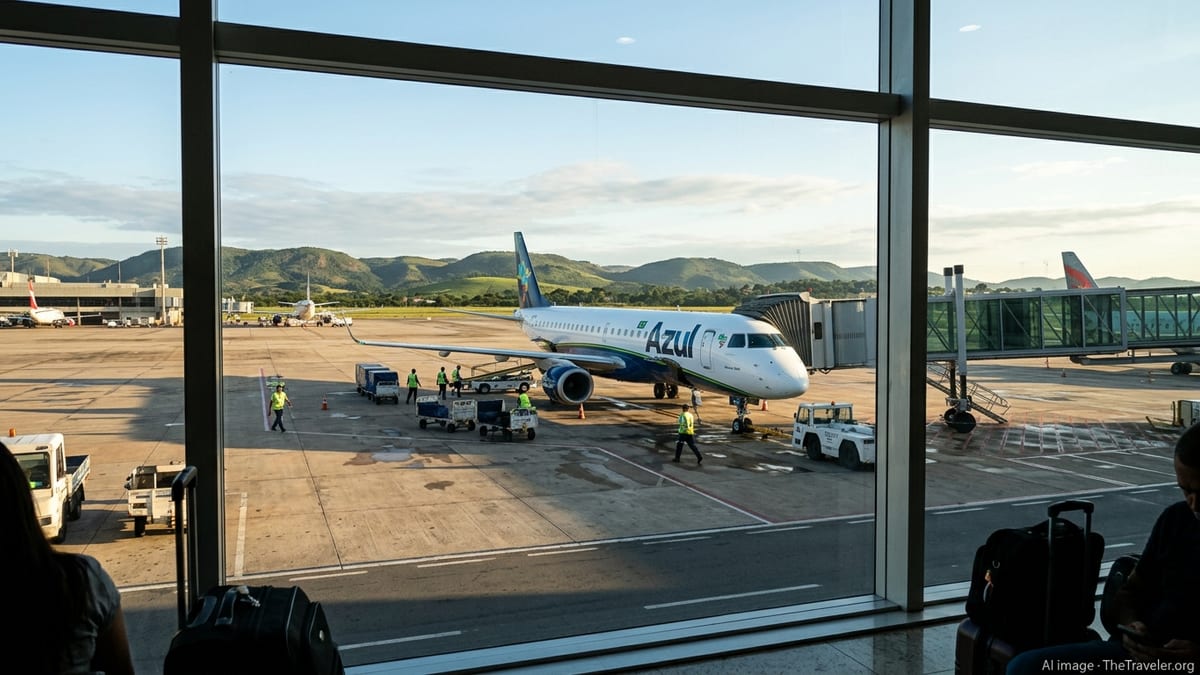
New Route Connects Key Regional Hubs
The new service links Tancredo Neves International Airport in Belo Horizonte and Carrasco International Airport in Montevideo, with operations commencing in early March 2026. Publicly available information shows that flights are currently scheduled twice weekly, creating a direct bridge between one of Azul’s main Brazilian hubs and Uruguay’s primary international gateway.
Reports indicate the route is operated with Embraer jets configured for around 130 to 140 passengers, positioning it to capture both leisure and business demand along the Brazil–Uruguay axis. Flight tracking data lists the operation under Azul flight numbers between Montevideo and Belo Horizonte, confirming consistent service on the corridor.
The launch also reinforces Carrasco International Airport’s growing role as a regional node. Official airport and government communications highlight Azul among a small group of carriers steadily rebuilding Uruguay’s international connectivity, with Belo Horizonte appearing alongside Recife as part of Azul’s network from Montevideo.
For Belo Horizonte’s Tancredo Neves hub, the new flights add another international link to a network that has expanded steadily over the past decade. Public data on Azul’s route strategy shows Belo Horizonte serving as one of the airline’s principal connecting points for both domestic and international traffic, and Montevideo now joins a roster that includes destinations in North America and Europe.
Boost for Tourism Flows Between Brazil and Uruguay
Tourism analysts in Uruguay have been flagging Brazil as a priority growth market, and the Belo Horizonte–Montevideo launch appears tailored to that trend. Recent tourism monitoring reports point to rising arrivals from Brazilian cities beyond the traditional hubs of São Paulo and Rio de Janeiro, citing Belo Horizonte among the key emerging sources of visitors.
The reinstatement of a direct link after roughly a decade, as noted in regional travel coverage, addresses one of the structural challenges for Uruguay: dependence on indirect routings and limited capacity from secondary Brazilian cities. By offering nonstop flights, Azul shortens travel times and simplifies weekend and short-break itineraries for Brazilian travelers considering Montevideo, Colonia del Sacramento, or Uruguay’s coastal resorts.
From the perspective of Minas Gerais, Uruguay’s reputation for cultural tourism, wine routes, and Atlantic beaches adds a distinctive option to the outbound travel mix. Industry commentary suggests that improved access could help smooth seasonality on both sides of the border, with Brazilian holiday peaks and Uruguayan events calendars creating demand throughout the year.
Travel trade publications in the region also note that each Azul flight brings more than one hundred seats directly into Montevideo, which can be significant for a market of Uruguay’s size. This incremental capacity supports local hotels, restaurants, and tour operators, while also spreading visitor flows beyond the oversubscribed routes from São Paulo and Buenos Aires.
Strengthening Azul’s South American Network Strategy
The Belo Horizonte–Montevideo launch fits a broader pattern in Azul’s recent network moves. The carrier has been steadily adding new international services from its Brazilian hubs, including routes from Recife and Campinas to European and regional destinations. According to the airline’s sustainability and expansion reports, the strategy centers on leveraging strong domestic connectivity to feed selective international points.
Azul’s published network data shows that in late 2025 the company and its regional arm Azul Conecta served around 150 destinations, with Belo Horizonte, Campinas, and Recife defined as central pillars. Adding Montevideo from Belo Horizonte deepens this hub concept, giving passengers from Brazil’s interior a one-stop pathway to Uruguay and, via Montevideo’s connections, to other South American cities.
Analysts following the Brazilian aviation market indicate that Azul has focused on underserved or secondary markets, using medium-size aircraft to stimulate demand where larger widebodies would be uneconomical. The use of Embraer jets on the Belo Horizonte–Montevideo route aligns with that model, balancing capacity with the need for schedule reliability.
Industry coverage of Azul’s 2026 plans also highlights new routes from Brazil to North America and Europe. Within that context, the move into the Belo Horizonte–Montevideo corridor signals that South American regional connectivity remains a key pillar, complementing longer-haul ambitions rather than being eclipsed by them.
Improved Regional Access and One-Stop Connectivity
Beyond the point-to-point market, the new route is significant for the network connectivity it unlocks. Belo Horizonte sits at the center of a dense domestic web, with Azul and other carriers operating links to cities across Minas Gerais and into Brazil’s north, northeast, and center-west. Public timetables and airport information show onward flights to destinations such as Brasília, Salvador, Recife, and Amazonian gateways.
For travelers originating in Uruguay, the Belo Horizonte hub therefore functions as a convenient one-stop entry into many Brazilian regions that previously required backtracking through São Paulo or Rio de Janeiro. Conversely, passengers from medium-size Brazilian cities can now reach Montevideo through a single connection, without having to route via more congested hubs.
Regional business travel also stands to benefit. Minas Gerais is a major industrial and services center, while Uruguay positions itself as a regional base for technology, logistics, and professional services. Travel industry reports suggest that better non-capital links within South America can support cross-border investment, conferences, and sector-specific events that do not necessarily revolve around the largest metropolitan areas.
For passengers, the practical advantages include shorter total travel times, fewer layovers, and more predictable itineraries. Even at two weekly frequencies, the route adds scheduling flexibility when combined with other Brazil–Uruguay services, giving both leisure and corporate travelers additional options when planning trips.
Competitive Landscape and Prospects for Growth
The new Belo Horizonte–Montevideo connection enters a regional market where other carriers already operate routes between Uruguay and Brazilian giants such as São Paulo and Rio de Janeiro. Publicly available route maps from major airlines in the Southern Cone show Montevideo connected to several Brazilian hubs, though often with limited weekly frequencies.
By tapping Belo Horizonte, Azul differentiates the offering and potentially broadens the catchment area for Uruguay-bound traffic. Commentators in Uruguayan media point out that the new flights also open additional one-stop possibilities beyond Uruguay, as Montevideo offers links into Argentina and other nearby markets, strengthening its role as a smaller but efficient regional bridge.
Market observers will be watching load factors and seasonal adjustments closely over the coming months. Reports on Azul’s approach to new routes indicate a focus on gradual development, with the airline commonly starting with a modest number of weekly frequencies before increasing capacity if demand materializes.
If the Belo Horizonte–Montevideo route performs well, it could encourage further South American additions from Azul’s hubs, reinforcing a trend in which secondary cities assume a more prominent role in regional connectivity. For travelers, the message is clear: options for crisscrossing South America without always passing through the largest capitals are expanding, one new route at a time.