

More news on this day
When Azul S.A. entered Chapter 11 protection in the United States in 2025, many analysts assumed Brazil’s largest carrier by destinations and daily departures was headed for the same fate as other distressed Latin American airlines. Less than a year later, the company is emerging from court supervision armed with fresh capital from American Airlines and United Airlines, a lighter balance sheet and a sharpened network strategy that is rapidly turning one of the region’s most troubled carriers into its most closely watched turnaround story.
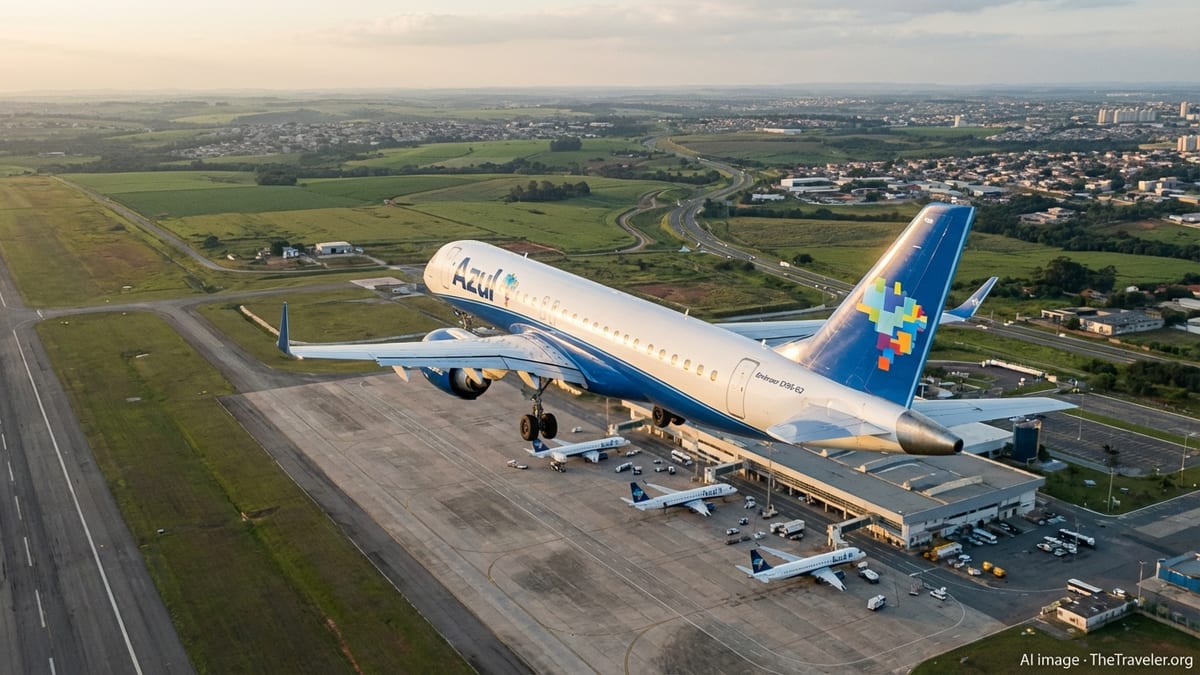
From Market Darling to the Brink of Collapse
Azul’s sudden fall from investor favorite to bankruptcy protection was years in the making. Founded in 2008 by JetBlue creator David Neeleman, the airline spent its first decade racing across Brazil, stitching together smaller cities that rivals ignored and building a reputation for high-frequency service and customer-friendly touches. By the eve of the pandemic it had become one of Brazil’s three dominant carriers, controlling roughly a quarter of the domestic market and operating hundreds of daily flights across a uniquely dense network.
That success came with a heavy price. Azul financed its growth largely with dollar- and euro-denominated leases and bonds, leaving it exposed when Brazil’s currency weakened and global interest rates climbed. The COVID-19 pandemic then gutted demand just as the airline’s obligations surged. Supply chain delays, inflation and a spike in fuel prices compounded the strain, while natural disasters such as the prolonged closure of Porto Alegre’s airport after severe flooding added fresh pressure to its already fragile cash generation.
By 2024 and early 2025 Azul had negotiated a series of complex deals with lessors and bondholders, shaving billions from future lease liabilities and exchanging existing notes for new, higher-coupon securities that offered creditors equity conversion rights. Ratings agencies described the transactions as distressed exchanges, warning that a conventional default or bankruptcy filing was a real possibility without deeper relief and fresh money. With net debt well above pre-pandemic levels and leverage ratios pushing past five times earnings, a full-scale restructuring became all but inevitable.
On May 28, 2025, Azul filed for Chapter 11 protection in New York, listing total debt and lease obligations that had more than quadrupled since 2019. The petition made the company the last of Brazil’s three major carriers to seek court-supervised reorganization in the wake of the pandemic, underscoring the depth of the crisis gripping Latin American aviation.
Inside a High-Stakes Chapter 11 Gamble
Azul’s management entered Chapter 11 with an unusually detailed blueprint. The company had already secured support from key financial stakeholders, including major bondholders and its largest aircraft lessor, and lined up a debtor-in-possession financing package worth around 1.6 billion dollars to fund operations during the case. Executives framed the bankruptcy not as a retreat but as a mechanism to push through a pre-arranged plan that would be difficult to achieve outside court.
The proposal called for converting roughly three billion dollars of debt into equity, cutting total obligations to about 3.7 billion dollars from an estimated 6.5 billion at the time of filing. Existing secured notes maturing in 2028, 2029 and 2030 were to be swapped for a mix of new first- and second-lien instruments with stepped-up coupons and built-in paths to equity ownership. At the same time, Azul committed to a sweeping rationalization of its fleet and route map, targeting older, less efficient aircraft and trimming loss-making or marginal routes to bring leasing and maintenance costs down.
Crucially, the company insisted it would continue flying normally throughout the process. Tickets, loyalty points and customer benefits remained valid, and the airline sustained around 900 daily flights across Brazil and international routes to North America and Europe. This continuity helped preserve revenue and maintain consumer confidence at a time when memories of abrupt service collapses elsewhere in the region were still fresh.
For creditors, the plan offered a trade-off: accept steep haircuts and take part of their recovery in equity, or risk a more painful outcome in a liquidation scenario in a country that offers bondholders fewer protections than the U.S. market. More than 90 percent of voting creditors ultimately backed the restructuring. That endorsement set the stage for a fast-moving court process that culminated in late 2025, when a U.S. bankruptcy judge approved Azul’s exit plan and cleared the way for a rare Latin American airline comeback.
The American and United Lifeline
What transformed Azul’s restructuring from a simple balance-sheet fix into a strategic shock to the aviation landscape was the role of U.S. carriers American Airlines and United Airlines. Both were already commercial partners of Azul before the filing, with United holding a small equity stake and a codeshare agreement that fed Brazil traffic into its North American network. During the Chapter 11 negotiations, the two airlines emerged as cornerstone investors in the exit financing package.
The court-approved plan envisioned up to 950 million dollars in new equity, funded by a mix of existing bondholders and strategic partners. Within that pool, American and United together committed between 200 and 300 million dollars in fresh capital, split roughly evenly. Their participation was structured through an equity rights offering and warrants, allowing them to increase their stakes while giving existing Azul shareholders the option to avoid or accept dilution by exercising preemptive rights.
By early 2026, the outlines of the new ownership structure were clear. United, which previously held about 2 percent of Azul, would expand its stake to a still-minority but more influential level, while American would become a new shareholder. Each U.S. carrier is expected to hold less than 10 percent of the Brazilian airline’s equity but will gain a seat on its board, formalizing their influence over strategy and governance. For Azul, the backing from two of the world’s largest airlines provides not only capital but also a powerful vote of confidence in its long-term viability.
In February 2026, Azul announced that American and United would inject a combined 200 million dollars as part of a broader package exceeding 300 million dollars when contributions from existing creditors are included. The funds will help stabilize post-bankruptcy operations, shore up liquidity and support investments in fleet renewal and network optimization. Structured through an equity rights offering and warrants, the capital raise underlines how central foreign strategic partners have become to Azul’s survival and eventual recovery.
Reshaping Brazil’s Airline Map
Azul’s turnaround is remaking competitive dynamics in one of the world’s most concentrated aviation markets. Brazil’s domestic skies are dominated by three carriers: LATAM Airlines Brasil, Gol Linhas Aéreas and Azul. Together they handle virtually all domestic passenger traffic, with LATAM typically controlling around 40 percent, Gol in the low-30s and Azul in the mid- to high-20s depending on the month and metric used.
Before the bankruptcy filing, Azul had been the driving force behind a proposed merger with Gol that would have created Brazil’s largest airline. That combination, which promised more than 60 percent domestic market share, attracted intense scrutiny from competition authorities and consumer advocates worried about higher fares and reduced service to smaller cities. As Azul’s financial position deteriorated and Gol pursued its own Chapter 11 path, those merger talks collapsed, leaving the three-way oligopoly intact but fluid.
Emerging from Chapter 11 with a stronger balance sheet, Azul is positioning itself as a disciplined growth player rather than an aggressive consolidator. Executives say the company will focus on profitable routes and leverage its strength in regional markets, while avoiding overextension that could reignite debt problems. Fleet reductions during the restructuring, including the return of older aircraft and the renegotiation of lease terms with major lessors, have cut more than 300 million dollars in annual leasing costs according to company disclosures, freeing cash to invest in higher-yielding routes.
At the same time, the new equity stakes held by American and United embed Brazil’s domestic champion more deeply in global alliance politics. Azul is not formally part of any of the three major airline alliances, but its tightened ties to two leading U.S. carriers give it leverage in negotiating codeshares, frequent-flyer reciprocity and joint marketing on transcontinental routes. That, in turn, could influence how Brazilian travelers connect to North America and beyond, intensifying competition with LATAM’s Oneworld partners and Gol’s relationships in the region.
Network Strategy: From Survival to Selective Expansion
The operational side of Azul’s comeback is anchored in a network strategy that tries to balance scale with resilience. The airline prides itself on serving more than 150 destinations, many of them secondary or tertiary cities that lack meaningful service from rivals. Its main hub at Viracopos International Airport in Campinas, near São Paulo, has become a crucial connector, feeding passengers from across Brazil onto international flights to Florida and Europe and redistributing inbound traffic to underserved domestic markets.
During the restructuring, Azul trimmed marginal routes and temporarily reduced some international capacity, particularly in the first half of 2024 when fleet and demand disruptions were acute. Yet data from Brazil’s aviation regulator show that by late 2025 the carrier was once again carrying record passenger volumes. In the nine months through September 2025, Azul transported around 23.7 million travelers, nearly 6 percent more than in the same period a year earlier, setting a new company high even as it remained under intense financial strain.
Executives credit a “disciplined expansion” philosophy that prioritizes routes with strong and growing demand, especially from Brazil’s northeast, where cities such as Recife have become standout performers in Azul’s network. Key routes linking Recife with Viracopos, Belo Horizonte and São Paulo’s Guarulhos airport consistently rank among the airline’s busiest. By concentrating capacity in corridors where it enjoys a structural advantage and loyal customer base, Azul aims to generate the cash flows needed to service its restructured obligations without relying on unsustainable growth targets.
Looking ahead, the injection of capital from American and United is expected to support incremental international expansion, particularly to U.S. gateways already served by those partners. Deeper codeshares could allow Azul to offer Brazilian passengers seamless access to dozens of onward destinations in North America without committing its own aircraft, while filling U.S. partners’ seats with Latin American traffic they might otherwise struggle to reach.
Financial Rebirth and the Road to Relisting
The financial architecture of Azul’s comeback is as important as its network strategy. The company’s restructuring deals with lessors, bondholders and strategic partners collectively removed more than two billion dollars in debt and lease obligations from its balance sheet. A January 2025 settlement with bondholders, lessors and aircraft manufacturers alone eliminated roughly 2.1 billion dollars in liabilities and brought in 525 million dollars in new capital through superpriority notes, giving the airline crucial breathing room.
The later Chapter 11 plan deepened that transformation by converting a large portion of unsecured and subordinated debt into equity. Existing shareholders have seen their stakes substantially diluted, but the trade-off leaves Azul with a leverage profile closer to global peers and a realistic path to further deleveraging. Management targets call for net debt to fall to around twice earnings by the end of 2026 and to 1.5 times by 2027, milestones that, if achieved, would complete one of the most ambitious corporate slimming efforts in the region’s recent history.
Another pillar of the financial strategy is a renewed focus on equity markets. Azul’s preferred shares continue to trade on São Paulo’s B3 exchange, and executives have signaled their intention to eventually relist in the United States once the company delivers several consecutive years of stable results. A successful U.S. relisting would mark a symbolic full-circle moment for a carrier founded by a U.S.-Brazilian entrepreneur and now partly owned by two of America’s largest airlines.
For now, the priority is to show that the post-bankruptcy Azul can generate free cash flow, maintain tight cost discipline and avoid the kind of debt-fueled expansion that exposed it so badly to economic shocks in the past. The presence of American and United on the board is expected to reinforce that conservative stance, bringing global best practices in fleet planning, revenue management and risk oversight into the São Paulo-based airline’s decision-making.
What Azul’s Comeback Means for Travelers
For passengers, Azul’s escape from the brink of insolvency has immediate and longer-term implications. In the short run, the restructuring has preserved competition on domestic and international routes that might have become more concentrated had the airline collapsed or been absorbed into a rival. Travelers in smaller Brazilian cities, in particular, benefit from Azul’s continued focus on regional connectivity that would likely be less of a priority for a consolidated mega-carrier.
Over time, deeper integration with American and United could reshape how Brazilians travel to North America. Expanded codeshares and reciprocal frequent-flyer benefits are expected to give Azul customers more one-stop options to U.S. and Canadian cities via hubs such as Miami, Dallas-Fort Worth, Houston and Chicago. At the same time, U.S. travelers heading to Brazil may find it easier to reach secondary destinations beyond Rio de Janeiro and São Paulo by connecting onto Azul’s dense domestic network using a single itinerary.
There are potential downsides. The concentration of ownership and strategic influence among a small group of large airlines raises questions about long-term pricing power and service levels, especially if fuel prices rise or Brazil’s currency weakens again. Consumer advocates will be watching closely to see whether the benefits of Azul’s revival, including new routes and improved connectivity, are shared with passengers in the form of competitive fares and reliable operations.
For now, though, Azul’s story reads as an improbable escape from a near-fatal spiral. A carrier that once seemed destined to be dragged under by pandemic-era debt has not only avoided liquidation but attracted massive investment and strategic backing from two of the world’s aviation heavyweights. In doing so, it has redrawn the map of airline alliances over Brazil and offered a rare example of how cross-border cooperation can pull a vital national carrier back from the edge.