

More news on this day
A routine overnight transatlantic service from the United States to the United Kingdom briefly drew heightened attention this week after a British Airways Airbus A350 flying from Las Vegas to London descended thousands of feet mid-Atlantic in response to a cockpit systems alert before later climbing back to cruising altitude and continuing safely to Heathrow.
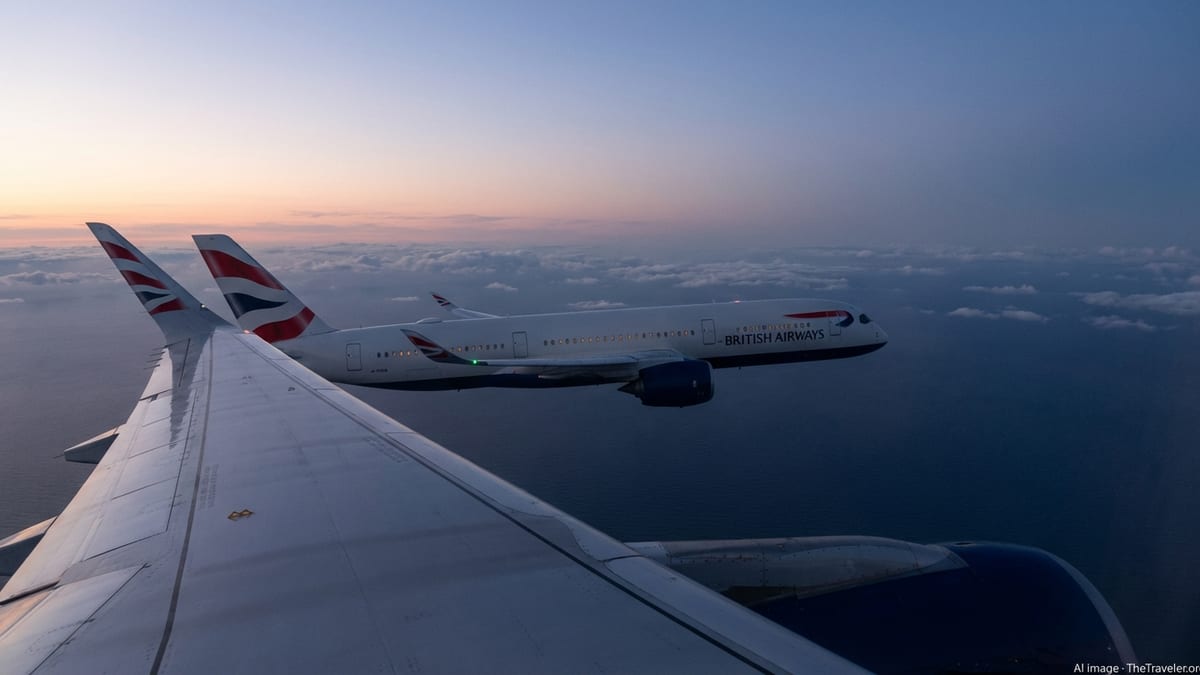
Mid-Atlantic Alert Triggers Precautionary Descent
The incident involved British Airways flight BA274, operating from Las Vegas Harry Reid International Airport to London Heathrow, on the night of 19 February into 20 February 2026. Several hours into the journey, as the aircraft crossed the North Atlantic, cockpit communications indicated a technical reference to a fire switch system, prompting the crew to adjust altitude while working through their checklists.
According to flight tracking data and aviation monitoring reports, the Airbus A350-1000, registered G-XWBR, had been cruising at around 39,000 feet when the alert was received. In a controlled response, the crew initiated a gradual descent to approximately 22,000 feet over the course of about half an hour, a profile consistent with precautionary troubleshooting rather than an abrupt emergency dive.
After stabilising at the lower level and completing technical checks, the aircraft subsequently climbed back to its original cruising altitude. The long-haul service then continued eastbound toward London without diverting to an alternate airport, arriving in the United Kingdom without further reported complications.
While a reference to a fire switch can be unsettling for passengers following developments from the ground, aviation safety specialists note that such messages are designed to trigger robust, well-rehearsed procedures in the cockpit, not panic. In this case, those procedures appear to have allowed the flight to continue safely once the crew and controllers were satisfied that the aircraft remained within normal performance parameters.
What the Fire Switch Message Means
In modern commercial jets such as the Airbus A350, the engine fire switch is a key part of the aircraft’s safety architecture. Located on the overhead panel, it allows pilots, in the rare event of an engine fire or severe malfunction, to shut down the affected engine, cut off fuel, hydraulic fluid and bleed air, and arm the fire extinguishing system. Any reference to that switch in cockpit communications naturally demands immediate attention.
Reports from aviation data channels indicated that an Aircraft Communications Addressing and Reporting System (ACARS) message was transmitted to air traffic control asking whether North Atlantic controllers needed to be aware of anything relating to the fire switch. That wording suggests the crew were liaising closely with Shanwick Oceanic Control, which manages a large portion of the transatlantic corridor between North America and Europe.
Industry analysts emphasise that a technical reference to a fire switch is not confirmation of an in-flight fire. It can also be linked to sensor readings, system alerts, or maintenance messages that must be evaluated carefully. Crews are trained to treat such indications conservatively, often by changing altitude, adjusting engine settings, and running through multiple checklists to rule out a developing fault.
The descent from 39,000 to roughly 22,000 feet in this case is consistent with a crew seeking a flight level better suited to engine-out or reduced-thrust scenarios while systems are checked. Once they confirmed that performance and parameters were acceptable, the climb back to cruising altitude signalled that any immediate concern had been contained.
Speculation Over Engine Issue but No Diversion
Unconfirmed monitoring of radio traffic suggested that the pilots may have been working through an engine-related issue and assessing whether a shutdown or restart was necessary. Twin-engine widebodies such as the Airbus A350 are certified to fly safely for extended periods on a single engine, but such a step requires meticulous decision-making and coordination with controllers.
If an engine is shut down as a precaution, crews must consider fuel burn, available alternates, weather and airspace congestion before deciding whether to press on or divert. For westbound departures from the United States bound for the United Kingdom, common diversion airports across the North Atlantic region include Halifax in Nova Scotia, Gander in Newfoundland, and airports in Iceland or Ireland, depending on track and location.
During this particular crossing, the aircraft remained within reachable distance of several alternates while at the lower altitude. The subsequent request to climb back to flight level 390 indicated that the operational situation had improved sufficiently to restore a standard long-haul cruise profile across the oceanic sector.
British Airways has not issued a detailed technical breakdown of the event, in line with usual practice when a flight lands normally and no formal investigation has been announced. However, the combination of a precautionary descent, a return to cruise, and a non-diverted arrival in London points to a system alert that was effectively contained through established cockpit procedures.
Passengers Report a Calm but Noticeable Change
For those on board, the most obvious sign that something was happening mid-flight would likely have been the sustained, gentle descent followed by a renewed climb, together with occasional announcements from the cockpit. Long-haul passengers are accustomed to moderate altitude changes as crews work around turbulence or optimise fuel, but a shift of more than 15,000 feet is unusual enough to prompt questions.
Initial accounts from travellers on similar events typically describe a subdued cabin atmosphere, with many passengers unaware of the technical specifics but alert to subtle changes in engine tone or the behaviour of the seatbelt sign. On overnight transatlantic sectors, where the cabin is often darkened and many travellers are sleeping, crews will usually aim to manage the situation as quietly as possible while maintaining clear communication when needed.
Cabin crew members are trained to respond consistently to cockpit instructions, from checking galley equipment to securing the cabin in case a diversion or rapid descent becomes necessary. In incidents such as this, their role is to reassure passengers, follow safety protocols and be ready for any change of plan, whether that involves continuing to destination or landing at an alternate airport.
There were no immediate reports of injuries or onboard distress associated with the BA274 altitude change. The absence of a diversion, emergency landing, or extended ground response at Heathrow suggests that any concern remained within the scope of routine safety management rather than escalating into a full emergency.
Recent Scrutiny of Transatlantic Operations
The mid-air alert on the Las Vegas to London sector comes at a time of heightened scrutiny of long-haul operations between the United States and the United Kingdom. In recent months, British Airways and other carriers have experienced a series of unrelated but widely reported events ranging from severe turbulence to smoke indications and precautionary returns.
A separate British Airways A350 operating a transatlantic service from Los Angeles to London earlier this year drew attention after encountering unexpected turbulence near Greenland, injuring a small number of passengers and one crew member before continuing safely to Heathrow. Investigators pointed to rapidly changing upper-level weather patterns over the North Atlantic, underscoring how dynamic the corridor has become for modern widebody traffic.
Elsewhere in the network, a British Airways A320 on a short-haul route between Istanbul and London diverted to Bucharest last year after reports of possible smoke in the cabin, while an A350 service between Mumbai and London diverted to Doha following a mid-flight distress call. In each of those cases, the aircraft landed safely and passengers were re-accommodated, but the incidents kept aviation safety and crew decision-making in the public eye.
For transatlantic travellers, these episodes serve as reminders that while serious accidents remain extremely rare, modern fleets and crews are constantly dealing with technical alerts, system messages and evolving weather en route. Most never reach the headlines, precisely because procedures and technology are designed to absorb them without compromising safety.
How Airlines and Controllers Coordinate Over the North Atlantic
The North Atlantic air corridor linking North America and Europe is among the busiest and most complex expanses of airspace in the world, with hundreds of widebody flights crossing nightly on a series of shifting tracks. Within this environment, coordination between flight crews and oceanic control centres is crucial whenever a technical or medical irregularity arises.
In the case of BA274, references to EGGX, the identifier for Shanwick Oceanic Control, highlight the role of controllers based in the United Kingdom and Ireland in managing traffic over international waters. When a crew flags a potential technical concern, controllers help by adjusting separation from nearby aircraft, approving altitude or routing changes, and keeping alternates and emergency services informed if necessary.
Because radar coverage is limited over parts of the ocean, communications for transatlantic flights continue to rely heavily on data link systems such as ACARS and controller–pilot data link communications, along with high-frequency radio. These channels allow crews to relay system messages, engine performance updates and requests for level changes even when they are far from land-based infrastructure.
Altitude changes such as the controlled descent undertaken by BA274 must be carefully coordinated so that other aircraft on the same or neighbouring tracks maintain safe separation. For passengers, that choreography is invisible, but behind the scenes it is a rehearsed exercise involving pilots, dispatchers and multiple air navigation service providers.
Understanding the Airbus A350’s Safety Systems
The Airbus A350-1000 is one of the most advanced long-haul aircraft in service today, with extensive built-in redundancy across its engines, hydraulics, electrics and avionics. Each of its two Rolls-Royce Trent XWB engines is monitored by a dense network of sensors feeding into onboard computers that alert crews to any deviation from normal parameters.
In the event of a suspected engine abnormality, the aircraft’s electronic centralised aircraft monitor guides pilots through a structured sequence of actions. These can include reducing thrust, changing altitude, shutting down an engine or preparing fire bottles, depending on the nature and severity of the alert. The reference to a fire switch in the BA274 communications aligns with the way those systems are designed to escalate only when warranted.
Because the A350 is approved for extended twin-engine operations across remote oceanic areas, it must meet stringent requirements for performance on one engine, including climb capability, drift-down profiles and diversion times to suitable airports. This regulatory framework underpins the confidence that airlines and regulators have in allowing twin-engine jets to ply ultra-long-haul routes over water.
Operators such as British Airways continuously analyse data from their fleets, feeding it into predictive maintenance programmes that can flag components for inspection or replacement before they fail. Events like the BA274 alert typically generate detailed post-flight reports that engineers and safety teams use to refine procedures and, where necessary, update training.
What This Means for Transatlantic Travellers
For passengers planning or already booked on transatlantic services between the United States and the United Kingdom, the BA274 episode is likely to prompt understandable questions about risk and reliability. Aviation experts stress that the incident is better seen as evidence of the system working as intended than as a sign of deteriorating safety standards.
Statistically, long-haul commercial aviation remains one of the safest forms of transport, with millions of passengers crossing the Atlantic every year without serious incident. When a technical irregularity does occur, crews are trained to err on the side of caution, whether that means changing altitude, diverting to an alternate airport, or, as in this case, temporarily descending while troubleshooting before continuing.
For travellers, the most practical takeaway is that occasional course or altitude changes are a normal part of modern flight operations, and that a diversion or unscheduled landing, while disruptive, is ultimately a safety-focused decision. Choosing well-established carriers with robust safety cultures and modern fleets, including aircraft such as the Airbus A350, remains a strong safeguard for those flying between North America and Europe.
In the coming days, British Airways’ internal review of the BA274 alert is expected to focus on the precise trigger for the fire switch reference and the sequence of cockpit responses. Unless regulators identify a broader concern, the route is set to operate as scheduled, continuing to connect Las Vegas and London across one of the world’s most closely watched oceanic corridors.