

More news on this day
Thousands of airline passengers were left stranded across the United Kingdom and France this weekend after British Airways and Air France delayed 183 flights and cancelled a further eight services, creating scenes of confusion and overcrowding at major hubs in Paris, Edinburgh, London, Nice and several other cities.
Storm System and Operational Strains Hit Key European Routes
The latest disruption unfolded as a powerful winter weather system swept across northwestern Europe, combining with already stretched airline operations to trigger rolling delays and targeted cancellations. Both British Airways and Air France trimmed and rescheduled services on some of their busiest short haul routes between the UK and France, including links from London to Paris and Nice, as well as services connecting Edinburgh with French hubs and onward destinations.
According to real time air traffic data and airport operation updates, the two carriers together delayed 183 flights and cancelled eight, with the majority of affected services clustered over a 24 hour period. While disruption levels fluctuated throughout the day, knock on effects were visible across morning and evening peaks as aircraft and crews fell out of position and turnaround times lengthened on congested aprons.
Meteorologists reported bands of snow, freezing rain and gusty winds moving across parts of the UK and northern France, particularly around the Channel and North Sea coasts, conditions that can quickly reduce runway capacity and necessitate extra separation between aircraft. Airport authorities also cited de icing bottlenecks and intermittent ground handling suspensions as contributing factors, although airlines said they were working to keep as much of the schedule operating as safely possible.
The timing has been particularly difficult for carriers that were already contending with increased winter traffic and a backdrop of earlier disruption episodes across Europe caused by similar storm systems, air traffic control staffing constraints and industrial action in several countries.
Scenes of Overcrowding in Paris, Edinburgh, London and Nice
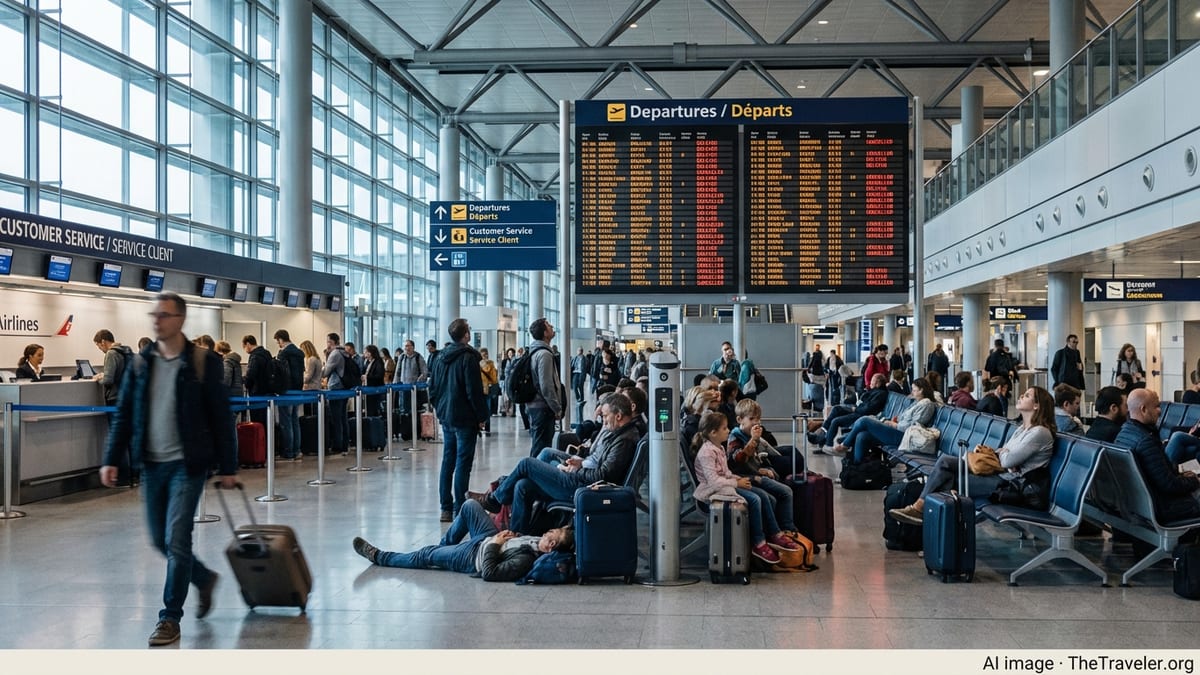
At Paris Charles de Gaulle and Orly airports, passengers arriving at departure halls in the early hours reported electronic boards filling with red and orange status alerts as more flights shifted from on time to delayed, and a smaller subset flipped to cancelled. Check in queues for British Airways and Air France snaked across terminal floors, with some customers waiting more than an hour just to speak to an agent about rebooking options.
In the UK, London Heathrow and London Gatwick saw similar scenes, while Edinburgh Airport experienced concentrated disruption as a number of UK domestic and cross Channel services were held back or pulled from the schedule. Travellers encountered dense crowds at security and boarding gates, with gate agents repeatedly announcing rolling delay extensions as aircraft awaited new departure slots or final safety clearances amid changing weather reports.
Further south on the Mediterranean, Nice Côte d’Azur Airport, a key French hub for both leisure and business travel, struggled to absorb the impact of delayed inbound aircraft. Passengers waiting to fly to London and regional UK airports watched departure boards tick forward in 30 and 45 minute increments, as crews waited on late arriving planes. Some flights were eventually cancelled outright when curfew limits and crew duty time restrictions were reached.
Across the affected airports, images from terminals showed passengers sitting on the floor near charging points, queuing at information desks and competing for limited seating near departure gates. Public address systems repeatedly urged travellers to stay close to their assigned gates and to consult airline apps for the latest status updates, while airport social media channels pushed out advisories warning of longer than usual processing times.
Airlines Urge Passengers to Rebook Digitally as Call Centers Jam
As the disruption intensified, both British Airways and Air France encouraged affected customers to use digital tools rather than queuing at desks or calling overwhelmed helplines. Airline apps and websites were updated with same day and next day rebooking options, as well as the possibility to reroute via alternative hubs where seats were available. However, with hundreds of services across carriers operating at or near capacity, many passengers reported difficulty finding convenient alternatives.
Once the scale of delays became clear, British Airways offered flexible rebooking for passengers due to travel on the most heavily impacted routes, allowing changes without additional fees when equivalent fare classes were available. Air France advised customers that they could postpone travel to a later date or, in some cases, request travel vouchers or refunds in line with its standard disruption policies and European air passenger rights legislation.
Industry analysts noted that the airlines were under pressure to stabilize not only point to point operations between the UK and France, but also complex connecting itineraries involving North American, African and Middle Eastern destinations. When short haul feeder flights are delayed or cancelled, large numbers of long haul passengers can miss onward connections, requiring hotels, meal vouchers and alternative routing at short notice.
Despite efforts to prioritize families with young children, elderly travellers and those with medical needs, frontline staff at several airports acknowledged that the sheer volume of disrupted itineraries made it difficult to offer tailored assistance to everyone. Some travellers resorted to booking last minute train or coach tickets between major cities such as London and Paris in order to salvage crucial business meetings or family events.
Passenger Stories Highlight Long Waits and Limited Information
Among those caught up in the disruption were holidaymakers returning from ski trips, business travellers heading to meetings in financial districts and students attempting to get back to universities after winter breaks. Many spoke of spending long hours in terminals with limited information about whether their flights would eventually depart or be cancelled.
At Edinburgh Airport, one family bound for Nice described arriving three hours before their morning departure, only to watch the estimated time gradually slip into the afternoon before the service was cancelled outright. With subsequent flights fully booked, they faced the choice of extending their hotel stay in Scotland or attempting a complex journey via London and Paris by mixing rail and air tickets.
In Paris, passengers on an Air France service to London recounted being boarded and then held on the tarmac while ground crews dealt with de icing backlogs and changing crosswind conditions. After several hours, the flight eventually took off, but many of those on board had already missed evening train connections or domestic onward flights in the UK.
Travelers at Heathrow and Gatwick reported difficulty accessing timely assistance from call centers, with some citing multi hour hold times and dropped calls. Others said chatbots and online forms did not adequately address complex multi segment itineraries, forcing them back into physical queues despite the airlines’ pleas to manage changes digitally.
Legal Protections and What Stranded Travelers Can Claim
The wave of delays and cancellations once again brought attention to passenger protections under European air travel regulations. Flights operating between the UK, France and other European countries remain largely covered by air passenger rights rules that set out when travellers may be entitled to compensation, refunds, meals, hotel stays and alternative transport.
Under these rules, if a flight is cancelled or significantly delayed, passengers are generally entitled to care and assistance, including food and refreshments proportionate to the waiting time, access to communication, and overnight accommodation when delays spill into the next day and require an unplanned stay. Where delays exceed certain thresholds, travellers may also be allowed to abandon their trip and receive a refund for the unused portion of their ticket, as well as a return flight to their original point of departure if necessary.
Compensation in the form of fixed cash payments is more complex and often depends on whether the airline can show that the disruption was caused by extraordinary circumstances, such as severe weather, security risks or air traffic control restrictions, rather than by operational or staffing issues within its control. With this latest episode clearly linked in part to adverse weather, legal experts expect that many claims will focus on care and reimbursement rights rather than automatic compensation.
Consumer advocates nevertheless urged passengers to keep detailed records of their experiences, including boarding passes, receipts for meals and accommodation, and screenshots of delay notifications, noting that mixed causes such as scheduling decisions and resource allocation can sometimes leave room for dispute over what is considered unavoidable.
Ripple Effects Across European Networks and Competing Carriers
Although the most visible impact of the current disruption has been on British Airways and Air France services between the UK and France, aviation analysts say the knock on effects extended across a wider European network. Aircraft and crew that were delayed on cross Channel routes arrived late into other hubs, compressing turnaround times for subsequent services to destinations in Spain, Italy, Germany and the Netherlands.
Competing airlines at airports such as London Heathrow, Paris Charles de Gaulle and Nice found themselves dealing with unexpected spillover demand from stranded travellers seeking alternative options. Low cost and regional carriers reported higher than usual same day bookings on routes parallel to those affected, including flights from London to secondary French airports and vice versa.
Airport operators warned that the combination of disrupted flights and surging walk up demand risked overwhelming terminal capacities, particularly at peak hours when security screening, border control and baggage handling systems were already under pressure. Some airports temporarily deployed extra staff to manage queues and directed passengers with imminent departures into fast track lanes in an attempt to prevent missed flights.
Industry observers noted that the event followed a pattern of repeated winter disruption episodes across Europe this season, each eroding public confidence in the predictability of air travel and prompting more travellers to build additional buffer time into their itineraries or explore rail alternatives on shorter routes.
Advice for Travelers Facing Ongoing Disruptions
With weather forecasts indicating that intermittent bands of snow and high winds could persist across parts of the UK and France in the coming days, airlines and airports have urged passengers to stay alert to potential further schedule changes. Travelers booked on British Airways and Air France services have been advised to check their flight status regularly before leaving for the airport and to ensure that airlines have up to date contact details for sending alerts.
Travel experts recommend that passengers traveling on critical itineraries consider arriving earlier than usual, particularly at heavily affected hubs such as Heathrow, Gatwick, Paris Charles de Gaulle, Orly, Edinburgh and Nice, where security and check in queues may fluctuate unexpectedly. Those with tight connections are encouraged to explore options to move to earlier feeder flights or, where practical, to switch to direct services that remove connection risk.
For travellers who do find themselves stranded, specialists in air passenger rights say that approaching airline staff calmly and prepared with alternative routing suggestions can improve the chances of securing a workable solution. Having a list of acceptable nearby airports, such as flying into London City or Lyon instead of Heathrow or Nice, may open up rebooking options that are less obvious in automated systems.
Given that hotel rooms near major airports can fill quickly during large scale disruption, passengers may benefit from requesting written confirmations from airlines about entitlement to accommodation and meals before leaving the terminal, and from keeping all receipts in case reimbursement requires formal claims submitted after travel.
Growing Questions Over Resilience of European Air Travel
The latest wave of disruption has reignited debate over the resilience of European air travel as the region grapples with climate driven weather volatility, infrastructure constraints and rising passenger demand. While airlines emphasize that safety considerations must always come first when adverse weather affects runways and airspace, passenger groups argue that carriers and regulators have been too slow to invest in systems and staffing capable of absorbing shocks without cascading cancellations.
Aviation analysts point out that even when severe weather is the initial trigger, underlying vulnerabilities such as tight aircraft rotations, limited spare capacity and crew rosters operating near legal limits can amplify the impact. Once delays ripple through multiple waves of flights, recovering normal operations can take many hours or even several days, particularly on networks that rely heavily on complex connection banks.
Regulators in the UK, France and at the European level are under growing pressure to review how airports and airlines plan for extreme weather, as well as how passenger rights frameworks can be enforced consistently. Some policy experts have suggested expanding mandatory reporting on disruption events and setting clearer minimum standards for communication, care and contingency planning when large numbers of passengers are affected.
For now, however, thousands of travellers caught in the latest tangle of delays and cancellations are focused on more immediate concerns: finding a seat on the next available flight, securing a place to sleep if they cannot, and salvaging as much of their intended journeys as the disrupted schedules will allow.