

More news on this day
A British Airways flight from London City to Edinburgh declared a mid-air emergency on Friday, transmitting the 7700 distress code just minutes before landing and triggering an urgent response from air traffic controllers and airport emergency teams.
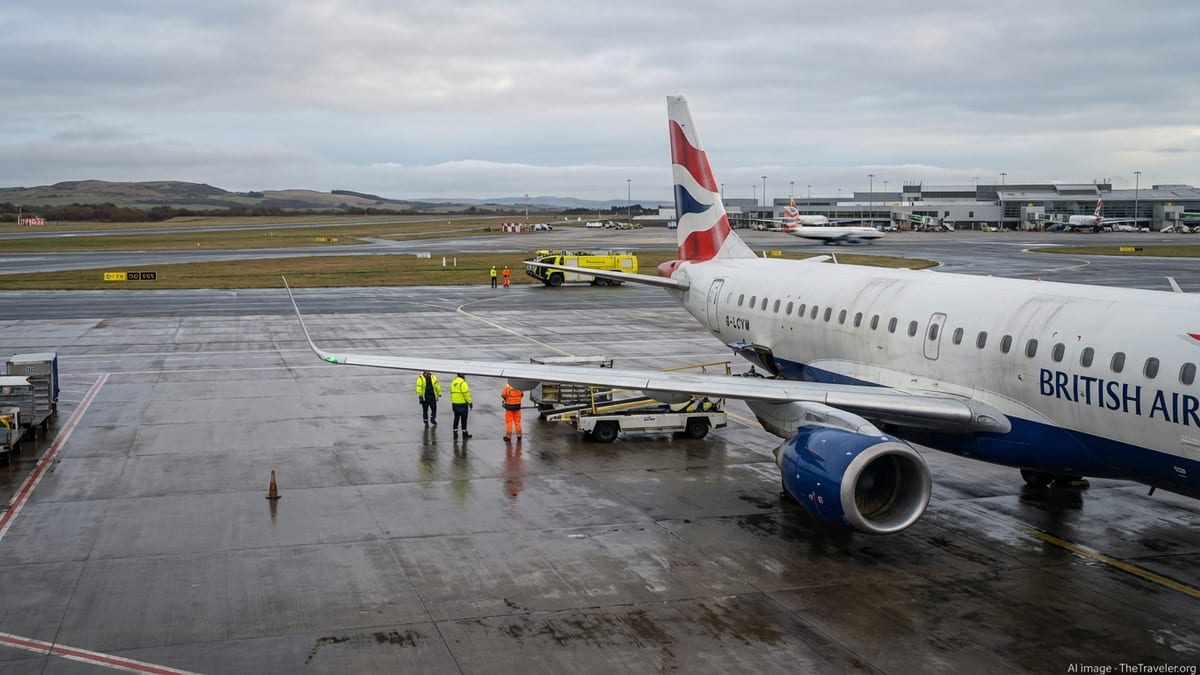
BA8704 Declares General Emergency on Final Approach
British Airways flight BA8704, operating the busy domestic route from London City Airport to Edinburgh, broadcast the internationally recognised 7700 emergency code as it approached the Scottish capital on February 27, 2026. The aircraft, operated by BA CityFlyer using an Embraer 190, had departed London shortly after 11:00 in the morning on what began as a routine service.
Tracking data shows the jet was already in its descent towards Edinburgh when the crew entered the 7700 code into the aircraft transponder, a move that immediately flags a general emergency to air traffic control. The signal was sent only minutes before the scheduled arrival, during one of the most demanding phases of any commercial flight.
Despite the in-flight alert, the aircraft continued its approach and landed safely at Edinburgh Airport, arriving several minutes ahead of its scheduled time. There were no immediate reports of injuries, visible damage or runway disruption following the touchdown.
British Airways has not yet disclosed the specific circumstances that led the cockpit crew to declare the emergency, and the event is expected to be subject to routine internal review and reporting procedures.
What the 7700 Distress Code Means for Pilots and Controllers
In commercial aviation, squawking 7700 is the standard transponder code used to indicate a general emergency. Unlike specialised codes that signify specific scenarios, such as unlawful interference or radio failure, 7700 serves as a broad alert that something onboard requires urgent attention and priority handling.
When a pilot manually selects 7700, the aircraft is highlighted on radar systems used by air traffic controllers, who immediately recognise that the flight must be given precedence over other traffic. The code does not reveal whether the issue is technical, operational or medical, but it is only used when the crew believe the situation warrants a formal emergency declaration.
Possible triggers for a 7700 alert can range from engine or system malfunctions to smoke indications, pressurisation concerns or serious medical incidents involving passengers or crew. Aviation specialists note that modern safety culture encourages pilots to err on the side of caution and declare an emergency early, rather than wait to see whether a potential problem might resolve itself.
Observers emphasise that while such alerts can cause public concern, they also demonstrate that layered safety systems are working as intended, allowing crews to quickly secure priority support when needed.
Emergency Protocols Activated at Edinburgh Airport
Once the 7700 code from BA8704 was received, standard emergency procedures were activated at Edinburgh Airport. Air traffic controllers began coordinating to ensure the flight could proceed direct to landing, with any conflicting traffic either rerouted or sequenced behind the British Airways jet to clear the approach path.
On the ground, emergency services including fire and rescue units, paramedics and airport operations staff were placed on heightened readiness near the runway. These response teams are trained to mobilise within minutes whenever an inbound aircraft declares an emergency, even if the nature of the issue remains unclear.
In many cases, such preemptive measures prove precautionary as the aircraft lands without further incident and passengers disembark normally. Nevertheless, aviation regulations require airports to prepare for worst case scenarios, particularly when an emergency is declared so close to touchdown, when speed, altitude and runway position leave limited time for additional decision making.
Following the safe arrival of BA8704, the aircraft was expected to undergo technical checks before operating any subsequent sectors, in line with standard safety and maintenance procedures.
Reassuring Safety Record on the London–Edinburgh Corridor
The London City to Edinburgh route is one of the United Kingdom’s most established domestic services, carrying business travellers and leisure passengers between the financial district of east London and Scotland’s capital. British Airways and its regional affiliate BA CityFlyer typically operate multiple rotations each week using Embraer 190 regional jets known for their short runway performance and efficiency on shorter sectors.
Data from recent operations indicates a strong on time performance record for flight BA8704, with the service frequently arriving ahead of schedule and only a small proportion of departures experiencing notable delay. Industry analysts say that events such as Friday’s emergency alert remain rare relative to the high frequency of flights operating safely along this corridor.
Aviation safety experts often highlight that the declaration of an emergency should not automatically be interpreted as a sign of imminent danger to passengers, but rather as evidence that crews are proactively using the tools available to them to manage risk. Once the immediate situation is under control, airlines typically review cockpit reports, maintenance logs and any recorded flight data to understand exactly what occurred.
It is expected that British Airways will conduct such an internal assessment of the BA8704 flight before the aircraft returns to regular rotation, and any findings that have broader relevance for operations or maintenance will be shared with regulators and internal teams.
Passengers Await Clarification as Investigation Continues
Passengers onboard BA8704 and those scheduled to travel on the same aircraft in the coming days are likely to seek further clarity on the reasons behind the emergency declaration. While many travellers are unaware of a 7700 alert until after landing, the widespread use of public flight tracking services means such events are quickly noticed and shared on social media.
In line with industry practice, British Airways is expected to provide updates once preliminary assessments are complete and more detailed information is available. Any communication will balance the need for transparency with operational and regulatory requirements, particularly if technical data or crew decision making is under review.
For now, the key outcome is that the flight landed safely and normal operations at Edinburgh Airport continued with minimal disruption. The incident nonetheless offers a visible reminder of how layers of technology, training and procedure combine to protect passengers when potential issues arise in the skies over the United Kingdom.
As more details emerge, aviation authorities and airline safety departments will examine whether the BA8704 alert yields any lessons that could further refine responses to in flight irregularities on busy domestic routes.