

More news on this day
A British Airways flight from London to Edinburgh declared a mid-air emergency minutes before landing on Friday, squawking the universal 7700 distress code and triggering an urgent response from air traffic control and emergency teams on the ground.
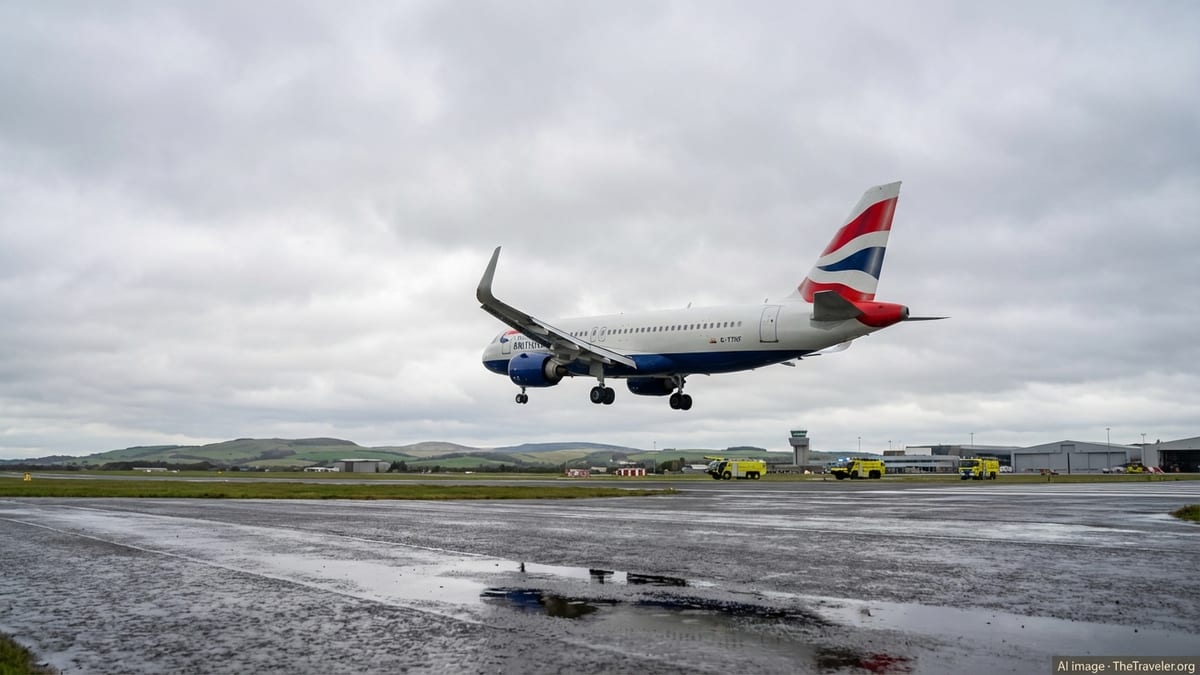
Routine Domestic Hop Turns High-Priority Incident
British Airways Flight BA8704, operating a scheduled domestic service from London to Edinburgh on February 27, was nearing the end of what appeared to be an uneventful journey when the cockpit crew entered the 7700 code into the aircraft’s transponder. The alert was issued during the final approach phase, only minutes before the aircraft was due to touch down in the Scottish capital.
The flight departed London at around 11:00 a.m. and was scheduled to arrive in Edinburgh shortly before midday. Flight tracking data shows the aircraft following its planned route for most of the journey, with no evident irregularities until the last segment of the descent, one of the most demanding stages of any commercial flight.
Passengers on board have not yet publicly reported any serious disruption in the cabin, and there have been no official indications of injuries. The aircraft was able to continue to Edinburgh, where it landed with emergency services on heightened readiness as a precaution.
What the 7700 Distress Code Signals
In international aviation, squawking 7700 is the standard transponder code used by pilots to declare a general emergency. Unlike codes that specify hijacking or loss of communications, 7700 is a broad signal that something has occurred onboard that requires immediate priority handling from air traffic controllers.
The code is manually selected by the flight crew and causes the aircraft to stand out on radar displays in control centers, alerting controllers that special attention and potentially altered procedures are required. It is routinely used in situations ranging from technical system failures to medical incidents involving passengers or crew.
As of Friday afternoon, the precise reason for BA8704’s emergency squawk had not been confirmed. Aviation sources stressed that a 7700 declaration does not automatically mean a catastrophic failure, but rather reflects a conservative safety culture in which pilots are encouraged to err on the side of caution and request assistance early.
Critical Approach Phase Under Extra Scrutiny
The fact that the 7700 signal was transmitted during the approach into Edinburgh has drawn particular attention from aviation watchers. Approach and landing are widely regarded as among the most critical phases of flight, requiring intense coordination between pilots and controllers, rapid configuration changes, and close monitoring of weather, runway conditions and surrounding traffic.
Any abnormal indication in the cockpit during this period, whether a technical warning, a performance anomaly or a sudden medical emergency, can prompt crews to escalate to an emergency declaration. Doing so ensures they receive immediate clearance changes, such as priority vectors to the runway, reduced spacing from other traffic and the option to abort the landing if circumstances deteriorate.
On Friday, air traffic controllers at Edinburgh coordinated to keep the airspace clear for BA8704’s arrival while ground crews positioned themselves to respond if the pilots requested assistance after touchdown.
Airport and Airline Emergency Protocols Activated
Once a 7700 emergency squawk is received, established procedures are activated almost automatically. At the airport level, fire and rescue services, medical teams and operations staff are placed on standby, often taking up positions along or near the active runway in case rapid intervention is needed following landing.
For the airline, an in-flight emergency declaration initiates an internal response that can include technical support from operations control, post-flight inspections and formal reporting to safety departments and regulators. Aircraft involved in such events are typically subject to detailed checks before returning to scheduled service.
British Airways has not yet released specific information about the nature of the incident affecting BA8704, but the carrier is expected to review flight data, crew reports and any maintenance findings. If the issue was technical, engineers will examine affected systems closely to identify root causes and determine whether any wider fleet actions are required.
Passenger Experience and Safety Context
For travelers on board, the declaration of an emergency can range from barely noticeable to highly unsettling, depending on the circumstances. In many cases, the most visible signs are operational rather than dramatic, such as an announcement from the crew, a faster than normal route to the runway or a visible presence of emergency vehicles after landing.
Aviation experts emphasize that the presence of fire and medical crews alongside a runway is a hallmark of precautionary planning rather than proof of a severe incident. Modern commercial aviation is built around layers of redundancy and risk management, and emergency codes like 7700 form part of that system, enabling swift, coordinated responses before a situation can escalate.
While full details of the BA8704 alert are still awaited, the safe arrival of the flight and the activation of standard emergency protocols underline how established procedures are designed to protect passengers and crew when an aircraft declares distress, particularly in the busiest and most sensitive phases of flight.