

Less than an hour south of Munich, Bad Tölz sits on a curve of the Isar River where the foothills begin to rise into the Bavarian Alps. With its baroque church towers, frescoed houses and riverside promenades, it feels a world away from the city yet is easy to reach by regional train. This guide walks you through a realistic, up to date day trip, from routes and prices to specific walks, viewpoints, cafés and seasonal tips.
Why Bad Tölz Works So Well as a Day Trip
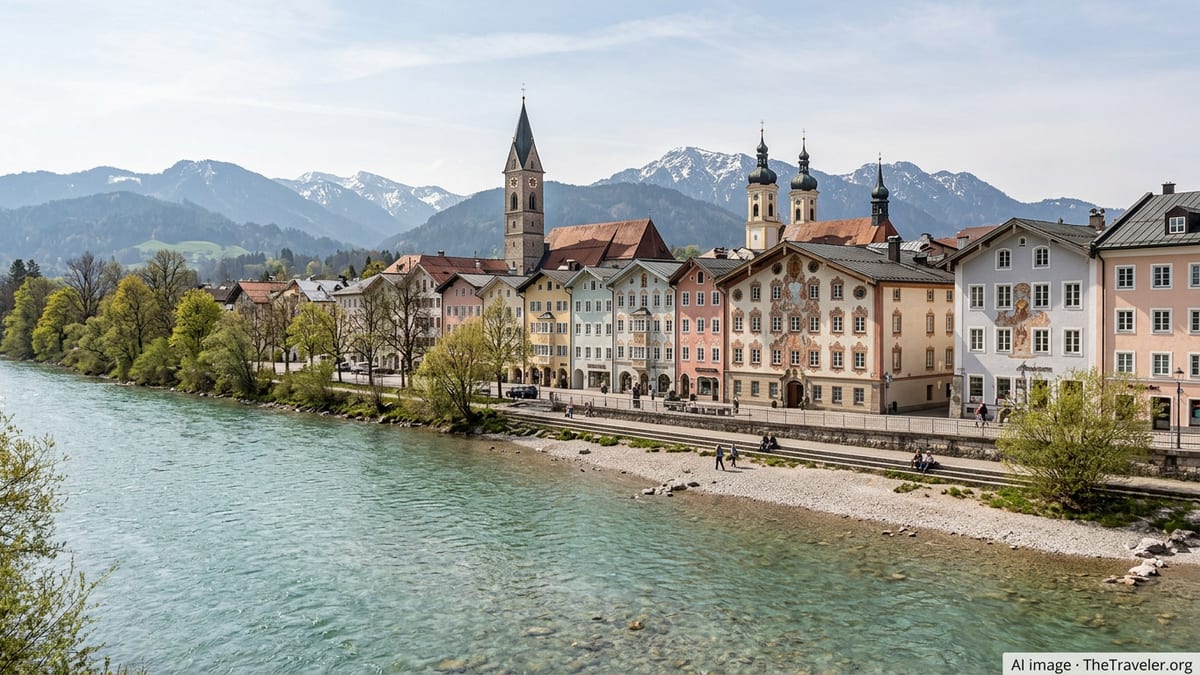
Bad Tölz is a small spa town in Upper Bavaria that combines walkable historic streets with open views toward the Alps. The Isar River bends through town in a turquoise ribbon, backed by the low ridge of the Kalvarienberg hill and, on clear days, by the jagged Karwendel mountains on the horizon. You can step off the train, stroll straight into the old town and be on the riverbank within ten minutes, which makes it ideal if you prefer exploring on foot rather than dealing with buses or long uphill walks.
Unlike some more famous Bavarian resorts, Bad Tölz is still primarily a local destination. You will see Munich day trippers, cyclists in Lycra and families heading for ice cream along Marktstrasse, but overall the pace is relaxed. There are no crowds lining up for a single blockbuster sight. Instead, the appeal lies in an ensemble of pastel facades, onion-domed churches, and the steady sound of the Isar as it runs below the town. That quieter character makes it a good choice if you find places like Garmisch-Partenkirchen a little too busy in peak season.
The town is also compact enough that you can see the historic center, walk a riverside path, climb to a panoramic viewpoint and still sit down for a long cake-and-coffee break all in one unhurried day. You do not need a car, a guide or any special equipment beyond comfortable shoes and a light jacket. For visitors based in Munich for three or four days, Bad Tölz offers a gentle counterpoint to urban museums and beer halls: more birdsong than traffic noise, more mountain air than exhaust fumes.
Because it sits on the German Alpine Road and close to other mountain valleys, Bad Tölz can also serve as a soft introduction to the Bavarian Alps. Many visitors use a first trip here to get familiar with regional train tickets, then return another day to ride the same line a bit farther to Lenggries for bigger hikes. If you are unsure about timing, language or logistics, Bad Tölz is a manageable way to see how easily day trips from Munich can work in practice.
Getting From Munich to Bad Tölz
The most straightforward way to reach Bad Tölz is by regional train from Munich Hauptbahnhof on the Bayerische Regiobahn (BRB) line toward Lenggries. Current timetables show roughly hourly trains on this route, with a typical journey time of about 55 to 60 minutes from Munich Central Station to Bad Tölz. Trains are modern, with open seating and space for bikes and strollers, and you do not need a reservation. You simply board, sit anywhere that is not marked reserved for disabled passengers, and have your ticket ready for inspection.
For tickets, visitors often weigh two options. If you already have the nationwide Deutschlandticket, which is widely used in 2026, it covers this regional line, so the trip does not cost anything beyond your existing monthly pass. If you do not, you can look at regional day tickets sold by Deutsche Bahn, such as the Bayern Ticket, or buy a point-to-point ticket. Recent sample prices from booking platforms indicate that a standard one-way fare from Munich to Bad Tölz starts around 15 to 19 euros per adult, while a Bayern Ticket for one person, valid all day on regional trains in Bavaria, typically costs a bit more but becomes good value if you travel with others or combine several journeys.
Departing Munich, aim for a morning train between about 8:00 and 10:00. That leaves you enough daylight to explore without rushing back in the evening. At Munich Hauptbahnhof, BRB services generally use the ground-level regional platforms; departure boards list them toward Lenggries and often display the green BRB branding. Board early if you want a window seat on the right-hand side; on clear days this side offers better views of the Alps as you approach Tölz. The train passes through suburban stations, then smaller towns, and gradually the landscape opens into meadows with free-standing farmhouses and chapel spires.
When you arrive at Bad Tölz station, you will find a small forecourt with taxis and a bus stop. The historic old town is not directly at the station but still within comfortable walking distance. Follow signs toward the Zentrum; it is an approximately 10 to 15 minute walk downhill along Bahnhofstrasse and then across the Isar to reach Marktstrasse, the main historic street. If you prefer not to walk, local city buses operate from in front of the station toward the center for a modest fare, usually a few euros, though many visitors simply enjoy the short stroll as part of the experience.
First Impressions: Marktstrasse and the Isar Promenade
Most travelers begin in Marktstrasse, the gently curving main street of the old town. Here you see the classic Bad Tölz postcard scene: tall townhouses painted in soft pastel shades with ornate Lüftlmalerei frescoes along their facades. These painted scenes often show saints, guild symbols or rural life and were historically a way for merchants and innkeepers to show status. If you stand near the old town hall and look uphill, you get a full perspective of rooflines and painted gables leading the eye toward the parish church tower.
Shops along Marktstrasse are a mix of traditional and practical. You may pass a Trachten outfitter selling dirndls and lederhosen, a bakery offering pretzels still warm from the oven, a stationer with Bavarian-themed postcards and a small supermarket used by locals. Prices here are generally lower than in Munich’s tourist zones. A sit-down cappuccino on Marktstrasse, for example, might cost around 3.50 to 4 euros, while a generous slice of fruit-topped sheet cake in a typical Konditorei is often in the 4 to 5 euro range. It is worth stepping into at least one café that displays a counter full of homemade tortes, both for the pastries and to watch the local rhythm of conversations.
From Marktstrasse it is only a few minutes’ walk down to the Isar. Head toward the Isarkai or cross one of the bridges to reach the riverside promenades. On the “Kurviertel” spa side of the river you will find landscaped paths, benches under large trees and broad grassy areas where locals spread blankets in summer. The water here is a characteristic milky turquoise, especially on sunny days, due to the glacial minerals carried down from the Alps. In warmer months you will see people walking dogs, families with strollers and cyclists following the Isarradweg long-distance bike route through town.
The riverside is where you begin to feel how close Bad Tölz is to the Alps even before you climb any hills. Looking upstream, forested slopes rise on either side of the river valley and, beyond them, the outlines of higher peaks are visible. In spring, the meadows near the promenade host dandelions and wildflowers. In winter, fog can linger in the valley in the morning, which makes the old town above the river look especially atmospheric when viewed from the opposite bank.
Views and Devotions: Climbing the Kalvarienberg
For the best overview of Bad Tölz and its surroundings, set aside an hour or two to walk up the Kalvarienberg, the hill that rises on the north side of town. The route starts from the Isar bank and follows a series of paths and steps through trees, passing wayside chapels that mark the Stations of the Cross. The climb is short but steep in sections; most visitors in average condition can reach the top in about 20 to 30 minutes from the old town. Wear shoes with a bit of grip, especially if it has rained, as roots and earth can be slippery.
At the summit stands a baroque ensemble that includes the Holy Cross double church and the Leonhardikapelle, dedicated to Saint Leonard. This hilltop complex dates back in parts to the early 18th century and has long been a local pilgrimage site. The chapels are surrounded by trees and grassy slopes where you can pause to catch your breath. Step outside again and walk to the open edge of the hill, and you are rewarded with a broad panorama over the Isarwinkel region: red roofs of Bad Tölz below, the bright stripe of the river, and in good weather, a chain of mountains closing the southern horizon.
Many visitors time their climb to late morning or late afternoon, when the light is softer and more flattering for photographs. From up here you can clearly distinguish the spa quarter with its larger hotels on one side of the river and the older market town on the other. If you bring binoculars, you may even pick out details such as frescoes on specific houses or the small island in the Isar created by a side arm of the river. Locals often bring a simple picnic to the slopes below the church, so do not be surprised to find people quietly reading or chatting on the grass on warm days.
The Kalvarienberg also anchors some of the town’s most important religious traditions, including the annual Leonhardifahrt in early November, when decorated horse-drawn wagons and riders in traditional dress process up the hill in honor of Saint Leonard. If your Munich stay happens to coincide with that period, expect Bad Tölz to be busier, with spectators lining the streets and temporary stalls selling snacks and hot drinks. For most of the year, though, the hill remains a peaceful place for contemplation and views, accessible for free and open at all hours.
Cafés, Bavarian Food and Where to Take a Break
Food in Bad Tölz tends toward robust Bavarian cooking, complemented by lighter options in spa-oriented cafés. Around Marktstrasse and the side alleys you will find inns serving classics like Schweinsbraten with dumplings, Käsespätzle baked with cheese and onions, and seasonal dishes such as white asparagus in late spring. Expect main courses in a typical Gasthaus to fall roughly in the 14 to 20 euro range, depending on the cut of meat or fish. Portions are usually generous, designed with hikers and cyclists in mind.
For a midday pause during your day trip, many visitors choose a café with outdoor seating on Marktstrasse or near the river. A common pattern is to order a coffee and a slice of cake or a simple open-faced sandwich and then linger for 45 minutes while watching the town go by. In the spa quarter, where some of the traditional Kurhotels are located, you will also find more health-focused menus featuring salads, grilled fish and dishes suitable for people following lighter diets. These can be appealing in summer when heavy roasts feel too much at midday.
Beer is present but not as dominant here as in Munich. You can, of course, order a half-liter of Helles from a regional brewery for around 4 to 5 euros in most restaurants and beer gardens, but you will also see many locals drinking Apfelschorle, a mix of apple juice and sparkling water that is a standard non-alcoholic refreshment in southern Germany. In cold months, Glühwein and hot chocolate appear on menus, particularly near Christmas when small seasonal markets or decorated stalls pop up in the center.
Because Bad Tölz is still more of a daytime town than a nightlife destination, restaurant kitchens may close earlier than in larger cities, particularly on weeknights outside high season. If you plan to have an early dinner before taking an evening train back to Munich, it is sensible to sit down between about 18:00 and 19:30. Reservations are rarely essential for small groups at lunchtime, but on sunny Saturdays or during local events it can help to call ahead or ask your chosen restaurant earlier in the day about availability.
Easy Walks, Spas and Family-Friendly Fun
Beyond the historic center and the Kalvarienberg, Bad Tölz offers several low-effort activities that fit neatly into a day trip. The simplest is an extended walk along the Isar promenade. You can follow the river upstream or downstream on both sides, using footbridges to create loops of one to three hours. These routes are mostly flat and well surfaced, suitable for sturdy strollers and children on small bikes. Along the way you will pass gravel banks where, in summer, people paddle or sit with their feet in the water, though the Isar’s alpine flow remains cold even on hot days, so full swimming is more for the hardy.
Bad Tölz also retains its status as a spa town, which means there are wellness facilities that welcome day visitors. The main Kurhaus complex and associated clinics focus on longer stays, but public pools and saunas in town or in the nearby region give you the chance to soak and warm up. Typical entry prices for thermal or adventure pools in Upper Bavaria are around 15 to 25 euros for a few hours, though exact figures vary by facility and by day of the week. If you plan to combine gentle walking with a spa session, packing a small towel, swimsuit and flip-flops in your day bag makes sense.
Families often add a short excursion to the Blomberg area, a low mountain just outside Bad Tölz. A chairlift runs up the slope, and in the warmer months there is a summer toboggan run, the Blomberg Blitz, which sends riders down on individual sleds fixed to a metal track. Recent price lists for similar Bavarian toboggan runs suggest that a combined chairlift up and toboggan ride down tends to fall somewhere around 15 to 20 euros per adult, with reduced prices for children, though it is wise to check the current tariff and operating hours on the day, as they can change with weather conditions. Reaching the Blomberg base typically requires a short bus ride or taxi from the center of Bad Tölz, so factor in a little extra time if you want to include it.
For those who prefer culture to adrenaline, small museums and galleries in town showcase local history and regional art. Exhibitions may focus on traditional costumes, the development of Bad Tölz as a spa or works by painters associated with the Isarwinkel. Entry fees are usually modest, often well under 10 euros, and combined tickets may be available. They provide an indoor alternative if the weather turns during your visit and are a reminder that Bad Tölz has long been more than just a pretty riverside backdrop: it has served as a trading center, a spa and an inspiration for artists over centuries.
Seasonal Atmosphere: When to Visit Bad Tölz
Bad Tölz works as a day trip in all seasons, but the character of your visit will change with the calendar. In late spring and summer, the focus is on outdoor life along the river and in the surrounding hills. Trees along the Isar are in full leaf, café terraces are open, and daylight stretches late into the evening, which means you can comfortably return to Munich on a later train. This period is ideal if you want to combine sightseeing with an easy hike or a ride on the Blomberg chairlift and toboggan run.
Autumn brings clear air and, on many days, very good visibility of the mountains from the Kalvarienberg and from open spots along the river. Forests on nearby slopes turn shades of orange and yellow, and cooler temperatures make uphill walks more comfortable. This is also the time of agricultural festivals and traditional events across rural Bavaria. Around early November, Bad Tölz hosts the Leonhardifahrt pilgrimage procession, which draws crowds and fills guesthouses; while you can still day trip from Munich, expect trains and streets in town to be noticeably busier.
Winter transforms Bad Tölz into a quieter, more introspective place. Snow may cover the Kalvarienberg and the rooftops of the old town, the Isar banks look stark and beautiful, and the early sunset creates a cozy atmosphere in inns and cafés. Before Christmas, there is often a seasonal market or at least decorated stalls and lights in the center. Day trips at this time of year require warmer clothing, proper boots and flexibility, as some attractions such as the Blomberg summer toboggan run shut or switch to winter operations. Still, a calm winter afternoon with coffee and cake after a brisk riverside walk can be as rewarding as any summer visit.
In shoulder seasons such as March or late October, weather can change quickly from sunny to rainy within a few hours. On such days, it is wise to plan both an outdoor and an indoor option, for example combining a shorter Kalvarienberg climb with time in a museum or spa. Keep an eye on rail updates as well; while the Munich to Bad Tölz regional line is not among Germany’s most heavily disrupted routes, infrastructure works elsewhere in Bavaria in 2025 and 2026 have led to occasional timetable adjustments and replacement buses. Checking your return connection on the Deutsche Bahn app shortly before heading back to the station is a simple precaution.
Practical Tips for a Smooth Day Trip
A little planning goes a long way in making your Bad Tölz day trip feel relaxed instead of rushed. Start with your train timing. Look up a morning BRB service that gets you into Bad Tölz between about 9:00 and 11:00, and identify one or two return trains in the late afternoon or early evening that would work for you. Services typically run hourly, so if you miss one, the next is not far off, but last-minute delays or busy trains on sunny weekends are easier to accept if you have a backup in mind. Remember that BRB trains do not require seat reservations and tickets on regional products like the Bayern Ticket must be validated with your name before boarding.
Footwear and clothing matter more than you might expect for a trip that is mostly in town. Comfortable walking shoes with a decent sole make the cobblestones of the old center and the paths up Kalvarienberg easier to handle. In summer, carry a light layer for the cooler breeze along the river and possible afternoon showers. In shoulder seasons and winter, bring a waterproof jacket, hat and gloves. Weather in the foothills can be a few degrees cooler than in central Munich, especially on overcast days.
Cash is less essential in 2026 than it once was, but some smaller cafés, bakeries or countryside kiosks around Bad Tölz may still prefer or even require cash for small amounts. Carrying 20 to 40 euros in notes and a few coins will help with this, while most restaurants and larger shops accept major cards. Public toilets can be found in the station area and in central locations in town; some may charge a small fee, usually around 50 cents, which is another reason to have coins handy.
Language is unlikely to be a major barrier. While Bad Tölz is not as saturated with English-speaking staff as inner-city Munich, you will find that many younger people in shops and restaurants have at least basic English. Menus in more tourist-oriented places often include English translations or at least dish descriptions that are easy to understand with the help of a phrase app. Learning a few simple German greetings such as “Grüß Gott” or “Danke” is appreciated and tends to open conversations in a friendly way.
The Takeaway
A day trip from Munich to Bad Tölz offers a realistic balance of Alpine scenery, historic architecture and everyday Bavarian life without requiring strenuous hikes or complex logistics. In under an hour by train you move from crowded city platforms to a riverside town where the loudest sounds are often church bells, rushing water and the murmur of conversations along Marktstrasse café tables. The compact layout means you can walk from the station to the old town, up to the Kalvarienberg viewpoints, along the Isar and back again within a single, unhurried day.
Bad Tölz is not about racing through a checklist of blockbuster sights. Instead, it rewards those who like to explore at a human pace: pausing to examine a fresco on a house front, watching kayakers navigate the Isar, or taking one more photograph from the hill as clouds shift over the mountains. With sensible shoes, a flexible return train in mind and a small budget for coffee, cake and perhaps a toboggan ride on the nearby Blomberg, you can create a rich and memorable excursion without leaving Bavaria’s regional train network. For travelers looking to add one quieter, more contemplative destination to a Munich itinerary, Bad Tölz is a strong candidate.
FAQ
Q1. How long does it take to get from Munich to Bad Tölz by train?
The regional BRB train from Munich Hauptbahnhof to Bad Tölz usually takes about 55 to 60 minutes each way, with services running roughly once per hour.
Q2. Do I need to book train tickets in advance for Bad Tölz?
No reservation is required on these regional trains, and many travelers simply buy a Bayern Ticket or point-to-point ticket on the day, though checking schedules in advance is sensible.
Q3. Is Bad Tölz suitable for a winter day trip?
Yes, Bad Tölz can be very atmospheric in winter, with snow on the Kalvarienberg and a cozy café scene, but you should dress warmly and expect some attractions to have reduced hours.
Q4. Can I visit Bad Tölz and still be back in Munich for dinner?
Yes, if you take a morning train from Munich and return in the late afternoon or early evening, you can comfortably be back in the city in time for dinner.
Q5. Is the walk up Kalvarienberg difficult?
The path up Kalvarienberg is short but somewhat steep in places; most reasonably fit visitors can make the climb in 20 to 30 minutes with normal walking shoes.
Q6. Are there good options for vegetarian food in Bad Tölz?
Many restaurants offer at least a few vegetarian dishes such as Käsespätzle, salads or seasonal pasta, though the overall cuisine is traditionally meat-focused.
Q7. Can I combine Bad Tölz with another town on the same day?
It is possible to travel a bit farther on the same line to places like Lenggries, but for a relaxed pace most visitors find that focusing on Bad Tölz alone fills a full day comfortably.
Q8. Is Bad Tölz child-friendly?
Yes, the riverside paths, playgrounds and nearby Blomberg toboggan run make Bad Tölz a popular outing for families, provided children are supervised near the river and on hillsides.
Q9. Will shops and cafés be open on Sundays?
On Sundays most regular shops are closed by law, but many cafés, bakeries, restaurants and some tourist-oriented businesses in Bad Tölz still open for part of the day.
Q10. How much should I budget for a day trip to Bad Tölz?
Excluding any monthly or regional pass you already have, a realistic budget for train fare, one sit-down meal, coffees and a small activity is often in the range of 50 to 80 euros per adult.