

More news on this day
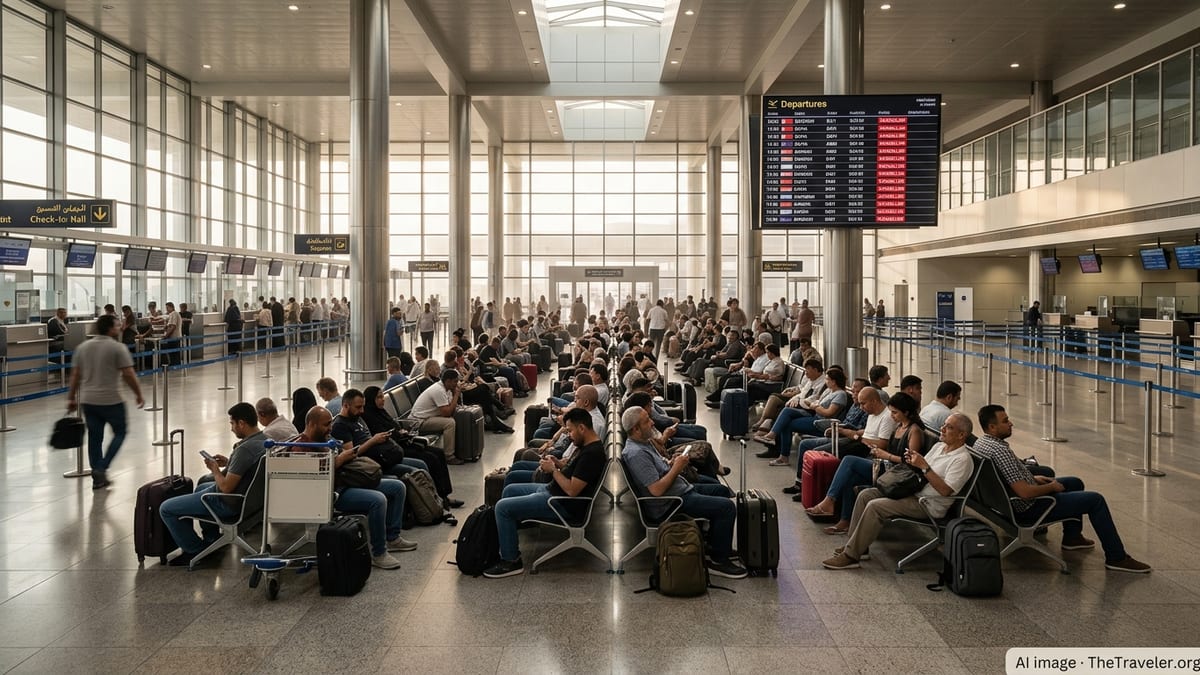
Travelers at Baghdad International Airport are facing mounting disruption as a wave of flight cancellations by several regional carriers cuts links to major hubs such as Bahrain, Doha, and Amman, leaving many passengers stranded and struggling to rebook amid wider instability across Middle East air corridors.
Get the latest news straight to your inbox!
Fresh Cancellations Hit Key Regional Routes
New cancellations affecting at least five additional services out of Baghdad International Airport have intensified disruption for travelers already grappling with unstable flight schedules. Recent updates to public flight information and aviation tracking data indicate that services operated by Gulf Air, Qatar Airways, Royal Jordanian, and other regional airlines have been pulled or suspended on short notice, particularly on routes connecting Baghdad with Bahrain, Doha, and Amman.
The suspended flights are part of a broader pattern of schedule cuts and ad hoc changes since late February, when escalating regional tensions triggered partial airspace closures and operational restrictions across several Gulf and Levant states. Airlines serving Baghdad have repeatedly adjusted timetables and routings, but the latest wave of cancellations has left larger groups of passengers isolated in the terminal, often with limited onward travel options the same day.
Reports from passengers and local media describe crowded departure halls, long queues at airline service desks, and frequent last-minute boarding gate announcements advising of delays or annulled departures. For many travelers, especially those relying on Baghdad as a gateway to long-haul connections via Bahrain, Doha, and Amman, a single cancellation has cascaded into missed onward flights and extended unplanned stays at the airport.
While some carriers have sought to consolidate demand onto remaining services or route passengers through alternate hubs, publicly available schedules suggest that replacement capacity remains thin. This has contributed to a sense of uncertainty for travelers already checked in or in transit when the latest cancellations were announced.
Regional Airspace Restrictions Undermine Connectivity
The disruption at Baghdad International Airport is closely tied to the wider instability affecting airspace across the Middle East and the Gulf. Bulletins from international aviation bodies and regional authorities highlight ongoing conflict-zone advisories covering the flight information regions of Iraq, Bahrain, Qatar, Jordan, and several neighboring states, reflecting elevated security risks and the potential for missile or drone activity.
In response, many airlines have adopted precautionary measures that include avoiding certain airspace corridors, rerouting flights around higher-risk areas, or suspending services altogether on selected routes. Publicly available coverage from global news agencies notes that multiple carriers have canceled or diverted flights to and from Gulf hubs in recent weeks, with Baghdad featuring among the affected destinations as airlines reassess the safety and commercial viability of their operations.
Baghdad’s role as a connecting point is particularly exposed when neighboring hubs come under operational pressure. Restrictions in the flight information regions serving Bahrain and Qatar, for example, can limit the number of arrivals and departures those airports can handle, which in turn reduces the slots and frequencies available for flights to and from Iraq. Similar dynamics apply to Amman, where Jordan’s airspace has also been subject to heightened caution and occasional temporary limitations on routing options.
Travel risk advisories issued by security consultancies and travel management firms underline that the situation remains fluid, recommending that travelers to or from Iraq and the wider Gulf closely monitor airline announcements and be prepared for short-notice changes. For those already at Baghdad International Airport when cancellations occur, however, such advice offers limited relief in the absence of immediate alternative flights.
Passengers Stranded as Rebooking Options Narrow
As Gulf Air, Qatar Airways, Royal Jordanian, and other carriers cut additional departures, the strain on rebooking systems has grown sharply. With multiple airlines reducing capacity on overlapping regional routes, standard workarounds such as transferring to a later service or an alternative carrier have become increasingly difficult to secure on the same day, particularly for travelers bound for Bahrain, Doha, or Amman to connect onward to Europe, North America, or Asia.
Accounts shared through public forums and regional media reports describe travelers facing long waits at customer service counters and limited clarity on when new seats might become available. Some passengers have been offered rebookings several days later or via circuitous routings that avoid the most affected airspace, while others have reported being advised to seek refunds or credit vouchers instead of immediate alternative itineraries.
The resulting bottleneck has also placed pressure on Baghdad’s airport facilities. With more travelers remaining airside for extended periods, seating, food services, and charging points are in high demand, and overnight stays inside the terminal have become more common. Families with children, elderly passengers, and those without local support networks are particularly vulnerable to the practical challenges of an unplanned, open-ended wait in the departure area.
Travel management firms monitoring the situation emphasize that, while airlines are gradually introducing some relief and repatriation flights on select routes, these services are limited in number and may be prioritized for passengers who have already experienced repeated cancellations. This has led to uneven access to scarce seats, depending on the carrier, fare type, and original date of travel.
Airlines Balance Safety, Capacity, and Commercial Pressures
For the airlines involved, the decisions to suspend or cancel flights from Baghdad to regional hubs reflect a complex balance of safety, regulatory, and commercial considerations. Publicly available statements and advisories from carriers serving the wider Gulf region point to rapidly changing risk assessments, with some routes restored temporarily only to be withdrawn again when conditions deteriorate or new advisories are issued.
Operational planning has also been complicated by the need to reposition aircraft and crew around restricted airspace. Extended routings to avoid sensitive areas can increase fuel burn and crew duty times, reducing the number of rotations each aircraft can complete in a given day. In such an environment, airlines may prioritize larger or more strategic markets, leaving secondary routes like some of those linking Baghdad to Gulf hubs more vulnerable to cuts when schedules must be trimmed.
Industry analysts note that the latest cancellations at Baghdad International Airport come on top of several weeks of broader disruption across the Middle East’s aviation network. Prior to the newest wave of suspensions, numerous carriers had already announced waivers, flexible rebooking policies, and limited relief flights to move stranded passengers out of major hubs affected by earlier airspace closures. The renewed interruption to Baghdad’s connectivity therefore represents an additional challenge for an already stressed system.
At the same time, airlines are under pressure to maintain at least a skeleton level of service where feasible, both to preserve market presence and to support essential travel. This tension between caution and continuity is likely to persist as long as regional risk levels remain elevated and airspace restrictions continue to evolve at short notice.
Uncertain Outlook for Travelers Planning Spring Journeys
The immediate priority for many passengers at Baghdad International Airport is simply to secure an onward seat, but the broader uncertainty has implications for upcoming travel plans as well. With flight timetables across the region still subject to change, travelers looking to depart Baghdad in the coming days and weeks face a moving target when assessing which routes and carriers are most likely to operate as scheduled.
Travel advisories recommend that passengers bound for Bahrain, Doha, Amman, and other nearby hubs build additional flexibility into their itineraries, including allowing more time for connections and considering the possibility of last-minute rerouting via alternative airports if conditions permit. Publicly available guidance from corporate travel managers and insurance providers also suggests reviewing ticket conditions, cancellation policies, and coverage for disruption linked to security-related airspace restrictions.
For now, the pattern of cancellations at Baghdad International Airport demonstrates how quickly regional aviation pressures can concentrate at a single hub, isolating travelers and complicating already complex journeys. Unless airspace conditions stabilize and airlines gain greater confidence in their ability to operate consistent schedules, passengers using Baghdad as a starting point or transit station may continue to face a higher risk of abrupt changes to their plans.
With the wider conflict environment still evolving, there is little indication that normal operations on all affected routes will resume immediately. Travelers heading to or from Baghdad in the near term are likely to continue relying on real-time updates from airlines and airports, and may need to prepare for a degree of disruption that remains uncommon in more stable regions but has become a defining feature of air travel across parts of the Middle East in recent weeks.