

More news on this day
Travel plans for hundreds of passengers at Baghdad International Airport were upended on March 3 as Emirates, Qatar Airways, Royal Jordanian, flydubai and other carriers scrubbed more than two dozen flights to major hubs including Dubai, Doha, Amman, Cairo, Istanbul, Bahrain, Athens and Copenhagen amid widening Middle East airspace closures.
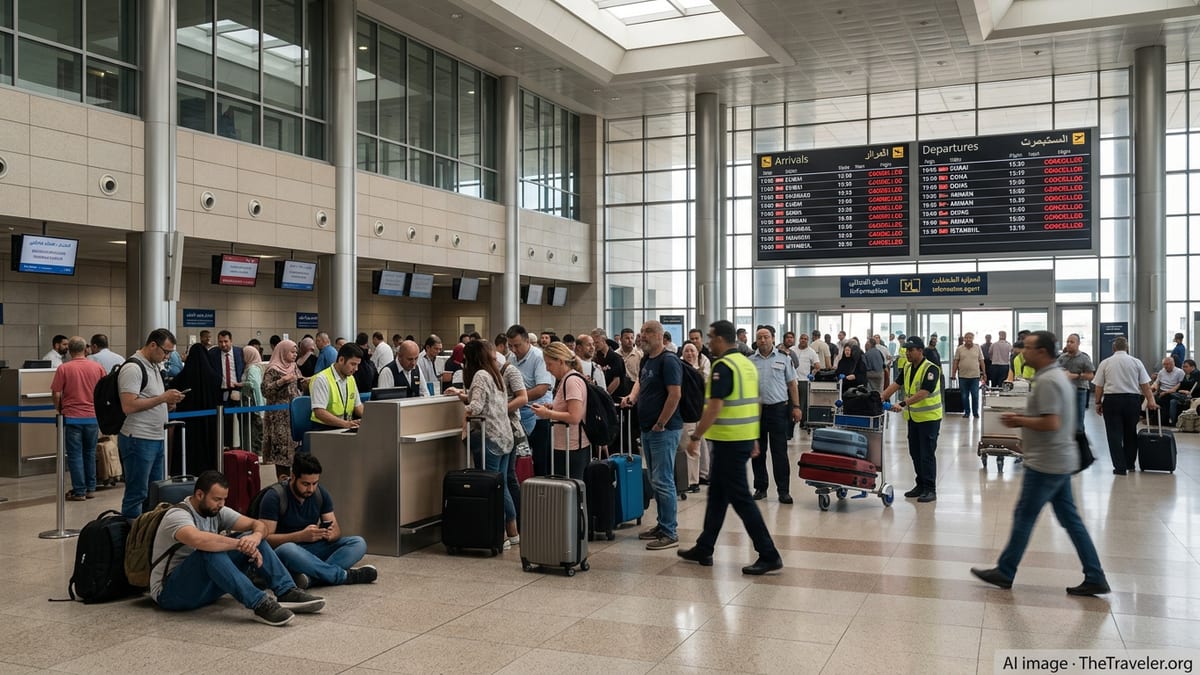
Baghdad Becomes Flashpoint in Widening Regional Aviation Shutdown
By Tuesday morning, departure boards at Baghdad International Airport showed swathes of red as outbound services to the Gulf and Europe disappeared from schedules. Airport and airline notices indicated that at least 25 flights were cancelled or indefinitely delayed, primarily on routes linking the Iraqi capital with key connection hubs such as Dubai, Doha, Amman and Istanbul, as well as onward services to Bahrain, Athens and Copenhagen.
The disruption follows sweeping airspace restrictions imposed after United States and Israeli strikes on Iran on February 28, which triggered retaliatory missile and drone attacks and prompted Iraq and several neighbouring countries to close or severely limit their skies to civil aviation. With Iraq’s airspace sitting at the heart of the busy corridor between Europe and Asia, the shutdown has immediate consequences for local travellers and for international networks that depend on Baghdad as both an origin and overflight point.
While Baghdad International Airport itself has remained physically open, airlines have been forced to ground or reroute services due to the evolving security risk and the knock-on effect of closures in surrounding states. Industry data and regional transport statements show that flights involving Iran, Iraq, Syria, Lebanon and Jordan are among the hardest hit, with many carriers extending cancellations into at least March 4 and, for some destinations, March 6.
Gulf Giants Suspend Baghdad Links as Airspace Closes
Emirates and Qatar Airways, two of the region’s largest long haul carriers, have emerged as central players in the Baghdad disruption. Both airlines have suspended much of their Middle East operation after the closure of Qatari and broader Gulf airspace, issuing rolling updates that stop short of promising firm restart dates. Their Baghdad services to Dubai and Doha, normally vital feeders for travel to Europe, North America and Asia, have been among the first casualties.
Flydubai, which operates multiple daily frequencies between Baghdad and Dubai and serves secondary Iraqi cities, has likewise halted operations as the United Arab Emirates keeps its skies largely shut and Dubai International Airport works through extensive network-wide cancellations. Gulf media and airline advisories indicate that UAE carriers have pushed their suspension window at least through March 3 while they await clearer guidance from aviation authorities on routing and risk levels.
Royal Jordanian, which relies on Baghdad to feed its Amman hub, has also trimmed or cancelled departures as Jordanian airspace faces restrictions and regional overflight options narrow. Together, these decisions have effectively severed Baghdad’s most important connecting gateways, leaving limited alternatives for passengers hoping to reach onward destinations in Europe and North America via the usual Gulf and Levantine hubs.
Ripple Effects on Routes to Europe, the Gulf and Beyond
The immediate impact for travellers in Iraq is a tangle of missed connections, long delays and uncertain rebooking options. Flights to Cairo and Istanbul, often used as alternate connection points when Gulf hubs are constrained, have also seen cancellations or significant schedule changes as Egypt and Turkey adjust routings to avoid closed airspace over Iran, Iraq and nearby states. Although Turkish airspace remains open, carriers have had to redraw flight paths, increasing flight times and complicating aircraft rotations.
Services from Baghdad to Bahrain, Athens and Copenhagen, largely operated via codeshares and one-stop itineraries through Gulf and Levant hubs, have been disrupted as well. With Gulf Air curtailing operations from Bahrain and European carriers such as Air France and Lufthansa temporarily withdrawing from several Middle Eastern destinations or avoiding regional airspace altogether, the usual network of one stop options from Iraq into Europe has been sharply reduced.
Global aviation analytics point to thousands of flights cancelled across the broader Middle East in recent days, with Qatar and Iraq posting some of the highest cancellation ratios. For Baghdad, which has worked in recent years to restore connectivity after previous rounds of conflict, the latest crisis underscores how dependent the airport has become on a handful of powerful hub airlines whose own networks are now under pressure.
Airlines Issue Rolling Updates as Passengers Scramble
One of the defining features of the current disruption is its uncertainty. Rather than setting firm restart dates, most major carriers have adopted rolling update windows, promising new guidance every 24 hours as security and regulatory assessments are refreshed. Emirates has tied its next decisions to a review scheduled around Tuesday afternoon local time, while Qatar Airways has said it will only resume operations once regulators declare Qatari airspace safe to reopen.
Other regional and international airlines, including Oman Air, Saudia, Turkish Airlines and low cost carrier Wizz Air, have announced cancellations or suspensions on routes touching Dubai, Doha, Amman and Baghdad, often through at least early March and in some cases longer. Many have waived change fees and are allowing passengers to rebook without penalty, but finding available seats on alternative routings is becoming increasingly difficult as the disruption spreads.
At Baghdad International Airport, ground staff have been advising passengers to avoid travelling to the terminal without a confirmed, operating flight and to monitor airline communication channels closely. With mobile networks and internet still functioning, carriers are relying heavily on email, text messages and app notifications to push schedule changes and rebooking options to ticket holders.
What Travellers Through Baghdad Should Expect Next
Travel industry observers warn that the situation at Baghdad International Airport is unlikely to stabilise quickly. As long as large sections of regional airspace remain closed and conflict dynamics remain unpredictable, airlines will face significant obstacles in restoring reliable schedules. Even once skies begin to reopen, carriers will need time to reposition aircraft and crews that are currently scattered across diversion points in Europe, Asia and Africa.
Passengers planning to travel from or via Baghdad over the coming days are being urged to treat all itineraries as provisional. Aviation experts say same day cancellations and last minute reroutes will remain common, particularly on flights crossing or approaching Iranian, Iraqi, Jordanian and Gulf airspace. Travellers are being encouraged to keep contact details updated with airlines, allow extra time for security and check in, and consider contingency plans if journeys are essential.
For now, Baghdad International Airport stands as a vivid example of how quickly geopolitical tensions can translate into frontline disruption for ordinary travellers. With departures to Dubai, Doha, Amman, Cairo, Istanbul, Bahrain, Athens, Copenhagen and other key cities sharply reduced, Iraq’s main gateway to the world is operating in a holding pattern, awaiting the next update from airlines and regulators alike.