

More news on this day
Baghdad International Airport has become a flashpoint in the Middle East’s spiraling aviation crisis, with Emirates, Qatar Airways, Royal Jordanian, flydubai and other major carriers cancelling more than two dozen flights to key hubs including Dubai, Doha, Amman, Cairo, Istanbul, Bahrain, Athens and Copenhagen amid widespread airspace closures linked to the US-Israel conflict with Iran.
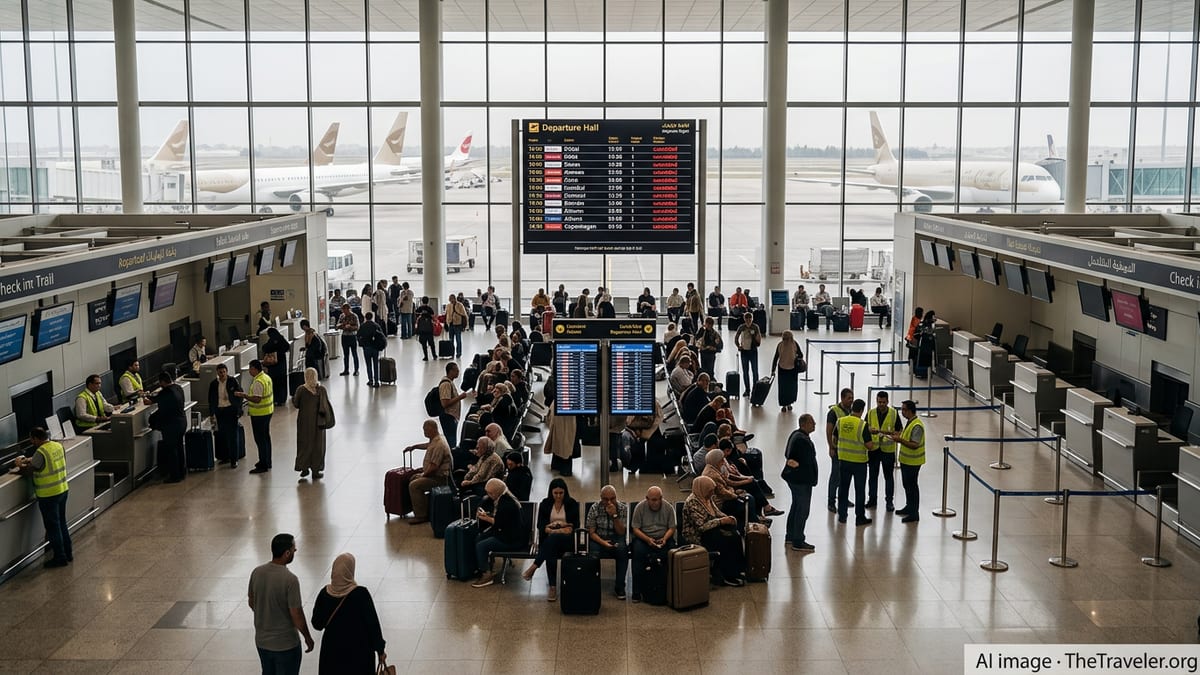
Wave of Cancellations Hits Baghdad Routes
Flight operations at Baghdad International Airport were heavily curtailed on Monday and Tuesday, as regional and international airlines moved to suspend services in response to continuing airspace restrictions across Iraq and neighboring states. Airport schedules showed more than 25 flights scrubbed over a 24-hour period, wiping out multiple daily departures to major connection points in the Gulf, Levant and Europe.
Among the hardest hit were services to Dubai and Doha, normally among Baghdad’s busiest corridors. Emirates and flydubai flights to Dubai, along with Qatar Airways departures to Doha, were listed as cancelled as carriers complied with the effective shutdown of airspace over the United Arab Emirates, Qatar and Iraq. Additional cancellations affected links to Amman on Royal Jordanian, as well as services to Cairo, Istanbul, Bahrain, Athens and Copenhagen operated by a mix of regional and alliance partners.
The disruption at Baghdad underscores how quickly the closure of multiple national airspaces has cascaded through the region’s aviation network. With Iraq itself enforcing restrictions and neighboring hubs effectively sealed off, many carriers concluded it was no longer operationally or commercially viable to maintain their usual Baghdad rotations, even on routes not directly overflying conflict zones.
Regional Airspace Closures Paralyze Key Hubs
The cancellations from Baghdad are part of a broader shutdown stretching from the Gulf to the Eastern Mediterranean. In recent days, authorities in Bahrain, Iran, Iraq, Israel, Jordan, Kuwait, Qatar, Saudi Arabia, Syria and the United Arab Emirates have all announced at least partial closures of their skies, forcing airlines to ground or reroute thousands of flights.
Data from aviation analytics firms shows that the United Arab Emirates and Qatar, home to mega-hubs Dubai International and Hamad International, have seen some of the highest cancellation rates in the region. Emirates, Qatar Airways, Etihad Airways and flydubai have all dramatically reduced operations, with hundreds of daily flights removed from schedules as air corridors over Iran, Iraq and the Gulf remain restricted or closed.
The ripple effect is particularly severe for Baghdad, which relies heavily on these hubs to connect passengers to Europe, North America, Asia and Africa. With Dubai, Doha and other Gulf gateways largely offline, point-to-point alternatives are limited, and many onward journeys from Iraq have become impractical or impossible for the time being.
Emirates, Qatar Airways, Royal Jordanian and flydubai Adjust Operations
Major Middle Eastern carriers have each issued a series of rolling schedule changes as the security situation evolves. Emirates and flydubai extended their blanket suspension of most services across the region into March 3, with priority given only to limited special or recovery flights where airspace and safety conditions allow. Their Baghdad flights to Dubai were among those cancelled, severing a key artery for Iraqi travellers heading to global destinations.
Qatar Airways, which has halted regular operations while Qatari airspace remains closed, has likewise suspended its Baghdad–Doha links. The airline has signalled that it will review conditions and provide further updates once regulators indicate it is safe to reopen. Until then, Baghdad-origin passengers who typically rely on the Doha hub for connections to Europe, the Americas and Asia remain stranded or forced to seek alternative routings through third countries.
Royal Jordanian, long a critical bridge between Iraq and the wider world via its Amman hub, has also pared back flights as Jordan maintains tight restrictions on its own skies. While some limited operations may continue, multiple Baghdad–Amman services were removed from the board, impacting connections to European cities including Athens and Copenhagen that are normally served via transit in the Jordanian capital.
Other regional players, including Turkish Airlines, Gulf Air, Saudia and low-cost operators, have similarly scaled back or cancelled Baghdad services as they navigate changing notams and corridor closures over Iraq, Iran and the Gulf. Combined, the adjustments have produced an almost patchwork network, with gaps on routes that, until last week, formed part of a dense, highly interconnected schedule.
Passengers Stranded as Airlines Prioritise Safety
The immediate human impact of the cancellations is visible in Baghdad’s terminals, where passengers bound for Dubai, Doha, Amman and beyond have been faced with last-minute disruption, long queues at airline counters and uncertainty over when normal schedules might resume. Travellers report being rebooked days later, rerouted via still-open hubs in countries such as Oman or Saudi Arabia, or advised to postpone their journeys entirely.
Airlines have stressed that passenger and crew safety remains the overriding priority. Carriers serving Baghdad are adjusting or cancelling flights in line with government directives, security assessments and insurance restrictions, all of which have tightened following the latest rounds of missile and drone activity in the region. With multiple states extending closure dates for overflights into early March, industry executives warn that disruption could persist even if tensions ease.
For many Iraq-based travellers, the current situation echoes the most severe phases of the pandemic, when international connectivity was abruptly severed and options to leave the country became scarce. Travel agents in Baghdad say demand remains strong, particularly from expatriate workers and students trying to reach Europe and North America, but available seats are limited and fares on remaining routes have risen sharply.
Uncertain Outlook for Baghdad’s Connectivity
Looking ahead, aviation analysts note that Baghdad International Airport’s recovery will depend heavily on how quickly Gulf and Levantine hubs can safely reopen their skies and restore transit flows. With Emirates, Qatar Airways, Royal Jordanian and flydubai at the core of Baghdad’s international network, any prolonged suspension risks reshaping travel patterns and pushing passengers to seek alternative gateways when they become available.
Short-term efforts are likely to focus on selective resumptions, with airlines initially operating a handful of frequencies on strategically important routes once airspace restrictions are eased. Priority may be given to flights that support government evacuation efforts, essential business travel and repatriation of stranded passengers. Only later, if security conditions stabilise, are carriers expected to rebuild the broader schedule that historically linked Baghdad to dozens of cities via Dubai, Doha, Amman, Istanbul and other hubs.
Until then, travellers with tickets to or from Baghdad are being urged to check their flight status frequently, stay in close contact with airlines or travel agents and be prepared for sudden changes, including further cancellations or lengthy diversions. For now, the city’s role in the regional aviation map remains constrained by forces well beyond the control of airlines or passengers, as the wider Middle East grapples with one of its most disruptive airspace crises in years.