

More news on this day
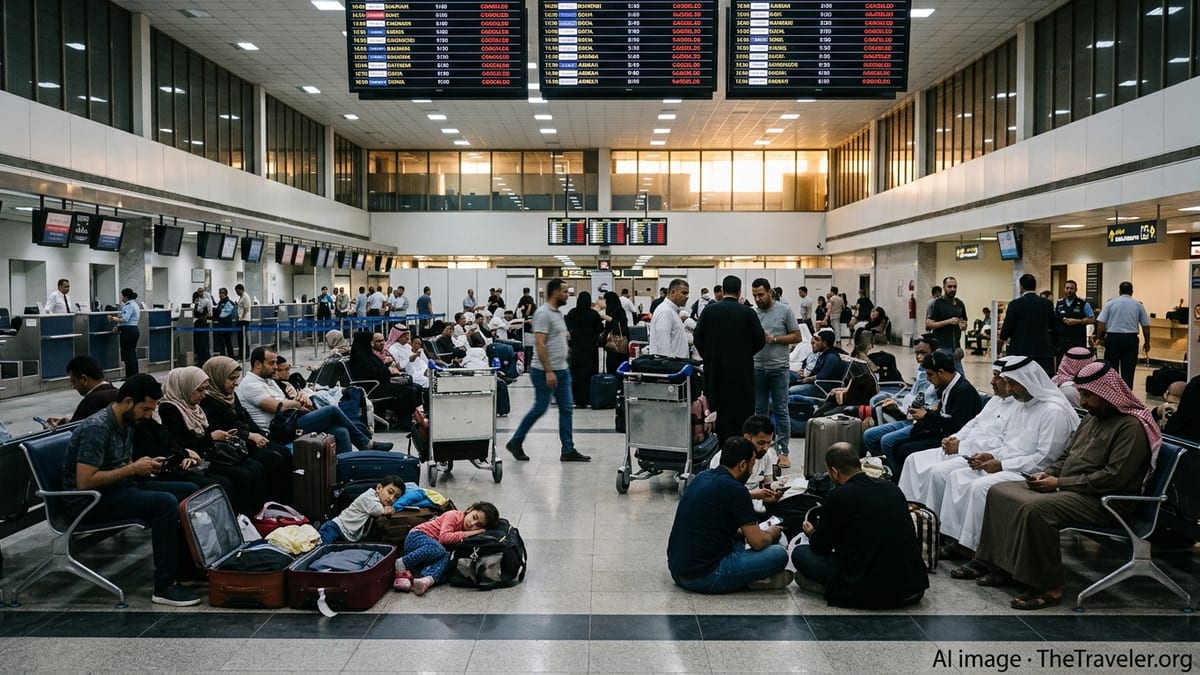
Passengers at Baghdad International Airport faced fresh disruption this week as Gulf Air, Qatar Airways, Royal Jordanian and other regional carriers canceled additional services, leaving travelers bound for Bahrain, Doha, Amman and other hubs unexpectedly stranded amid continuing instability in Middle East airspace.
Get the latest news straight to your inbox!
Fresh Cancellations Hit Key Regional Routes
Newly disrupted flights linking Baghdad with Bahrain, Doha and Amman have intensified an already volatile travel situation for passengers using Iraq’s main international gateway. Flight-monitoring data and airline advisories indicate that at least five more departures operated by Gulf-based and regional carriers were withdrawn from schedules, affecting both point-to-point travelers and those connecting onward to Europe, Asia and North America.
The latest cancellations involve services marketed or operated by Gulf Air to Bahrain, Qatar Airways to Doha and Royal Jordanian to Amman, alongside adjustments by other Middle Eastern airlines serving Baghdad. These routes normally function as vital connectors from Iraq to major global networks, meaning schedule changes can strand passengers far beyond the immediate region when last-minute disruptions occur.
Publicly available timetables for the final week of March show thinning frequencies on several Baghdad links that, under normal conditions, would see multiple daily rotations. Some services remain listed but marked as subject to operational review, adding to uncertainty for travelers holding tickets in the coming days.
Regional Security Crisis Drives Airspace Constraints
The disruption at Baghdad comes amid a broader regional crisis that has reshaped how airlines use Gulf and Levant airspace since late February 2026. Security advisories and risk assessments published in early March describe a sharp reduction in commercial overflights across several Middle Eastern corridors as carriers reroute or suspend operations in response to missile and drone activity and shifting military postures.
Port and aviation bulletins issued on 3 March highlighted widespread airspace closures or restrictions across parts of the Gulf, including Qatar and several neighboring states, forcing airlines to adjust routes or trim schedules. In parallel, travel advisories noted that services to destinations such as Bahrain, Kuwait, Qatar and Iraq were increasingly affected as carriers reassessed flight paths and crew safety policies.
Baghdad’s own proximity to sensitive facilities, including the diplomatic support center near the airport, has kept risk levels elevated. Incident reporting from 10 March referenced drone activity in the vicinity of the broader airport complex, reinforcing airlines’ cautious approach to planning, even in the absence of sustained damage to civilian infrastructure.
Passengers Face Long Waits, Rebookings and Detours
For travelers on the ground in Baghdad, the immediate impact of the newest cancellations is measured in missed connections, overnight stays and complex rebooking efforts. Social media posts and traveler forums describe instances of passengers who arrived at the airport expecting to board flights to Bahrain, Doha or Amman, only to learn at check-in that services had been withdrawn or rerouted at short notice.
Many affected passengers rely on Gulf hubs for onward long-haul journeys to Europe, North America and Asia. With Gulf Air’s Bahrain operations heavily curtailed and Qatar Airways still operating only a limited schedule from Doha after weeks of disruption, alternative routings have become harder to secure, particularly for those traveling on tightly constrained visas or with fixed return dates.
Reports indicate that some travelers have been offered rebooking via alternative regional airports where capacity remains available, sometimes involving longer ground transfers or overnight connections. Others are opting to purchase entirely new tickets with carriers that still maintain relatively stable links to Iraq, in the hope of securing more predictable itineraries.
Airlines Juggle Safety, Capacity and Communication
Airlines serving Baghdad and the wider region are attempting to balance operational safety with the need to maintain essential connectivity. Statements and advisories from Gulf carriers in recent weeks have emphasized that route suspensions are driven by ongoing security assessments and regulatory guidance, particularly where national aviation authorities have imposed temporary airspace closures or altitude restrictions.
Qatar Airways has continued to publish rolling updates on a restricted network after Qatar’s airspace closure in late February led to a near-total halt in its regular commercial schedule. Limited repatriation and evacuation-style flights have operated on selected days from Doha to major European hubs, but services across the broader network, including links to Iraq, remain subject to late changes as conditions evolve.
Royal Jordanian, based in Amman, has also adjusted operations in line with Jordan’s partial overnight airspace closure announced in early March. Travel advisories note that flights to several regional destinations, including Iraq and Gulf states, have been suspended or reduced at times, leading the airline to urge passengers to monitor schedules closely and to allow extra time for potential rebookings.
Outlook for Travelers Using Baghdad as a Gateway
With regional tensions still elevated and airspace restrictions changing on short notice, the near-term outlook for travelers planning to route through Baghdad International Airport remains uncertain. Industry risk analyses published in mid-March suggest that carriers are likely to retain a conservative posture into early April, keeping schedules flexible and limiting exposure on routes that depend on contested or congested corridors.
For passengers, this means that itineraries involving transits through Bahrain, Doha or Amman may continue to face disruption even if tickets appear confirmed at the time of purchase. Travel planners increasingly recommend building in longer connection windows, considering alternative hubs outside the Gulf where possible, and remaining prepared for last-minute changes to departure times or routings.
Public guidance from aviation and security consultancies stresses the importance of checking flight status frequently on the day of travel and maintaining direct contact through airline digital channels for rebooking support. As Baghdad’s travelers wait for a more stable operating environment, the latest wave of cancellations underscores how quickly regional crises can cascade through global air networks, leaving passengers far from home in limbo on the airport concourse.