

More news on this day
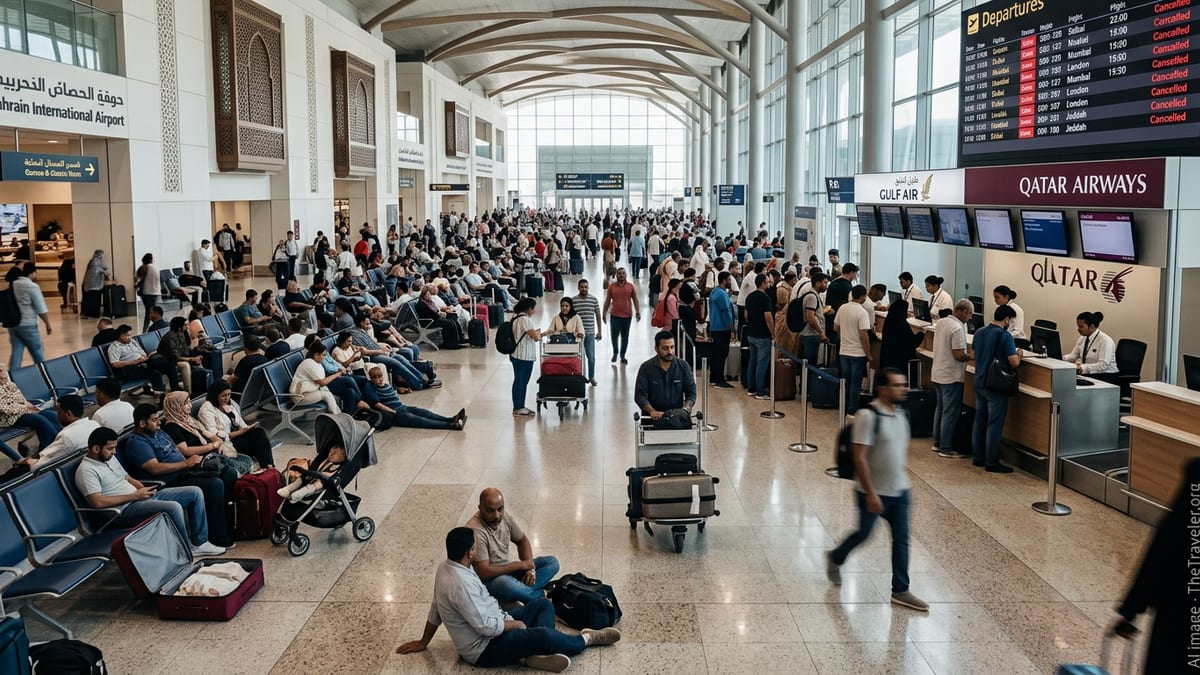
Hundreds of passengers were left stranded in and around Bahrain on Sunday as a fresh wave of flight cancellations rippled across the Gulf, with at least 123 services scrubbed by Gulf Air, Pegasus Airlines, IndiGo, Qatar Airways, Flydubai, Oman Air and other carriers, disrupting links to Dubai, Mumbai, London, Jeddah and a string of onward destinations.
Regional Airspace Closures Snarl Bahrain Operations
The latest disruption stems from ongoing closures and tight restrictions in key Middle Eastern airspaces, which have forced airlines to reroute, delay or cancel flights at short notice. Bahrain, Qatar, Kuwait and several neighboring states have imposed severe limits on civilian overflights in recent days as military tensions remain elevated across the region.
With Bahrain International Airport operating on a sharply reduced schedule, carriers reported that a significant share of their planned arrivals and departures could not be operated safely within the restricted corridors. Schedules that were already thinned by earlier days of cancellations were further pared back, pushing the cumulative impact on passengers into the thousands.
Aviation officials in the region have framed the measures as a necessary response to a fluid security environment, noting that complex re-routing around closed airspace would, in many cases, require fuel stops or flight plans that are impractical for short-haul services. As a result, complete cancellations are often chosen over lengthy diversions.
For travelers, the effect has been immediate and visible. Terminal departure boards at Bahrain and nearby hubs showed long blocks of red “cancelled” notices through Sunday, while check-in zones for operating flights were crowded with anxious passengers hoping to secure scarce seats out of the region.
Gulf Air, Qatar Airways And Regional Carriers Cut Schedules
Flag carrier Gulf Air has been among the hardest hit, with multiple flights to and from Bahrain, Dubai and other Gulf points scrubbed as the airline works around the closure of its home airspace and the tight capacity of alternative routings. The carrier has been operating limited rescue and repositioning services using aircraft based outside Bahrain, but these have not been sufficient to clear the mounting backlog of customers.
Qatar Airways, which also relies heavily on now-restricted corridors, has focused on a pattern of limited relief flights through approved safe corridors. Airline statements in recent days have emphasized that priority is being given to travelers whose original flights were cancelled, particularly families, elderly passengers and those with urgent medical or compassionate needs. However, those efforts have not eliminated scenes of long queues and crowded transfer areas at partner airports.
Low-cost operators Pegasus Airlines and IndiGo, which feed large numbers of passengers between South Asia, the Gulf and Europe, have likewise trimmed their schedules involving Bahrain and other Gulf gateways. Their cancellations have had a knock-on impact on connecting itineraries to cities such as Mumbai and London, where passengers have found themselves stranded midway through multi-leg journeys.
Flydubai and Oman Air have meanwhile cancelled swathes of flights linking Dubai, Muscat, Bahrain, Doha and secondary Gulf cities, often in multi-day blocks. Passengers with bookings over the next week have been urged to check for updates frequently, as airlines warn that additional cancellations remain possible with little notice if airspace restrictions tighten further.
Passengers Stranded Across Dubai, Mumbai, London And Jeddah
Although Bahrain International Airport has become a focal point of the disruption, the impact has cascaded along major long-haul corridors. In Dubai, one of the world’s busiest transit hubs, travelers connecting from Europe and North America to Bahrain and other Gulf cities reported missed onward connections and last-minute hotel vouchers as airlines struggled to rebook them.
In Mumbai, passengers on IndiGo and Gulf Air services to Bahrain and beyond described spending hours in check-in queues only to be told their flights had been cancelled or indefinitely delayed. With alternative routings also constrained by regional closures, many were offered departures several days later or refunds instead of near-term rebookings.
London-bound and London-originating travelers have also been affected, particularly those booked via Bahrain and Doha on Gulf Air, Qatar Airways and partner airlines. Some reached Bahrain only to find onward Gulf flights cancelled, leaving them in transit hotels while carriers sought spare capacity on remaining services operating through Saudi Arabian or Turkish gateways.
In Jeddah, where Saudi Arabia has become an important staging point for re-routed traffic, airport officials have reported unusually high volumes of transfer passengers. Many of them were originally ticketed through Bahrain or Doha and are now being redirected through Saudi gateways as airlines assemble patchwork routings around the still-closed airspace.
Airlines Prioritise Repatriation And Backlog Clearance
In response to mounting criticism from stranded travelers, multiple Gulf-based airlines have shifted their focus from regular commercial schedules to what they describe as repatriation and backlog-clearance flights. These services, often operating outside normal timings, are designed to move passengers who have already had one or more cancellations.
Gulf Air has indicated that it is working with regional authorities to secure corridors that allow it to bring home passengers stuck abroad, even as its regular timetable into and out of Bahrain remains largely suspended. Qatar Airways, for its part, has rolled out a series of limited services from European and Asian cities back to Doha, using aircraft that were positioned outside Qatar when the closures began.
Other carriers, including Pegasus Airlines, IndiGo, Flydubai and Oman Air, are leaning on regional partnerships to place disrupted customers on remaining services operated by allied airlines where seats are available. However, with capacity tight and demand high, these options are being allocated cautiously, and many travelers are being advised to accept full refunds if their trips are not essential.
Airline contact centers and digital channels remained under heavy strain through Sunday, with many customers reporting difficulty accessing booking systems or reaching agents. Industry analysts note that even if all airspace were reopened immediately, it would still take days of flying at or above normal capacity to clear the backlog of displaced passengers.
Uncertain Outlook For Travellers Planning Gulf Journeys
For travelers with upcoming itineraries through Bahrain, Dubai, Doha and other Gulf hubs, the situation remains fluid. Aviation officials have not provided firm timelines for a full reopening of all affected corridors, and airlines are generally loading only partial or provisional schedules into their systems for the coming week.
Travel agents across the region are advising customers to avoid tight connections through Bahrain and Doha, to build in longer layovers, and to be flexible about routing through alternative gateways such as Riyadh, Jeddah or Istanbul where possible. They also warn that day-of-travel cancellations are likely to continue as carriers adjust operations to security assessments made in real time.
Passengers already stranded in Bahrain and surrounding hubs have been urged to remain in close contact with their airlines through official websites and customer apps and to confirm flight status before heading to the airport. Many carriers are offering complimentary date changes and, in some cases, hotel accommodation and meal vouchers, though policies vary widely between airlines and ticket types.
With no clear end in sight to the airspace restrictions, travelers across the Gulf are bracing for further days of uncertainty. For now, the immediate priority for airlines at Bahrain International Airport and nearby hubs is simply to keep limited operations running, move stranded customers where possible and prevent today’s 123 cancellations from cascading into an even larger disruption in the week ahead.