

More news on this day
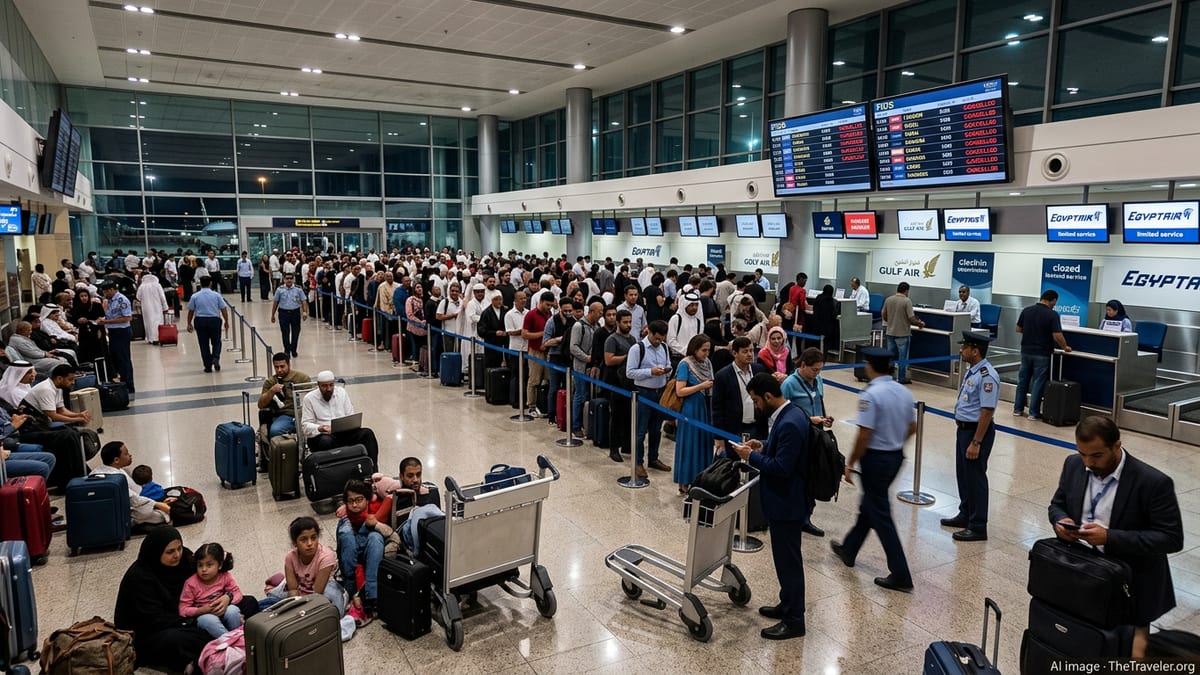
Bahrain International Airport is facing severe disruption after a sudden airspace closure linked to the wider 2026 Iran conflict, with around 140 flights reportedly cancelled and services by Gulf Air and EgyptAir to major cities including London, Dubai and Cairo heavily affected.
Get the latest news straight to your inbox!
Airspace Closure Triggers Wave of Cancellations
Publicly available operational notices and regional aviation briefings indicate that Bahrain closed its airspace at the end of February 2026 as security risks escalated across the Gulf. Flight operations at Bahrain International Airport were temporarily halted, leaving airlines scrambling to divert, suspend or consolidate services. Regional analysis suggests that Bahrain’s move formed part of a broader pattern of airspace closures across several Middle East and North Africa countries following intensified hostilities involving Iran.
Within days, schedules at Bahrain International Airport had been stripped back sharply. Industry reports and live flight-tracking snapshots point to roughly 140 cancelled or suspended movements over the first phase of the disruption, affecting both inbound and outbound services. While some carriers were able to reroute via alternative hubs in Saudi Arabia and elsewhere, Bahrain’s status as a transfer point for Gulf Air and partner airlines meant that even passengers not originally bound for the kingdom experienced disruption.
The volume of cancellations placed significant pressure on airline call centres and digital channels, as travellers sought clarification on their rights to refunds, rebooking and accommodation. Travel forums and social media posts from affected passengers describe repeated cancellations and last-minute schedule changes, with some travelers attempting to exit the region via alternative hubs such as Dubai, Doha or Riyadh.
Gulf Air Operations Severely Curtailed
Gulf Air, Bahrain’s national carrier, has been among the most heavily affected airlines. Passenger advisories and independent travel guidance note that the airline sharply reduced its scheduled operations after the Bahrain airspace closure, with many flights cancelled outright and others repositioned to neighbouring airports. In some cases, Gulf Air aircraft have been relocated to hubs in Saudi Arabia to allow limited onward connectivity while Bahrain’s main gateway remains constrained.
Key long-haul and regional routes operated by Gulf Air, including services linking Bahrain with London and Dubai, have seen widespread cancellations or temporary suspension. Travellers who had planned to transit via Bahrain on multi-sector itineraries report being forced to rebook on other carriers or re-route through different hubs, often at short notice and sometimes at higher cost. In a number of cases, passengers shared accounts of multiple sequential cancellations, undermining confidence that flights still listed in schedules would actually depart.
Advisories circulated by travel consultancies and corporate risk teams strongly encourage Gulf Air customers to check flight status right up to departure time and to consider flexible options, such as open tickets or alternative routings, where possible. For many, the most reliable path out of the region has involved booking away from Bahrain entirely, using more stable hubs in the United Arab Emirates, Turkey or Europe.
EgyptAir Cuts Regional Links Including Cairo
EgyptAir has also moved to trim its network in response to the evolving security and airspace picture. According to recent corporate travel alerts, the Egyptian flag carrier has suspended flights to a cluster of Middle Eastern cities as a precaution, despite Egyptian airspace itself remaining open. Bahrain is among the destinations affected, resulting in the effective shutdown of direct links between Bahrain and Cairo for the duration of the current restrictions.
The loss of EgyptAir services has immediate consequences for both point-to-point travelers and those using Cairo as a connection point to Africa, Europe and North America. Holidaymakers, business travelers and expatriate workers who had planned to travel between Bahrain and Cairo now face a complex patchwork of alternatives, often involving indirect routings via Saudi Arabia, the United Arab Emirates or other regional hubs.
In practical terms, the suspension of EgyptAir’s Bahrain flights further reduces options for passengers already affected by Gulf Air’s own cutbacks. Reports from travel agents and corporate mobility teams suggest that itineraries are being rewritten around remaining operational routes, with some travelers opting to travel overland to Saudi airports to access more stable long-haul networks.
London, Dubai and Cairo Among Hardest-Hit Destinations
Key global and regional destinations, particularly London, Dubai and Cairo, have emerged as focal points of the Bahrain disruption. London services operated by Gulf Air from Bahrain have faced repeated cancellations, affecting not only UK-bound passengers but also those connecting onward to North America and Europe. With limited capacity and higher demand on alternative routes, seats on other carriers have been at a premium.
Dubai, itself coping with intermittent disruption and a reduced schedule in the wake of regional airspace closures, has also seen ripple effects from Bahrain’s shutdown. Passengers who would typically route via Bahrain to reach Dubai have been forced onto a smaller number of direct or repatriation-style flights into the United Arab Emirates. Publicly available updates from Dubai’s airports reference a mix of delays, cancellations and schedule consolidation as airlines respond to both local constraints and wider regional instability.
Cairo’s connectivity to Bahrain has been constrained by EgyptAir’s suspension of selected regional routes and Gulf Air’s limited operations. For travelers attempting to move between the Gulf and North Africa, the combination of cancelled Bahrain–Cairo flights and restricted capacity elsewhere has significantly complicated routing. Some have reported resorting to multi-leg journeys via multiple third countries in order to complete what would normally be a straightforward nonstop or one-stop itinerary.
Passengers Face Uncertainty as Situation Remains Fluid
For travelers caught in the middle of the disruption at Bahrain International Airport, the most consistent factor has been uncertainty. With airspace closures directly tied to fast-moving geopolitical developments, schedules and advisories have continued to evolve day by day. Traveller accounts highlight the importance of monitoring airline apps, airport announcements and travel advisories closely, rather than relying solely on original booking confirmations.
Corporate mobility teams and travel-management firms are advising clients with imminent departures involving Bahrain to consider rerouting in advance, particularly where travel is non-essential or alternative hubs are readily available. In many cases, passengers have been able to secure refunds or credit vouchers for cancelled flights, although processing times vary and some travellers report long waits to reach airline customer-service teams.
While there have been isolated signs of limited operations resuming via alternative regional airports, there is no clear public indication of when normal flight patterns through Bahrain International Airport will return. Until airspace conditions stabilize and airlines can confidently restore their schedules, travelers planning to fly to or through Bahrain, London, Dubai or Cairo are likely to face continued disruption, constrained availability and the need for considerable flexibility.