

More news on this day
Thousands of travelers were left stranded at Bahrain International Airport on March 7 as a fresh wave of flight cancellations swept across the Gulf, with 94 services scrapped and knock-on disruption felt at major hubs in Dubai, Cairo, Riyadh, Muscat, Kuwait City and beyond amid an escalating regional security crisis.
Flight Cancellations Mount as Regional Airspace Stays Fragile
Operations at Bahrain International Airport were severely curtailed after authorities confirmed that scores of outbound and inbound flights had been cancelled or classified as no-fly, following days of intermittent airspace closures across the Gulf. Airport data and aviation analytics pointed to Bahrain among the hardest-hit hubs, with cancellation rates spiking and only a small fraction of scheduled movements operating on time.
Gulf Air, Bahrain’s flag carrier, was forced to ground multiple regional rotations, while Qatar Airways, FlyDubai, Oman Air and IndiGo all confirmed Bahrain-related disruptions as they reworked Middle East networks around restricted corridors. Many of the scrapped services were short-haul links that normally funnel passengers onward through Dubai, Doha, Muscat and Riyadh, magnifying the impact far beyond Bahrain’s compact terminal.
Aviation trackers reported that the latest 94 cancellations at Bahrain formed part of a wider regional tally in which more than a thousand flights were grounded on Saturday across Hamad International in Doha, Dubai International, King Khalid International in Riyadh, Cairo International, Kuwait International and other Gulf and Levant gateways. While some carriers have cautiously resumed limited operations, planners warned that schedules remain highly volatile and subject to last-minute changes.
For passengers already en route, the abrupt cancellations translated into missed connections and unexpected stopovers. Many who had been routed via Bahrain to destinations in Europe, South Asia and Africa found themselves unable to secure new bookings before midweek at the earliest, as airlines prioritized evacuation-style relief flights over regular commercial services.
Travelers Face Long Delays, Scarce Information and Packed Terminals
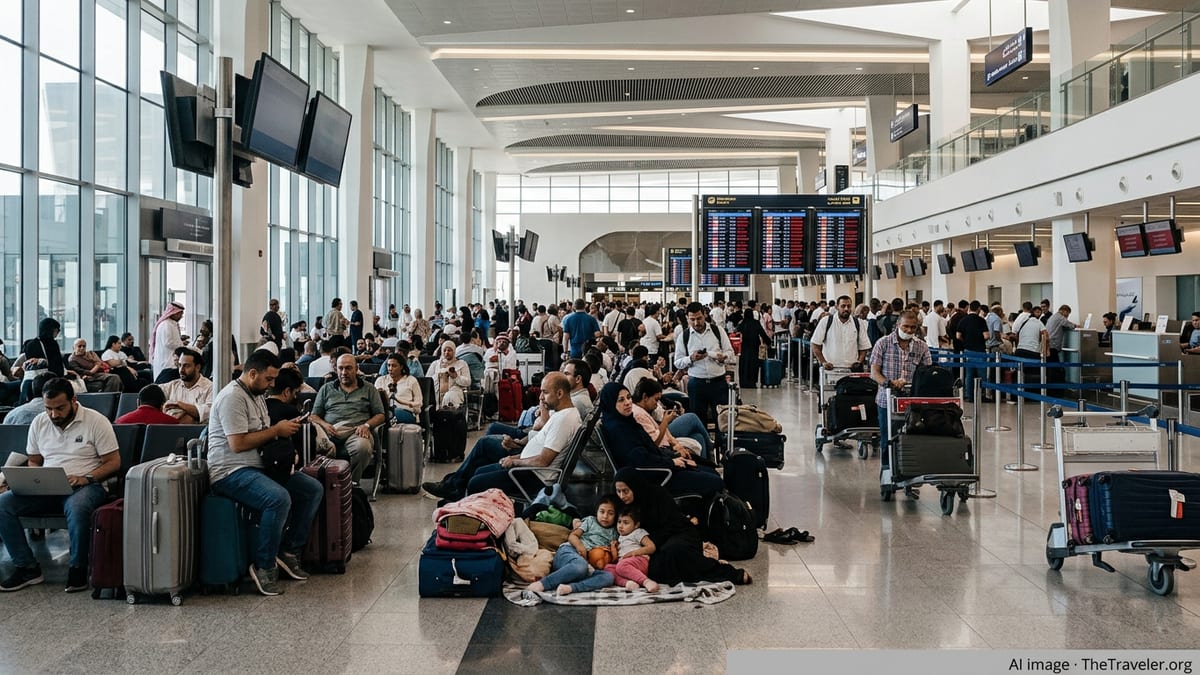
Inside Bahrain International Airport, scenes of frustration unfolded as departure boards filled with red-coded cancellations and delays. Families on overnight connections spread out on terminal floors, business travelers queued at airline desks seeking rebooking options, and airport seating areas quickly overflowed as more passengers arrived from already-delayed feeder flights.
Several travelers described struggling to obtain up-to-date information, with airline hotlines overwhelmed and mobile apps updating more slowly than social media channels. Ground staff from Gulf Air and other affected carriers attempted to triage the backlog, issuing meal vouchers and hotel arrangements where possible, but capacity in nearby accommodation was stretched by days of prior disruption.
Those holding tickets on Qatar Airways, FlyDubai and Oman Air reported particular uncertainty when their Bahrain legs were cancelled while long-haul sectors to Europe or Asia still appeared as active in booking systems. In many cases, carriers urged passengers not to travel to the airport unless they had been proactively rebooked, creating confusion for travelers who had already cleared earlier segments of complex itineraries.
IndiGo customers transiting from India to Gulf destinations also faced an anxious wait. The airline had previously outlined flexible change and cancellation policies for Middle East routes, but at Bahrain the sheer volume of impacted passengers meant long lines at service counters as travelers weighed whether to seek refunds, reroute through alternative hubs or wait out the disruption.
Ripple Effects Hit Dubai, Cairo, Riyadh, Muscat and Kuwait City
The Bahrain cancellations fed into a much larger web of disruption stretching across the Middle East’s most important aviation crossroads. At Dubai International, one of the world’s busiest international airports, airlines were still working to restore capacity after days of near-standstill operations, with regional feeders from Bahrain among the last to be reliably reinstated.
In Riyadh and Kuwait City, cancellations of Bahrain-bound flights left aircraft out of position and crew rosters in disarray, prompting additional cuts on routes that were otherwise cleared to operate. Cairo International reported a spike in delays as rerouted aircraft from the Gulf arrived outside normal banks, complicating turnarounds and onward connections to Africa and Europe.
Muscat, a key diversion airport during the initial airspace closures, bore a heavy share of the knock-on effects. Oman Air scrapped a series of rotations linking Muscat with Bahrain, Dubai, Doha and Kuwait over the coming days, warning passengers that further adjustments were likely as regional authorities updated overflight permissions and safety assessments.
Analysts noted that even as some airspace corridors reopened on a limited basis, the highly interconnected nature of Gulf aviation meant that a cluster of 94 cancellations in Bahrain could reverberate across the network for several days. Aircraft and crew that would normally touch multiple hubs in a 24-hour window remained out of position, while airlines juggled the competing demands of stranded passengers, cargo commitments and operational safety.
Airlines Offer Waivers and Relief Flights but Warn of Ongoing Volatility
In public statements, Gulf Air, Qatar Airways, FlyDubai, Oman Air and IndiGo all apologized for the disruption and emphasized that safety considerations dictated the decision to suspend or reroute flights touching Bahrain and neighboring states. Several carriers highlighted coordination with national regulators and air navigation authorities as they assessed the security situation and potential routing alternatives.
Qatar Airways and other major Gulf carriers have begun operating limited relief flights aimed at clearing stranded passengers from regional hubs to key long-haul destinations in Europe and Asia. Seats on these services are being prioritized for travelers whose original itineraries were cancelled earlier in the week, leaving many of Saturday’s Bahrain-stranded passengers facing an uncertain wait for placement.
IndiGo, along with a number of Indian and European airlines serving the Gulf, has extended travel waivers allowing customers booked to or through Bahrain, Dubai, Doha, Muscat, Riyadh and Kuwait City to change dates or cancel without penalty for travel over the coming weeks. FlyDubai and Oman Air have issued similar notices, urging passengers to manage bookings through official digital channels rather than crowding already congested airport counters.
Despite these measures, airline executives cautioned that schedules will likely remain unstable as long as regional airspace restrictions and security alerts persist. With planners forced to rebuild networks day by day, even travelers whose flights currently appear confirmed were advised to check status repeatedly in the hours before departure and to be prepared for last-minute timetable adjustments.
What Stranded Passengers Can Expect in the Coming Days
Industry experts say the key question for travelers stuck in Bahrain and other Gulf hubs is how quickly airlines can restore predictable patterns of traffic while maintaining safety margins. If airspace corridors continue to reopen and remain stable, carriers are expected to progressively shift from emergency relief flying back to regular schedules, gradually reducing the backlog of stranded passengers.
At Bahrain International Airport, authorities signaled that they are working closely with airlines to prioritize vulnerable travelers, including families with young children, medical cases and those whose transit visas or onward connections are at immediate risk of expiring. However, officials also warned that re-accommodating everyone affected by the 94 cancellations will take time, particularly on high-demand routes into South Asia and Europe.
Travel advisers recommend that stranded passengers maintain direct contact with their airlines via official apps and call centers, keep digital copies of all travel documents and receipts, and avoid making nonrefundable onward arrangements until a confirmed replacement itinerary is in place. Given the fluid situation, some may find it faster to accept rerouting through secondary hubs rather than waiting for their original Bahrain connections to resume.
For now, Bahrain’s experience encapsulates the broader reality facing travelers across the Middle East: even as runways and terminals remain open, a fragile and fast-changing security environment is dictating what can actually take off. Until regional skies fully stabilize, airports from Dubai and Cairo to Riyadh, Muscat and Kuwait City are likely to see further waves of cancellations, delays and weary passengers trying to find a way home.