

More news on this day
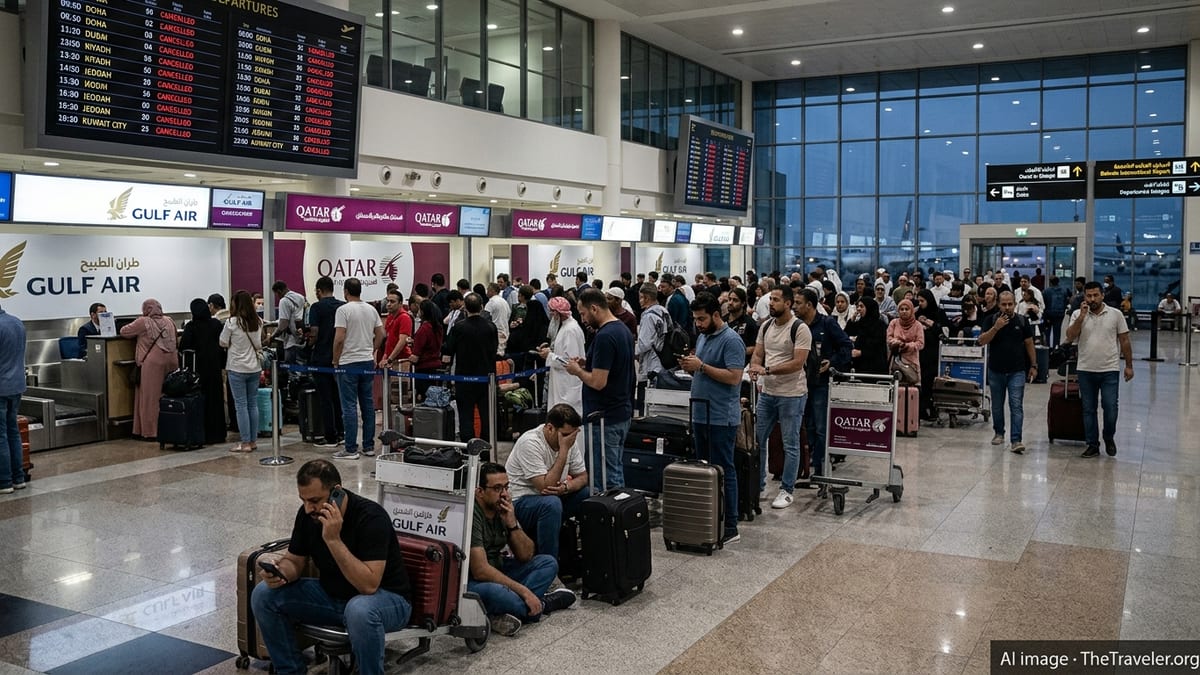
Travel across the Gulf region has been thrown into fresh turmoil as Bahrain International Airport experiences a wave of disruption, with Gulf Air and Qatar Airways linked to at least 94 flight cancellations that have rippled through major hubs in Doha, Dubai, Riyadh, Jeddah, Kuwait City and beyond.
Get the latest news straight to your inbox!
Regional Tensions Trigger New Wave of Cancellations
Published coverage and airline updates indicate that Bahrain International Airport has become a focal point of a wider Gulf aviation crisis following recent security tensions and airspace restrictions. Bahrain’s national carrier Gulf Air and Doha-based Qatar Airways have each scaled back operations, resulting in dozens of cancellations on key trunk routes that connect the region to Europe, Asia and North America.
Information circulating through airline advisories and passenger communications suggests that commercial traffic through parts of Bahraini and Qatari airspace remains curtailed or heavily constrained. While some limited evacuation and rerouted services are operating, regular scheduled flights have been repeatedly pulled from timetables, with short-notice changes adding to the uncertainty for travelers.
The current disruption follows a series of missile and drone incidents reported across the Gulf since late February and early March 2026, including attacks that targeted or affected facilities around Hamad International Airport in Doha and critical infrastructure in Bahrain and the United Arab Emirates. Publicly available information shows that aviation authorities have responded with tightened airspace controls and periodic suspensions of routine commercial traffic.
As schedules are adjusted, the cumulative impact has grown. Travel tracking data and passenger reports indicate that at least 94 flights involving Gulf Air and Qatar Airways have been cancelled or suspended over a short window, concentrating the shock at Bahrain International Airport but radiating across the Gulf’s busiest hubs.
Gulf Air Groundings Hit Bahrain Hub and Saudi Gateways
Gulf Air, headquartered at Bahrain International Airport, has been among the hardest hit carriers. Recent passenger guidance and third-party travel advisories describe the airline as operating on a significantly reduced basis, with much of its fleet repositioned to neighboring Saudi airports as a precautionary measure following security incidents in Bahrain.
Routes linking Bahrain with Riyadh, Jeddah and Dammam have been particularly affected, according to publicly available schedules and traveler accounts. While some services have been rerouted from Saudi gateways, numerous Bahrain-originating flights have been scrubbed entirely, severing an important regional shuttle network that many passengers rely on for onward long-haul connections via Gulf hubs.
Airspace limitations over the kingdom have compounded the operational challenge. Industry analyses note that Bahrain sits on key east–west air corridors used by Gulf Air and partner airlines. When that airspace is constrained, carriers must either route around the affected zone, accept longer flight times and higher fuel costs, or cancel services outright. For a relatively small but strategically located hub such as Bahrain International Airport, the result is immediate and visible on departure boards.
Travel consultants monitoring the situation report that Bahrain-origin passengers are increasingly being advised to reposition by road to Saudi Arabia, in particular to Dammam, in order to access more stable flight options. This workaround, however, is adding hours of overland travel and new logistical hurdles for families and business travelers who had counted on Bahrain’s normally efficient hub to anchor their journeys.
Qatar Airways Disruptions Spread to Doha, Dubai and Beyond
Qatar Airways has also enacted extensive schedule cuts as Qatari airspace faces periodic closures and restrictions. Publicly accessible airline statements and passenger notices indicate that many flights through Doha were initially suspended from late February, with rolling reviews extending disruption into mid and late March. While a limited number of services have been restored under emergency or revised routing conditions, normal commercial operations remain significantly curtailed.
The knock-on effect has been strongly felt at Hamad International Airport in Doha, one of the region’s largest transit hubs. Travelers connecting between Europe and Asia, or between Africa and North America, have reported cancelled or rebooked itineraries involving Qatar Airways, often with little notice as airspace decisions evolve. With Doha’s role as a mega-hub constrained, pressure has shifted onto neighboring airports in Dubai and Abu Dhabi as passengers scramble for alternative routes.
Routes that typically link Doha with Dubai, Riyadh, Jeddah and Kuwait City are among those most affected, according to schedule snapshots and traveler accounts. Some services have been rerouted or downgraded, while others have been cancelled altogether, forcing passengers into lengthy rebooking queues or multi-stop replacement journeys that add cost and complexity to their plans.
Industry observers note that the disruption is particularly acute for travelers who chose Qatar Airways itineraries with tight connections in Doha. With waves of cancellations tied to evolving airspace restrictions, many connecting passengers are finding that one broken segment can unravel entire multi-leg trips, leaving them stranded in intermediate cities or without clear rebooking options.
Major Gulf Hubs Struggle With Capacity and Rebooking
The cancellations touching Bahrain International Airport are reverberating across the wider Gulf aviation ecosystem, affecting airports in Dubai, Abu Dhabi, Riyadh, Jeddah and Kuwait City. These hubs, already operating near capacity during peak periods, are now absorbing displaced demand from grounded or rerouted Gulf Air and Qatar Airways services.
Public flight-tracking data and airport information boards show clusters of cancellations and delays across popular city pairs such as Dubai–Doha, Riyadh–Bahrain and Kuwait City–Doha. As travelers attempt to pivot to alternative carriers including Emirates, Etihad, Saudia, flydubai and Kuwait Airways, seating inventory on many short-haul and regional flights has tightened sharply.
Airports in Dubai and Riyadh, in particular, are contending with surges of transfer passengers whose original itineraries involved Bahrain or Doha connections. Reports from travelers describe longer security and check-in lines, crowded transfer areas and an uptick in overnight stays due to missed onward connections. Hotel availability near major Gulf hubs has correspondingly come under pressure, raising costs for stranded passengers.
Operationally, airlines are also juggling aircraft and crew positioning challenges. When a hub such as Bahrain cannot reliably receive or dispatch flights, aircraft may be parked or redeployed to secondary airports, while crews reach or exceed duty-time limits as they manage extended routings. These compounding factors are helping to explain the rising tally of cancellations, which has now surpassed 90 flights across the two carriers in the latest disruption phase.
What Travelers Are Being Advised To Do
In the absence of firm timelines for full airspace normalization, travel organizations and consumer advocates are urging passengers booked on Gulf Air or Qatar Airways to closely monitor their reservations and consider contingency plans. Public advisories consistently recommend checking flight status through official airline channels and airport information feeds multiple times in the 48 hours before departure.
For those holding tickets routed through Bahrain International Airport or Hamad International Airport, rebooking via alternative Gulf hubs such as Dubai, Abu Dhabi or Riyadh may offer more reliable options, albeit often at higher cost or with longer travel times. Some passengers departing Bahrain have opted to travel overland to Saudi Arabia to board flights from Dammam or other Saudi airports that currently show more stable schedules.
Travel insurance policies are under renewed scrutiny, as many travelers seek clarity on coverage for security-related airspace closures, extended delays and additional hotel nights. Consumer guidance suggests that passengers carefully review policy wording related to “force majeure” events and conflict or security incidents, as not all plans treat these disruptions in the same way.
With conditions evolving quickly and airspace reviews occurring on a rolling basis, industry analysts caution that further changes to flight programs remain likely in the coming days. For now, the concentration of at least 94 cancellations tied to Gulf Air and Qatar Airways underscores how fragile the Gulf’s interconnected aviation network can become when security concerns intersect with the region’s dense web of hub-and-spoke routes.