

More news on this day
Bahrain International Airport has been thrust into unprecedented disruption after a drone attack and sweeping regional airspace closures forced airlines to cancel at least 118 flights, stranding passengers from the Gulf to Europe and North America amid rapidly escalating US-Israel-Iran tensions.
Drone Strike and Airspace Closures Paralyse Bahrain Hub
Authorities in Bahrain confirmed on Sunday that Bahrain International Airport sustained minor damage in a drone attack, triggering emergency procedures that included evacuating the passenger terminal and suspending normal operations. Civil aviation officials said rapid response plans were activated in advance as part of a broader regional security posture, allowing staff to move travellers away from vulnerable areas while security teams assessed the site.
While physical damage was described as limited, the operational fallout was immediate. Bahrain’s air defence systems also reported intercepting dozens of missiles and multiple drones in the wider attack, underscoring the risks to civil aviation as hostilities between the United States, Israel and Iran spilled across the Gulf. Officials reported only a handful of minor injuries linked to the incident, but warned that further attacks could not be ruled out.
In the hours that followed, Bahrain joined neighbouring states in restricting or closing airspace to civilian traffic, effectively severing a key corridor linking Europe and North America with South and Southeast Asia. Aviation tracking data showed normally dense flight paths thinning out dramatically over Bahrain, Qatar, Kuwait and parts of Saudi Arabia, mirroring the near-empty skies already seen over Iran, Iraq and Israel.
Airport sources said at least 118 flights touching Bahrain’s airspace or using the airport as a hub were cancelled or diverted as the situation unfolded. Many more remained under review as airlines scrambled to interpret shifting security guidance and secure alternative routings.
Global Carriers Cancel and Divert as Gulf Network Unravels
The disruption in Bahrain formed part of a cascading shutdown across the Gulf’s interlinked aviation system. Regional giants including Emirates, Qatar Airways, Gulf Air and flydubai, along with low-cost and mid-size carriers such as Pegasus Airlines and Air Arabia, moved to cancel or suspend services as airspace closures widened. Industry data indicated that across the broader Middle East, well over a thousand flights were scrapped on Saturday and Sunday, with Bahrain among the most severely affected markets relative to its size.
For Gulf Air, Bahrain’s flag carrier, the airport disruption struck at the heart of its network strategy. With Manama serving as a transfer point for routes between Europe, the Indian subcontinent and regional Gulf destinations, cancellations rippled quickly through its schedule. Travellers reported receiving short-notice cancellation messages for flights to cities including Doha, Riyadh, Dubai and Istanbul as the airline sought to keep aircraft and crews out of vulnerable airspace.
International airlines were also forced into rapid recalculations. Long-haul services operated by carriers such as Emirates, Qatar Airways and European and North American airlines that would normally overfly Bahrain’s airspace were diverted mid-route, in some cases turning back to origin airports or landing in alternative hubs such as Istanbul, Rome or Athens. Aviation analysts said the loss of key Gulf transit points at short notice represented the most far-reaching shock to global flight planning since large-scale airspace closures in Eastern Europe earlier in the decade.
Carriers warned that even flights still listed as scheduled could experience last-minute disruption as military advisories, insurance constraints and crew duty limits were reassessed hour by hour. With regional control centres processing complex rerouting requests, traffic flows over safer corridors such as western Saudi Arabia and northern Egypt surged, adding further strain to air traffic management systems.
Passengers Stranded From Doha to New York and London
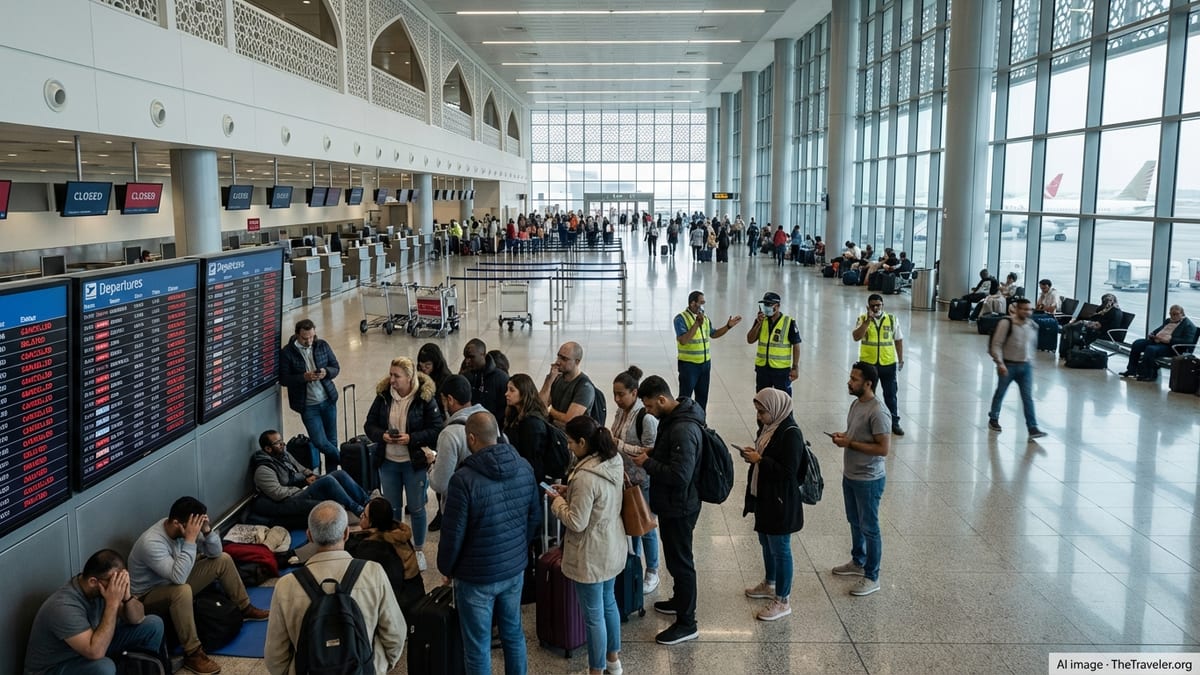
For travellers, the operational complexity translated into scenes of confusion and frustration across multiple continents. In Bahrain, passengers who had already cleared security were escorted back to landside areas as the terminal was partially evacuated, with many left sleeping on seats or the floor as they awaited news of rebooked flights. Check-in halls that briefly emptied during the evacuation quickly refilled as later passengers arrived to find departure boards lit with red cancellation notices.
Because Bahrain functions primarily as a transfer hub, the impact extended far beyond the island kingdom. Passengers en route to or from Manama found themselves unexpectedly grounded in other Gulf cities including Doha and Riyadh after connecting legs were scrubbed. In some cases, travellers bound for Bahrain from Europe and North America were held in origin cities such as London, Paris and New York, or diverted mid-flight to alternate destinations when overflight permissions were withdrawn.
Airline call centres and digital channels were quickly overwhelmed as stranded passengers sought clarity on refunds, accommodation and rerouting options. Travellers described long queues at transfer desks in major hubs and a patchwork of responses, with some airlines offering hotel vouchers and flexible rebooking, while others directed customers to online forms and future travel credits. Corporate travel managers, already dealing with shifting regional risk assessments, scrambled to re-route staff or postpone non-essential journeys.
Travel industry experts warned that even passengers whose trips did not originally involve the Gulf could feel knock-on effects. With aircraft and crews out of position and long-haul routes extended by wide detours, aircraft rotation plans on transatlantic and intra-European flights risked slipping, potentially pushing delays into the working week.
Security Concerns and Political Fallout Deepen Aviation Risks
The chaos in Bahrain unfolded against the backdrop of a rapidly escalating confrontation involving the United States, Israel and Iran, with Gulf states caught on the front line. Military strikes and retaliatory attacks across the region prompted aviation safety regulators and insurers to reassess the risk profile of large swathes of Middle Eastern airspace. Several governments issued advisories urging airlines to avoid the region entirely or to operate only on routes explicitly cleared by defence and civil aviation authorities.
Analysts noted that for Bahrain, which hosts a significant US naval presence and lies close to critical shipping lanes, the airport disruption carried an added symbolic weight. The drone attack and subsequent missile interceptions underscored fears that civilian infrastructure could remain exposed as long as hostilities continued. Security officials in Manama stressed that defensive systems were operating at a high state of readiness and that further protective measures could be introduced if the threat level rose.
Diplomatic efforts to restore calm have so far done little to reassure airlines. Industry figures pointed out that even a partial reopening of airspace might not lead to an immediate resumption of normal schedules, as carriers weigh the safety of crews and passengers against the commercial costs of prolonged suspension. Several aviation insurers are expected to review war-risk premiums for flights that traverse the Gulf, potentially increasing operating costs and putting pressure on fares once services resume.
The wider political fallout also loomed large over the travel sector. With public concern heightened, some governments in Europe and Asia began advising against non-essential travel to parts of the Middle East, and multinational companies reviewed evacuation and remote working plans for staff based in Gulf cities. Tourism boards across the region, which had spent years marketing the Gulf as a safe and convenient hub between East and West, suddenly faced a narrative dominated by missile sirens, terminal evacuations and empty skies.
Uncertain Outlook for Bahrain’s Recovery and Travelers’ Plans
As of Sunday afternoon local time, there was no clear timeline for a full restoration of Bahrain’s flight operations. Authorities said reopening decisions would depend on ongoing security assessments and coordination with regional partners, while airlines warned customers that disruption could extend for days even after formal restrictions begin to ease. Ground handlers and airport retailers, many of whom rely heavily on transfer traffic, braced for a sharp short-term downturn in revenue.
Aviation consultants said Bahrain’s role as a compact, high-frequency hub may help it rebound quickly once conditions stabilise, but stressed that the longer airspace remains constrained, the harder it will be to restore finely balanced schedules. With aircraft and crews scattered across multiple diversion points, carriers will have to carefully prioritise which routes to bring back first, potentially focusing on core trunk links to major cities before reinstating secondary destinations.
For travellers with upcoming itineraries through the Gulf, industry bodies urged a cautious approach. Passengers were advised to monitor airline notifications closely, consider alternative routings that bypass the most affected airspace and allow extra time for connections if rebooked via congested hubs. Travel agents reported a surge in enquiries about re-routing through southern Europe, North Africa and Central Asia, as corporate and leisure customers alike sought to avoid the most volatile areas.
With tensions still high and diplomatic efforts at an early stage, few in the aviation sector were prepared to predict a swift return to normality. For now, the scene at Bahrain International Airport, with its darkened departure boards, parked aircraft and restless crowds of stranded passengers, has become a stark visual symbol of how fast geopolitical shocks can ground the world’s most connected travel corridors.