

More news on this day
Hundreds of passengers were left stranded at Bahrain International Airport this week after authorities halted traffic through the kingdom’s airspace, forcing the cancellation of 172 flights and triggering a fresh wave of disruption for Gulf Air, Qatar Airways and other regional carriers serving hubs such as Dubai, Doha and Abu Dhabi.
Get the latest news straight to your inbox!
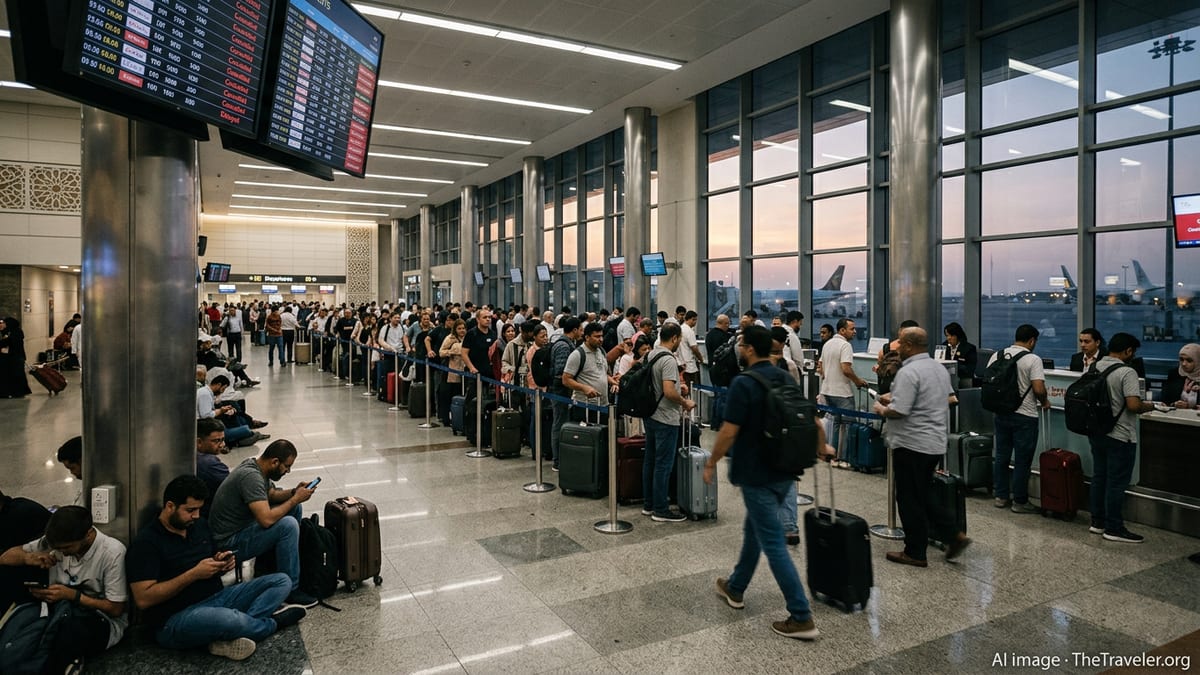
Airspace Lockdown Brings Bahrain Hub to a Standstill
Bahrain’s Civil Aviation Affairs ordered an immediate halt to commercial traffic through the kingdom’s skies as regional security tensions escalated, effectively freezing operations at Bahrain International Airport. The move, introduced as part of wider airspace controls across the Gulf, led to the grounding of hundreds of travelers as airlines rushed to suspend or reroute flights that typically funnel through Bahrain’s busy hub.
Airport officials and airline representatives said 172 departures and arrivals were canceled at Bahrain International over a span of several days, with most short-haul links to neighboring Gulf capitals among the first to be scrapped. The cancellations affected services to and from Dubai, Abu Dhabi and Doha in particular, mirroring similar disruptions across the region as neighboring states tightened their own airspace restrictions.
Although some ferry and cargo movements continued on a limited basis, Bahrain’s role as a passenger transfer point was largely suspended. Terminal departure boards were dominated by red cancellation notices, as security officials and airline staff focused on securing parked aircraft and managing stranded travelers rather than processing new departures.
Officials framed the decision as a precautionary step in line with regional partners, part of a coordinated response to a volatile security environment that has already seen several Gulf and Middle Eastern states impose partial or total closures of their airspace.
Gulf Air and Regional Carriers Forced to Rip Up Schedules
Gulf Air, Bahrain’s flag carrier and the primary tenant at Bahrain International Airport, has been among the hardest hit by the sudden shutdown. With its home hub effectively off limits for normal passenger operations, the airline was forced to cancel a large portion of its short and medium haul schedule, including high-frequency links to Dubai, Abu Dhabi and Doha that are central to its regional network.
Industry advisories and airline bulletins indicate that while some repositioning flights without passengers have operated to move aircraft out of Bahrain, commercial departures to and from the kingdom remain suspended until further notice. In practice, this has left Gulf Air dependent on limited services from alternative airports in the region and has sharply curtailed its ability to move connecting passengers onward to Asia and Europe.
Qatar Airways, Emirates, Etihad Airways and flydubai have also been forced to adjust flight plans, with several carriers dramatically scaling back operations to Bahrain and nearby hubs as air traffic corridors shifted or closed. Qatar Airways and other operators serving Doha have already faced hundreds of cancellations in recent days linked to overlapping airspace bans, with Bahrain’s closure adding an extra layer of complexity to route planning and crew rotations.
European and Asian airlines that rely on Gulf hubs for connections have equally cut services. Some, such as British and European carriers, have announced broader suspensions covering multiple Gulf destinations, citing the uncertainty around when airspace over Bahrain and its neighbors will fully reopen to regular commercial and transit traffic.
Passengers Face Long Waits, Reroutings and Limited Alternatives
For ordinary travelers, the closure of Bahrain’s airspace has translated into long hours in terminal waiting areas, overnight stays in airport hotels and, in many cases, extensive reroutings via distant hubs. With flights in and out of Bahrain canceled at short notice, many passengers reported receiving text messages and app alerts while already en route to the airport, advising them not to proceed to check in unless contacted directly by their airline.
Airlines have implemented a mix of rebooking, refund and voucher options for disrupted customers. Where possible, passengers are being shifted onto the small number of flights still operating via alternative Gulf gateways, including limited services from Dubai, Abu Dhabi and other regional airports that retain partial connectivity. However, the reduced capacity and ongoing uncertainty have meant that rebooking options are often days away rather than hours.
Airport staff and ground handlers at Bahrain International have prioritised vulnerable travellers, including families with small children and those in need of medical assistance, while coordinating with airlines to distribute meal vouchers and arrange hotel accommodation. Many stranded travelers, speaking to local media, described scenes of long queues at airline desks and departure boards that changed from delayed to canceled in rapid succession.
Travel agents and corporate travel managers have urged passengers with upcoming itineraries touching Bahrain or neighboring Gulf hubs to monitor airline updates closely and to avoid unnecessary trips to the airport until they have a confirmed alternative booking. They also note that knock-on delays are spreading well beyond the region as aircraft and crews become out of position.
Regional Ripple Effects Across Dubai, Doha and Abu Dhabi
The closure of Bahrain’s airspace is part of a wider patchwork of Gulf airspace controls that has reshaped flight paths across the Middle East over the past two weeks. Dubai, Abu Dhabi and Doha, normally among the busiest hubs for global long haul travel, have each seen sharp swings in traffic volumes as authorities adjust restrictions in response to changing security assessments.
Dubai and Abu Dhabi have begun cautiously rebuilding limited schedules following earlier shutdowns, with local carriers resuming selected services via designated safe corridors. Even so, many international airlines continue to suspend flights to these airports or cap frequencies, unwilling to commit to full restoration of capacity while neighboring airspaces, including Bahrain’s, remain restricted.
Doha has similarly experienced mass cancellations, with more than five hundred flights in a single day scrapped or heavily delayed at Hamad International Airport due to overlapping closures of Qatari and nearby airspace. For airlines that customarily triangulate routes between Bahrain, Doha and the United Arab Emirates, the loss of Bahrain as a transit option has reduced flexibility and aggravated congestion on the remaining open corridors.
Analysts say that as long as Bahrain’s skies are effectively closed, the Gulf’s interconnected hub model will struggle to function normally. Carriers that rely on short regional hops to feed their long haul networks must now rely on more circuitous routings, often adding hours of flight time and additional fuel costs just as demand from business and leisure travelers remains robust.
What Travelers Should Expect in the Coming Days
Authorities in Bahrain have not issued a firm timeline for when full commercial operations will resume, beyond indicating that the airspace restrictions remain in place until further notice. Aviation security experts suggest that any reopening is likely to be gradual, beginning with limited corridors for national carriers and cargo operators before extending to broader scheduled passenger services.
In the near term, travelers booked on Gulf Air, Qatar Airways or other airlines with flights touching Bahrain, Dubai, Doha or Abu Dhabi should anticipate potential last minute changes, including reroutings through secondary hubs or outright cancellations. Airlines continue to advise passengers to verify the status of their flight on official channels shortly before departure and to allow extra time for security checks and immigration procedures in case of congestion at alternative airports.
Industry observers say it could take several weeks after the eventual lifting of airspace restrictions for schedules to stabilise, as airlines work through aircraft positioning challenges, crew rostering backlogs and a buildup of passengers seeking to rebook canceled journeys. In the meantime, tourism boards and hospitality operators around the Gulf are bracing for a short term dip in arrivals as travelers opt to postpone or reroute non essential trips away from the region.
For the hundreds of passengers still waiting at Bahrain International Airport and across the Gulf network, the priority remains simply getting home. How quickly that happens will depend on both the evolution of the regional security picture and the capacity of airlines and regulators to reopen critical airspace safely yet swiftly.