

More news on this day
Travel across the Gulf region remains severely disrupted as Bahrain’s airspace closure continues amid an escalating regional conflict, with publicly available data indicating at least 139 flight cancellations involving Gulf Air, Qatar Airways, IndiGo and other carriers in recent days.
Get the latest news straight to your inbox!
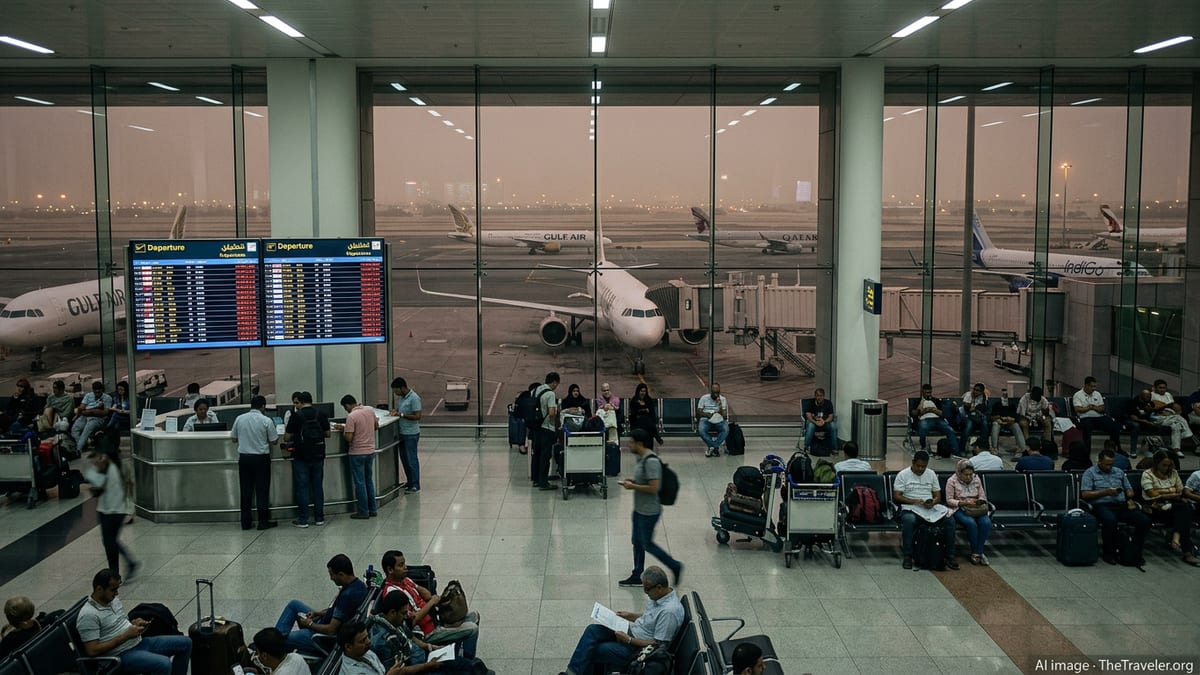
Escalating Conflict Keeps Bahrain Skies Closed
Bahrain’s airspace has remained shut since early March 2026 as part of a wider regional aviation crisis triggered by the latest phase of the Iran conflict, according to multiple operational bulletins and airspace risk advisories. The Bahrain Flight Information Region, which normally handles a dense flow of commercial overflights linking Europe, Asia and Africa, is currently closed to routine civil aviation traffic.
Specialist aviation security platforms and logistics advisories describe a high risk from missile and drone activity across the Gulf, highlighting concerns over both direct attacks on aviation assets and the potential for miscalculation involving air defence systems. These assessments point to Bahrain’s closure as one element in a broader pattern of airspace restrictions stretching across several Middle Eastern states.
Information from regional travel and security briefings indicates that Bahrain International Airport has suspended regular passenger operations while the closure remains in force, with only limited or exceptional movements permitted under strict control. Minor physical damage from earlier drone activity has been reported at the airport, further complicating any rapid restart of normal services.
The airspace shutdown came after a series of Iranian strikes and retaliatory actions involving the United States and Israel, which have affected airports and infrastructure in Bahrain, Qatar, the United Arab Emirates and other Gulf states. Published situation reports describe a rapidly evolving security picture, with airspace authorities adjusting restrictions at short notice as the conflict develops.
Gulf Air Grounded as Regional Hubs Scramble
Bahrain-based Gulf Air, the kingdom’s flag carrier, remains effectively grounded at its home hub, based on public statements from the airline and the airport. Updates issued since 5 March indicate that scheduled passenger services from Bahrain are still suspended while the national airspace is closed, although a small number of special services and repatriation flights have operated from alternative airports in the region.
Local and regional coverage notes that Gulf Air has focused on assisting stranded passengers, including repatriating those caught in transit when the closures began. Some reports mention special flights operating from cities such as Dammam for travellers who are legally able to enter or depart Bahrain via neighboring states, reflecting an improvised patchwork of options rather than a restored network.
For Gulf Air, the prolonged grounding strikes at the heart of its hub-and-spoke model, which relies on Bahrain’s central location for east–west connections. Travel analysts point out that every additional day of closure deepens the operational and financial strain on the carrier, while also diminishing Bahrain’s status as a regional connecting hub compared with competitors whose airspace has partially reopened.
Industry observers suggest that even once the Bahrain airspace is declared safe, the restart may be gradual, with aircraft repositioning, crew scheduling, and safety checks all required before a full schedule can resume. For now, the carrier’s immediate focus appears to remain on disrupted passengers and essential movements rather than commercial expansion.
Qatar Airways, IndiGo and Global Carriers Face Rolling Cancellations
The crisis is not confined to Bahrain. Published operational updates from freight forwarders, air travel rights organisations and aviation risk services indicate that Qatar Airways, IndiGo and a long list of international airlines have faced severe knock-on disruption from overlapping closures in Bahrain, Qatar, Kuwait and parts of Saudi and Emirati airspace.
Recent tallies drawn from airline advisories and air traffic data point to at least 139 cancellations directly linked to Bahrain’s airspace and closely connected Gulf routes, with the total number of disrupted services across the wider region running far higher. These figures form part of a broader pattern that some economic analyses estimate as involving several thousand cancellations per day at the height of the closures.
Qatar Airways, which was already grappling with the closure of Qatari airspace following missile activity near Doha, has been operating only limited corridors for repatriation and essential flights. Travel advisories describe a highly dynamic schedule, with permitted flights subject to short-notice changes as authorities assess security conditions.
Indian low-cost carrier IndiGo, along with other Asian and European airlines, has suspended or rerouted services that would typically overfly Bahrain or connect through hubs such as Doha, Dubai and Abu Dhabi. Passenger-rights platforms report widespread cancellations and delays on India–Gulf and Europe–Gulf routes, with airlines implementing flexible rebooking and refund policies to manage the disruption.
Regional Airspace Patchwork Complicates Rerouting
With large sections of the Gulf’s skies either closed or heavily restricted, airlines have been forced to stitch together complex alternative routings that avoid conflict zones and high-risk airspace. Conflict zone information bulletins issued for operators in recent days advise against flying over Bahrain and several neighboring states at any altitude, citing the potential for long-range missile activity and defensive interceptions.
Some carriers have shifted long-haul services to track further south over the Arabian Sea or to use alternative hubs where airspace remains comparatively open, such as Muscat in Oman. Logistics and freight advisories describe Muscat as a preferred staging point for relief and repatriation flights, as operators seek viable corridors into and out of the region without transiting closed flight information regions.
However, the patchwork pattern of openings and closures means that rerouting options are limited and can change quickly. Partial restrictions over bordering waters, temporary safe corridors, and time-limited approvals have all been reported, increasing flight times and fuel burn while reducing airlines’ flexibility to absorb further shocks.
Travel risk specialists note that the current situation differs from short, localized closures in previous years, because the present conflict affects multiple interconnected hubs simultaneously. As a result, the normal strategy of shifting traffic from one Gulf hub to another is proving less effective, with congestion and operational bottlenecks visible across a wide geographic area.
Passengers Confront Uncertainty and Prolonged Disruptions
For travellers, the practical impact of Bahrain’s closed airspace and the wider Gulf disruption has been days of uncertainty, missed connections and extended layovers. Airport and airline updates consistently advise passengers not to proceed to the airport until their flights are reconfirmed, underscoring the fluid nature of schedules across the region.
Passenger forums and social media discussions describe travellers being rerouted via distant hubs, or being advised to delay trips altogether as airlines await clearer guidance on when more normal operations might resume. Many carriers have introduced waiver policies allowing free rebooking or refunds for itineraries touching Bahrain, Qatar and other affected countries within defined travel windows.
Travel industry guidance stresses the importance for passengers of monitoring airline apps and official channels closely, given that departures can be cancelled or re-timed at short notice in response to updates from aviation authorities and security services. Package tour operators and corporate travel managers are similarly being urged to maintain flexible plans and contingency routings.
With no firm public timeline for the full reopening of Bahrain’s skies and continuing volatility across the region, aviation analysts expect rolling disruption to persist in the near term. For now, Bahrain’s closed airspace remains a critical pinch point in a wider Gulf aviation crisis that is still unfolding.