

More news on this day
Bahrain’s decision to keep its airspace closed amid an escalating regional conflict is sending shockwaves through global aviation, with airlines scrambling to reroute traffic, cancel departures and warn travelers of prolonged disruption across key East–West corridors.
Get the latest news straight to your inbox!
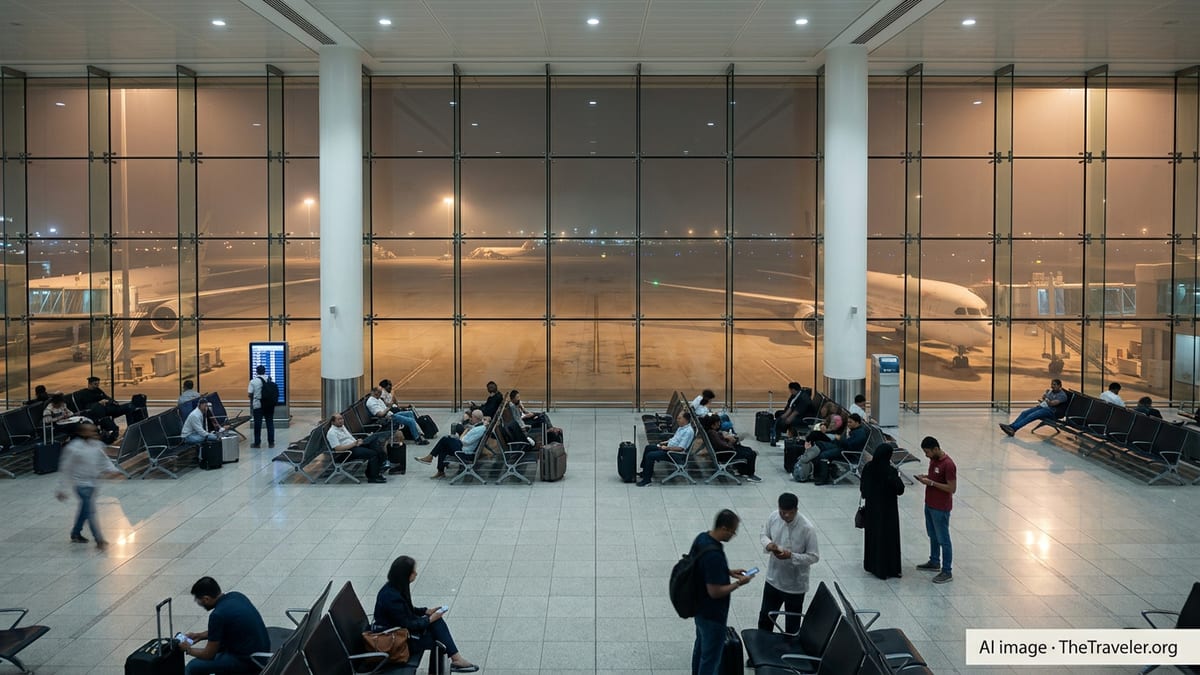
A Strategic Hub Suddenly Goes Dark
Publicly available aviation notices show that Bahrain’s flight information region, which sits astride some of the world’s busiest routes between Europe and Asia, remains effectively shut to commercial overflights. Conflict zone bulletins circulated to airlines in recent days describe a total closure of Bahraini airspace at all altitudes due to the elevated risk from missiles and drones linked to the widening Iran war.
Industry and risk-advisory updates indicate that the current shutdown is more far-reaching than previous short-term restrictions in the Gulf. Bahrain’s airspace is not only closed for overflying traffic but has also severely curtailed access to Bahrain International Airport, forcing scheduled passenger operations to be suspended or drastically reduced.
Airport and airline statements monitored by aviation analysts show that Gulf Air, Bahrain’s national carrier, has halted regular departures from its Manama hub following missile and drone strikes across the region. Reports indicate that part of the Gulf Air fleet has been repositioned to neighboring airports in Saudi Arabia and Oman to keep aircraft out of the conflict zone and preserve flexibility for future recovery flights.
Specialist aviation risk platforms now classify Bahraini airspace as one of the highest-risk segments in the Middle East, advising operators to avoid the area entirely. The closure is adding further strain to a Gulf region already grappling with overlapping restrictions in Iran, Iraq, Kuwait, Qatar and parts of Saudi Arabia.
Mass Cancellations, Diversions and Lengthy Reroutes
Operational bulletins shared with corporate travel clients describe a wave of cancellations touching both regional and long-haul services. Carriers based in Europe and Asia have progressively suspended flights to Bahrain and neighboring hubs or rerouted them around the Gulf, adding significant flying time and fuel costs.
Airlines that continue to operate to the broader region are using lengthy detours over Turkey, the Caucasus, Egypt or the Arabian Sea to skirt closed and high-risk airspace. Flight-tracking data compiled by aviation observers shows Europe–South Asia and Europe–Australasia routes in particular being pushed hundreds of kilometers off their usual tracks, in some cases extending flight times by an hour or more.
Travel management advisories reference cascading knock-on effects as aircraft and crew are displaced from their normal rotations. With Bahrain off-limits and multiple neighboring states imposing either full closures or tight capacity limits, carriers have fewer diversion options when things go wrong, increasing the likelihood of last-minute cancellations and missed connections for passengers worldwide.
Freight operations are also being hit. Logistics updates point to suspended or heavily constrained air cargo flows through Bahrain and nearby hubs, complicating supply chains that depend on fast, reliable uplift for high-value and time-sensitive goods between Asia, the Gulf and Europe.
Stranded Passengers and Regional Travel Chaos
First-hand accounts on travel forums and social media paint a picture of passengers stranded in Manama and elsewhere across the Gulf after abrupt flight cancellations. Travelers describe repeated rebookings that fail to materialize as the closure drags on, with some being advised to travel overland into Saudi Arabia in search of alternative departures.
Public communications from Gulf Air and Bahrain International Airport in recent days have focused on repatriation efforts for transit passengers caught mid-journey when the closures took effect. According to published coverage, several hundred travelers have been moved out on limited special services, but widespread commercial operations remain suspended.
Regional carriers that have managed to resume partial schedules from cities such as Dubai, Abu Dhabi and Doha are prioritizing passengers with earlier disrupted bookings, leaving very limited availability for new reservations. Travel agencies report that economy seats on remaining flights out of the Gulf are scarce and often priced significantly higher than normal, especially on routes to major European and South Asian gateways.
On the ground, hotel occupancy near key airports is rising as delays stretch from hours into days. Travel risk firms are advising corporate clients to prepare for extended layovers, monitor airline alerts closely and consider flexible routing that avoids the most heavily affected hubs wherever possible.
Global Network Impact Beyond the Gulf
Analysts tracking airline schedules suggest that Bahrain’s airspace shutdown is amplifying an already severe squeeze on global capacity created by overlapping closures across the wider Middle East. Network planners in Europe, Asia and North America are having to redraw schedules on short notice, reallocating aircraft away from Gulf-connected itineraries toward more stable routes.
According to publicly available timetable data, several major international airlines have temporarily removed Bahrain from their networks and sharply reduced frequencies to nearby markets. Some carriers have announced short-term suspensions of multiple Middle East destinations, citing the difficulty of maintaining reliable operations while so many neighboring airspace segments are either closed or subject to sudden restrictions.
The disruption is being felt well beyond passengers whose journeys touch the Gulf. Airport coordination reports indicate that long-haul aircraft normally routed via the Middle East are being reassigned to transatlantic or intra-Asian services, altering capacity and pricing dynamics in markets far from the conflict zone. As a result, travelers in Europe, South Asia and Australasia are encountering route changes and higher fares even when their tickets do not explicitly include a Gulf stopover.
Meanwhile, insurers and aviation finance specialists are assessing the broader economic hit. Studies on the economic impact of the Iran conflict highlight a sharp rise in fuel costs and war-risk premiums, as well as the financial pressure on airlines forced to absorb the cost of diversions, crew disruption and passenger care obligations during prolonged irregular operations.
Uncertain Timeline for Reopening
Conflict-zone assessments issued this week underline that there is no clear timeline for a full reopening of Bahraini airspace. Safety advisories circulated by European and international regulators remain in force, formally recommending that commercial operators avoid the skies over Bahrain and several neighboring states while the risk from missile and drone activity persists.
Travel-management alerts emphasize that any initial easing is likely to be partial and tightly controlled, with limited corridors, curfews or altitude restrictions rather than an immediate return to pre-crisis traffic levels. This means airlines will be cautious about restoring full schedules through Bahrain, as further escalations could trigger renewed closures without warning.
For travelers, experts stress the importance of contingency planning. Industry guidance encourages passengers with upcoming itineraries touching the Gulf to monitor their bookings closely, ensure contact details are up to date with airlines, and consider alternative routings through hubs outside the immediate conflict area where possible.
With Bahrain’s airspace still effectively sealed and the wider regional picture volatile, aviation observers expect continued turbulence for global travel in the days ahead. The Gulf’s role as a vital bridge between continents means that what happens over Bahrain’s skies reverberates across flight boards from London to Singapore and beyond.