

More news on this day
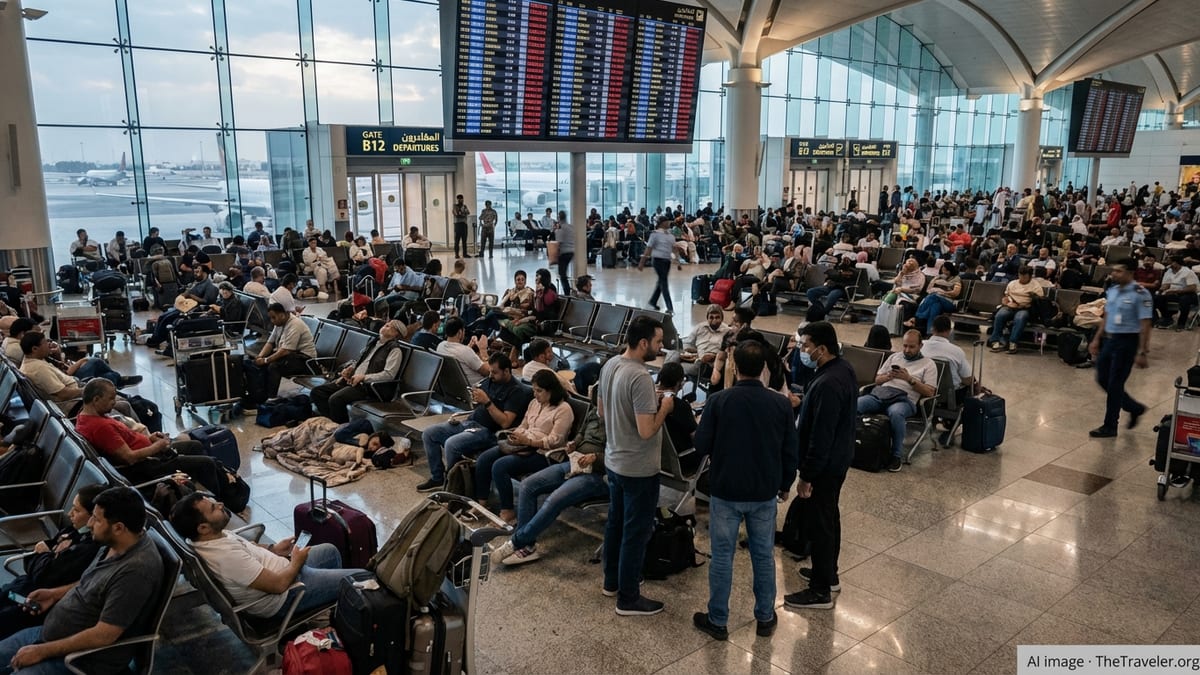
Thousands of travelers are stranded in Bahrain after the kingdom abruptly shut its airspace on February 28, 2026, as coordinated US and Israeli strikes on Iran and Tehran’s retaliatory attacks triggered a cascade of closures across the Gulf, igniting fresh fears over safety, diversions and the stability of one of the world’s busiest aviation corridors.
How the US–Israel–Iran Escalation Reached Bahrain’s Skies
The shutdown over Bahrain comes amid a dramatic military escalation that began when Israel, with support from the United States, launched wide-ranging strikes on targets inside Iran early on February 28. Tehran responded within hours with missile barrages aimed at Israel and at Gulf states hosting US military facilities, jolting the wider region into crisis mode.
As explosions and intercepts were reported across West Asia, aviation authorities from Iran and Israel to Iraq, Kuwait and Qatar issued sweeping airspace closures. Regional tracking data showed vast stretches of sky almost empty of civilian aircraft as carriers rerouted or cancelled flights, severing vital links between Europe, Asia and Africa that normally funnel through the Gulf.
In Bahrain, home to a major US naval presence and within easy reach of Iranian missile ranges, officials moved quickly to halt overflights and commercial movements. The decision was framed as a precautionary security step as regional commanders assessed potential threats, but its impact on ordinary travelers was immediate and severe.
The closure follows recent years in which Gulf airspace has become increasingly exposed to the geopolitical contest between Iran, Israel and the United States. The rapidity of Bahrain’s move underlines how closely aviation safety is now intertwined with shifting military calculations.
Airspace Closed, Flights Frozen: What Travelers Are Experiencing
By Saturday afternoon local time, Bahrain’s skies were effectively off limits to routine commercial traffic. Departures were paused, incoming flights diverted mid-route to alternative hubs, and aircraft already on the ground were held in place as airport authorities halted movements beyond essential operations.
Passengers reported scenes of confusion and fatigue inside Bahrain International Airport as departure boards flipped from “on time” to “delayed” and “cancelled” in quick succession. Long queues formed at airline transfer and ticket desks, with many travelers scrambling to rebook journeys via alternative hubs that themselves were coming under pressure from the wider Middle East shutdown.
Regional carriers with major operations in Bahrain and neighboring states announced rolling schedule changes. Some suspended services for at least the next 24 to 48 hours, while others attempted to operate limited flights around the affected airspace, adding several hours to journey times. For many travelers in transit between Europe and South or Southeast Asia, itineraries simply collapsed as connecting routes through the Gulf disappeared.
While some airlines offered hotel vouchers or meal allowances, capacity in nearby accommodation quickly became strained. Families with small children and elderly passengers were particularly hard hit, many left to sleep in terminal seating areas as they waited for clarification on when flights might resume.
Safety, Security and Official Messages From Bahrain
Bahraini authorities have emphasized that the airspace standstill is a preventative measure designed to shield civilian traffic from any risk connected to the unfolding confrontation between the United States, Israel and Iran. Officials have stressed that security inside the kingdom itself remains under control, even as regional tensions sharpen.
Defence and civil aviation statements have characterized the situation as evolving but manageable, with government agencies coordinating closely with military partners and international aviation bodies. They have highlighted that no casualties have been reported inside Bahrain as a direct result of the current hostilities, and that critical infrastructure is being closely monitored.
At the same time, authorities have urged residents and visitors to follow official advisories and avoid spreading unverified reports of additional attacks or imminent threats. Mobile alerts and state media broadcasts have focused on encouraging calm while acknowledging the severe disruption facing travelers.
Diplomats from several embassies in Manama are working to track affected citizens, liaise with airlines and provide updated travel guidance. Some missions have advised their nationals to avoid non-essential travel through the region until the air picture stabilizes and clearer timelines for reopening are available.
Ripple Effects on Global Routes and Gulf Travel Hubs
The sudden loss of Bahrain’s airspace, combined with closures or heavy restrictions over neighboring Iran, Iraq, Kuwait, Qatar and the United Arab Emirates, has effectively constricted one of the world’s main aviation chokepoints. Airlines that routinely rely on Gulf overflight rights to connect Europe with India, Southeast Asia and Australasia are being forced into last-minute, fuel-intensive detours or outright cancellations.
Major European and Asian carriers have already suspended or limited services to destinations across the Middle East, citing safety concerns and operational complexity. Many have stopped selling new tickets on affected routes while they work through a backlog of stranded passengers. Industry analysts warn that if the closures persist even for a few days, knock-on effects will be felt well beyond the region, with aircraft and crew out of position and global schedules needing wholesale recalibration.
For Bahrain, which has invested heavily in its role as a regional connector, the standstill represents both an immediate logistical crisis and a reputational risk. Its national airline and airport operator face the dual challenge of safeguarding passengers while trying to preserve confidence in the kingdom as a reliable transit point in an increasingly volatile neighborhood.
Neighboring hubs such as Dubai, Doha and Abu Dhabi, themselves grappling with restrictions or partial closures, are contending with similar dilemmas. Together, their experience underlines how the Middle East’s rise as an aviation super-corridor has left global travel acutely vulnerable to sudden geopolitical shocks.
What Travelers Should Do Now and Planning Ahead
For anyone currently stranded in Bahrain or holding tickets that involve transit through the kingdom in the coming days, the most immediate priority is to remain in close contact with airlines. Carriers are updating rebooking policies in real time, in many cases waiving change fees and fare differences for trips affected by airspace closures, though availability on alternative routings remains limited.
Travelers are being advised to monitor airline apps and official social media channels, as call centers are overwhelmed and airport information desks face long lines. Those with flexible travel dates may be asked to postpone non-essential trips until the regional aviation picture becomes clearer, freeing scarce seats for passengers who need to travel urgently.
For future journeys, industry experts recommend building extra margin into itineraries that cross the Middle East, including longer connection times and fully refundable or changeable tickets where possible. Comprehensive travel insurance that explicitly covers war-related disruption and airspace closures is becoming increasingly important, as standard policies may exclude such events.
Ultimately, the situation in Bahrain illustrates how quickly a regional security crisis can cascade into global travel paralysis. Until tensions between the United States, Israel and Iran ease and Gulf airspace gradually reopens, travelers should be prepared for a period of continued uncertainty, sudden schedule changes and longer, more complex routes across an already strained international network.