

More news on this day
Travel across the Middle East and beyond has been thrown into fresh turmoil as more than 120 flights operated by Gulf Air and Royal Jordanian have been cancelled or severely disrupted following the prolonged closure of Bahraini airspace, with knock-on impacts on routes linking Riyadh, Kuwait, Dubai, Abu Dhabi, Singapore, Bangkok, London, Istanbul, major Indian cities and other global hubs.
Get the latest news straight to your inbox!
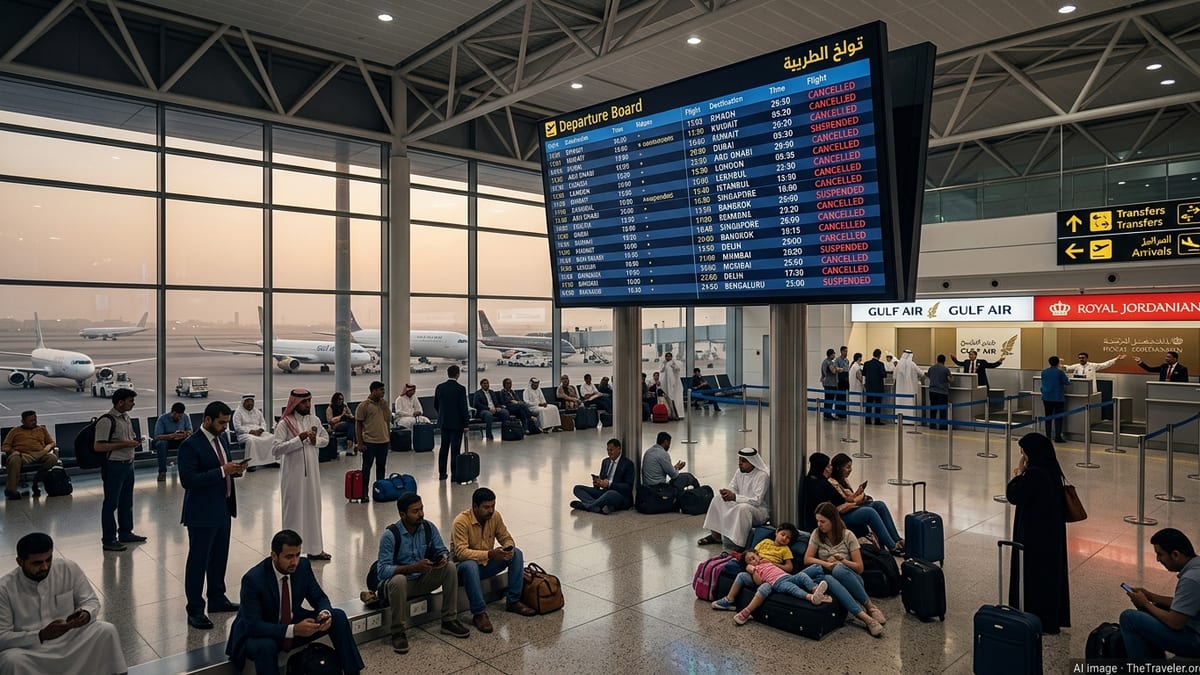
Expanded Cancellations Hit Regional and Long-Haul Networks
Published airline advisories and regional travel industry updates indicate that Gulf Air, Bahrain’s flag carrier, has now cancelled or suspended well over 120 flights in recent weeks, after Bahrain International Airport’s operations were curtailed by the ongoing regional security crisis. Many of these flights served as critical connectors between Gulf cities and long-haul destinations in Europe and Asia, magnifying the disruption for transit passengers.
Royal Jordanian has also adjusted its schedules, cutting or retiming services that normally route via or alongside Bahraini and neighboring airspace. Coverage in regional media shows that its network to Gulf destinations, including Kuwait and Qatar, has been repeatedly reshuffled, narrowing options for travelers trying to reach onward connections to Asia and Europe.
The combined effect has been particularly acute on high-demand corridors such as Bahrain to Riyadh, Kuwait, Dubai and Abu Dhabi, which normally funnel business travelers and migrant workers throughout the Gulf. With Bahrain off the map as a transfer point and frequencies reduced elsewhere, travelers are facing longer journeys, higher fares and limited seat availability.
Long-haul routes are under similar strain. Flights that previously routed through Bahrain to connect South and Southeast Asia with Europe, including links to Singapore, Bangkok, London, Istanbul, Mumbai, Delhi and Bengaluru, have been trimmed or rerouted via alternative hubs, often with extended flight times to avoid closed or restricted airspace.
Airspace Closures and Security Concerns Drive the Turmoil
Publicly available aviation notices and conflict reporting describe a sharply deteriorated security environment across parts of the Gulf since late February 2026, following a surge in missile and drone attacks tied to the wider Iran conflict. Airspace over Bahrain, Kuwait and several neighboring states has been subject to full closures or tight restrictions, forcing airlines to suspend services or operate only within carefully defined corridors.
Analyses from aviation consultancies and travel publications note that Gulf Air’s operations out of Bahrain have been among the hardest hit, with the carrier effectively grounded for stretches of March and only able to run limited ferry or repositioning flights. Royal Jordanian, while based outside the immediate closure zone, has had to adapt to rapidly changing routings and overflight permissions, which has contributed to late schedule adjustments and cancellations.
The closures have rippled throughout the region’s air traffic control network. Reports on wider Middle East airspace patterns describe unprecedented congestion on the remaining open corridors, particularly through Saudi Arabia and Egypt, where airlines are concentrating rerouted flights between Europe, Africa and Asia. This congestion has increased the risk of knock-on delays for services that are still technically operating.
Travel risk briefings suggest that airlines are continuing to reassess routings on a daily basis as security assessments evolve. Even where some flights remain listed as operating, passengers are being warned that last-minute cancellations and diversions remain possible, particularly on routes that previously relied on Bahraini or Kuwaiti airspace.
Global Connectivity Squeezed as Hubs Shift and Fares Spike
Industry coverage indicates that the suspension of Bahrain as a functioning hub has wider consequences for global connectivity than raw cancellation totals might suggest. Gulf Air’s network historically acted as a mid-sized bridge between Europe, South Asia and Southeast Asia, with Bahrain offering relatively quick one-stop itineraries between cities such as London or Istanbul and Indian and Thai destinations.
With that bridge disabled, passengers are being pushed onto a smaller number of alternative hubs, including Jeddah, Riyadh, Cairo and select airports in the United Arab Emirates that remain partially open. Airlines using these hubs are seeing surging transit volumes, and some have responded by adjusting capacity and pricing, a dynamic that has already led to significant fare increases on certain city pairs.
Travel and business media report that airlines across the wider region are confronting higher operating costs, driven by longer routings around conflict zones and a sharp rise in jet fuel prices tied to disruptions in Gulf oil infrastructure and shipping. Carriers that previously relied on efficient Gulf routings now face extended flight times, tighter crew scheduling and complex operational planning, all of which filter through to ticket prices and schedule reliability.
These pressures are not confined to travelers starting or ending their trips in the Middle East. Long-haul passengers flying between Europe and Asia, or between North America and South Asia, are encountering schedule changes even when their itineraries no longer pass close to the Gulf, as airlines reorganize fleets and crews to cope with the loss of traditional corridors.
Passengers Confront Missed Connections and Limited Recourse
Accounts compiled from travel forums, airline notices and regional news outlets portray a difficult picture for passengers with tickets on affected Gulf Air and Royal Jordanian routes. Many itineraries were built around short connections in Bahrain or other Gulf cities, leaving little margin when flights are rescheduled or cancelled. As cancellations have cascaded, travelers have reported being stranded in intermediate hubs or facing multi-day delays before alternative flights become available.
Updated fare and ticketing policies published by airlines and major ticketing platforms show that Gulf Air has introduced temporary measures allowing rebooking or refunds for passengers impacted by Bahrain’s airspace closure, typically within a specified travel window. Royal Jordanian has issued similar waivers on certain routes, although eligibility criteria can differ depending on when the ticket was purchased and which sectors are affected.
Travel law specialists cited in consumer-focused coverage caution that standard travel insurance policies often exclude disruptions linked to armed conflict or government-ordered airspace closures. This means that many passengers must rely primarily on airline waiver policies or regional consumer protection rules, which can vary significantly between jurisdictions and may not fully compensate for hotel stays, missed tours or other nonrefundable elements of a trip.
Advisories from major travel brands recommend that affected passengers document all expenses, monitor airline channels for updated waivers, and consider contacting their payment card providers, some of which offer limited interruption coverage that may apply when flights are cancelled for security reasons.
What Travelers Should Do Now
Travel guidance published over the past week consistently urges anyone booked on Gulf Air or Royal Jordanian, particularly on routes touching Bahrain, Kuwait or nearby airspace, to verify their flight status repeatedly in the days and hours before departure. Same-day cancellations and schedule changes remain a real possibility as security assessments evolve.
Experts quoted in recent travel and aviation analysis pieces suggest that passengers who have not yet started their journeys should consider flexible rerouting via more stable corridors, even if that means adding an extra stop or accepting a longer travel time. Alternative hubs in Saudi Arabia, Egypt and parts of Europe are currently absorbing a larger share of east–west traffic, and airlines may be more likely to maintain services along these paths.
For travelers still deciding whether to book new trips involving Gulf stopovers in the coming weeks, risk assessments advise a cautious approach. While some carriers are gradually testing limited resumptions on selected routes, the broader picture of Middle East airspace remains unsettled, and further cancellations by Gulf Air, Royal Jordanian or other regional lines cannot be ruled out.
Analysts widely expect that the impact on global travel will continue even after airspace restrictions eventually ease, as airlines work through backlogs, reposition aircraft and adjust long-term schedules. For now, Bahrain’s severe flight disruption and the sweeping cancellations by Gulf Air and Royal Jordanian stand as a stark illustration of how quickly a regional security crisis can redraw the world’s flight map.