

More news on this day
Passengers traveling with Gulf Air through Bahrain’s Muharraq hub are facing another wave of disruption today, with publicly available data indicating around 85 flight cancellations affecting routes across the Gulf region and beyond.
Get the latest news straight to your inbox!
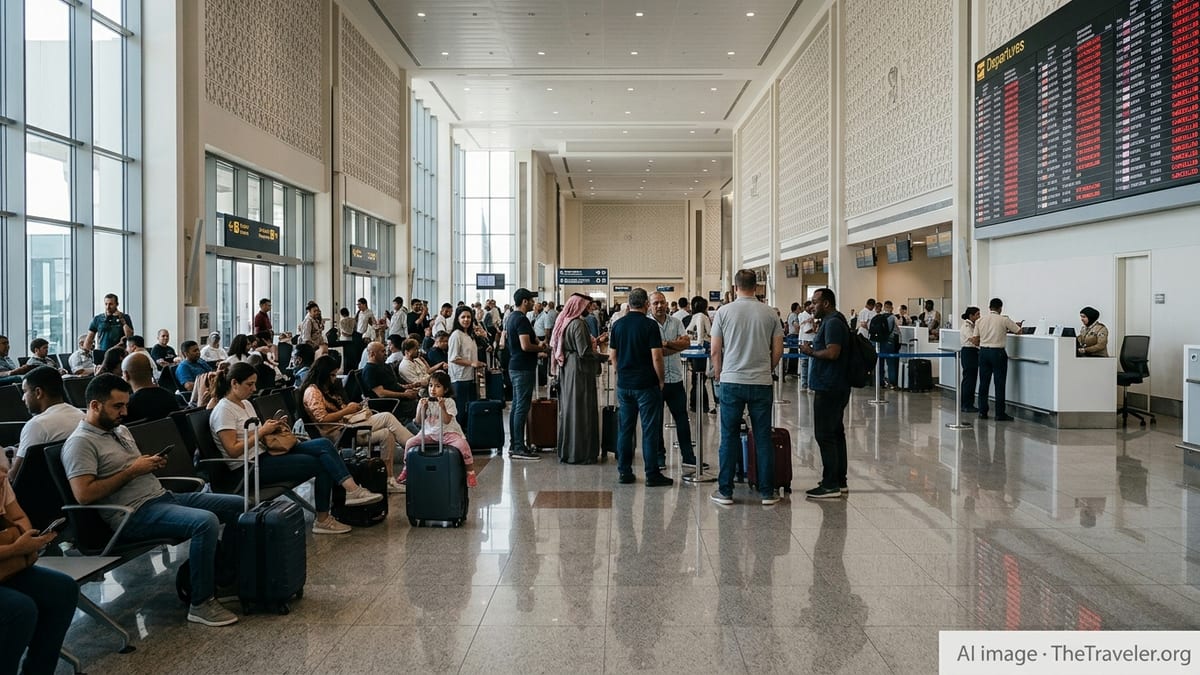
Fresh Cancellations Hit Bahrain’s Main Aviation Hub
Newly compiled schedules and airport operation feeds show that Gulf Air’s network from Bahrain International Airport has been sharply reduced today, with approximately 85 services removed from the departure and arrival boards. The latest wave of cancellations is concentrated at the Muharraq-based hub, where the national carrier typically operates dense daily schedules to neighboring Gulf states and key long-haul markets.
The cancellations include frequent regional trunk routes to the United Arab Emirates, Saudi Arabia, and Qatar, alongside services to longer-haul destinations such as mainland China and other Asian cities. Many of the affected flights are normally used by business travelers and transit passengers, amplifying the impact across connecting journeys.
Airport monitoring platforms and travel management advisories indicate that disruption at Bahrain International remains closely tied to broader regional airspace constraints that have persisted into March. Although some limited operations and diversions through neighboring airports are continuing, the pattern for Bahrain today is dominated by grounded services rather than restored frequencies.
The operational picture at Muharraq has evolved from an initial full halt in early March to a patchwork of partial resumptions and renewed suspensions. Today’s figure of around 85 cancellations underscores that a full normalization of Gulf Air’s schedule from Bahrain is still distant.
Airspace Restrictions Continue to Undermine Regional Connectivity
Travel industry advisories issued in recent weeks describe a Middle East aviation environment still constrained by airspace closures and restrictions across several Gulf states. Bulletins on 2 and 3 March noted that airspace in Bahrain, the United Arab Emirates, Qatar and parts of the wider region remained restricted, forcing major carriers to suspend or significantly curtail operations.
Subsequent security and risk briefings for corporate travelers have continued to flag Bahrain as a hotspot for aviation disruption, with Bahrain International Airport listed as temporarily closed or heavily constrained at various points in March. These documents also highlight that air cargo capacity has been reduced and that reroutings via alternative corridors are adding time and complexity to journeys.
Reports on recent Iranian missile and drone activity in the wider Gulf, including incidents affecting Bahrain and Qatar, reinforce the backdrop of elevated security risk that has led aviation regulators and airlines to adopt a cautious approach. Publicly available information on these events describes repeated interceptions over key Gulf states and the temporary closure of multiple national airspaces.
Against this backdrop, Gulf Air’s reliance on Bahrain as its primary hub has left the carrier particularly exposed. While some regional airlines have been able to shift capacity through secondary hubs or exploit alternative corridors, Bahrain’s constrained airspace and airport operations continue to limit the options for the country’s flag carrier.
Passengers Face Delays, Diversions and Complex Rebookings
For passengers in Muharraq and across the Gulf Air network, today’s 85 cancellations are the latest in a series of disruptions stretching back several weeks. Social media posts, traveler forums and airline advisories reference a growing list of passengers stranded in transit points or forced into lengthy overland transfers in search of alternative flights.
Recent traveler accounts describe Gulf Air itineraries through Bahrain being replaced with routings via Saudi Arabian airports, particularly Dammam, where some services have been used as a workaround to reach Europe and Asia. Others report switching carriers entirely, choosing airlines operating from less affected hubs where airspace remains open or more stable.
Travel management companies monitoring the situation continue to advise corporate clients to check flight status repeatedly in the 24 to 48 hours before departure, and to anticipate last-minute schedule changes. Online advisories recommend allowing additional time for connections, and where possible, prioritizing routings that avoid the most heavily impacted airspaces.
Consumer guidance circulating in the market also emphasizes the importance of understanding fare rules and disruption policies. Passengers are being encouraged to document cancellations, keep receipts for unexpected accommodation or ground transport, and monitor official airline channels for eligibility on refunds, rebookings or travel vouchers.
Key Routes to UAE, Saudi Arabia, Qatar and China Heavily Affected
Gulf Air’s most heavily disrupted services today appear to include high-frequency routes linking Bahrain with Abu Dhabi and Dubai in the United Arab Emirates, Riyadh and Dammam in Saudi Arabia, and Doha in Qatar. These corridors normally function as vital short-haul connectors within the Gulf, underpinning business travel, family visits and onward long-haul connections.
Publicly accessible schedule snapshots and aviation tracking data show that a significant proportion of these short-haul rotations have been removed, leaving only a limited number of operational flights or, in some cases, none at all. Airlines across the region have been contending with similar pressures, but Bahrain’s status as an affected airspace has intensified the fallout for its home carrier.
Beyond the Gulf, Gulf Air’s network to Asia is also feeling the strain. Routes to East Asia, including services to China, feature among today’s cancellations, limiting direct connectivity between Bahrain and major commercial centers. Travel industry analysts note that long-haul routes are particularly sensitive to airspace uncertainties, given the fuel, crew and scheduling implications of extended detours.
For travelers with complex itineraries involving multiple stops, the loss of these links can trigger a cascade of missed connections. This has led to rising demand for alternative routings via European or non-Gulf Middle Eastern hubs that remain open, even if those options involve longer total journey times.
Outlook: Limited Visibility on Full Restoration of Services
Forward-looking advisories from risk consultancies and travel management firms suggest that Bahrain’s aviation outlook remains uncertain. While there have been intermittent signs of improvement, the pattern of recurring cancellations and partial resumptions indicates that operators are planning on a day-by-day basis rather than committing to firm long-term schedules.
Some recent traveler reports point to Gulf Air exploring limited operations using neighboring airports to maintain a minimal level of connectivity, particularly for critical long-haul markets. However, these workarounds do not yet compensate for the scale of disruption at Bahrain International Airport itself, where today’s 85 cancellations highlight the continued fragility of the network.
Industry observers note that any sustained recovery will depend on a combination of factors, including clearer timelines on regional airspace reopening, risk assessments by insurers, and the ability of airlines to reposition aircraft and crew efficiently. Until those pieces align, Bahrain’s role as a reliable Gulf aviation hub is likely to remain constrained.
For passengers, the practical guidance remains consistent: build flexibility into travel plans, verify bookings close to departure, and stay alert to updates from airlines and travel providers. With cancellations at Muharraq still running high today, travelers using Gulf Air and Bahrain International Airport may need to prepare for ongoing changes to their journeys in the days ahead.