

More news on this day
Passengers traveling through Bahrain are facing a new round of disruption on March 10 as Gulf Air, Qatar Airways and IndiGo scrub more than 20 flights, hitting popular routes to Doha, London, Mumbai, Paris, Frankfurt, Istanbul, Milan and other major hubs across Europe, the Gulf and South Asia.
Wave of Cancellations Deepens Bahrain Travel Turmoil
The latest cuts come on top of an already fragile regional aviation picture, with Bahraini airspace still subject to tight restrictions linked to the wider security crisis in the Gulf. Gulf Air, Bahrain’s flag carrier, remains largely grounded, while partner and competitor airlines continue to trim or reroute services in and out of the kingdom.
According to airport operations data and airline advisories reviewed on March 10, more than 20 departures and arrivals associated with Bahrain were removed from schedules in a single day. The bulk of these involved services that either originated in Bahrain, transited via Bahrain to Doha or other Gulf gateways, or connected passengers onward to European and Indian cities.
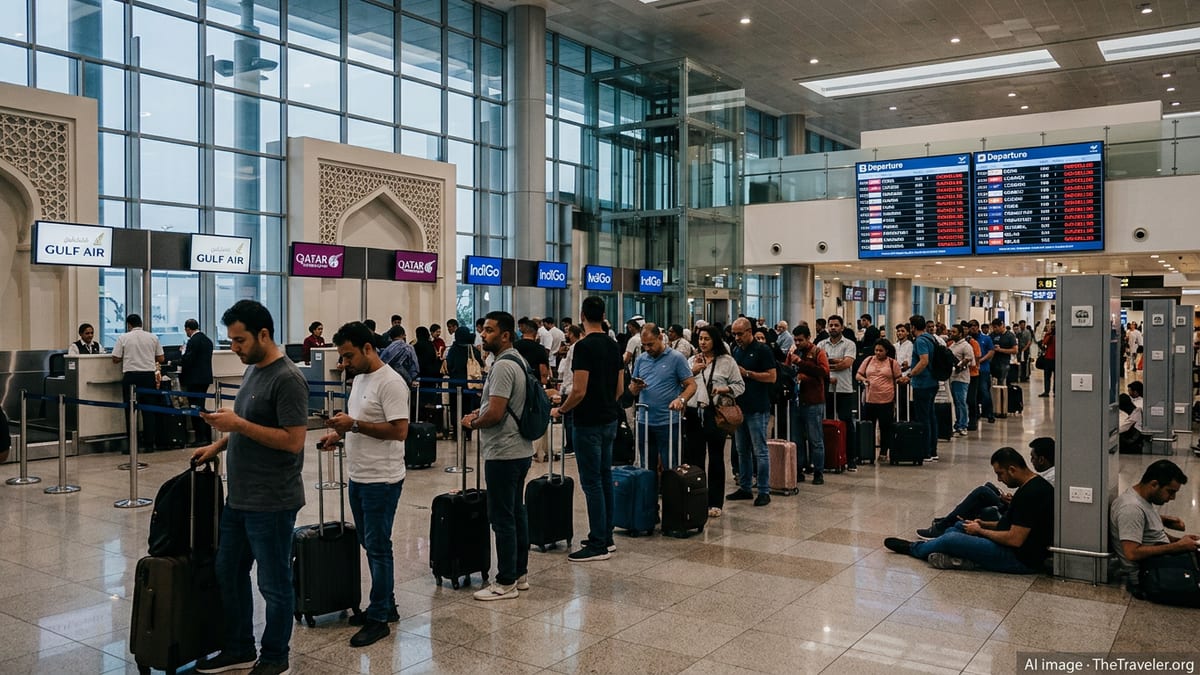
While some flights are being consolidated into limited repatriation services, the scale of the latest cancellations is again stranding travelers or forcing last‑minute changes to carefully planned itineraries. Airport staff reported heavier than usual queues at ticket desks as passengers sought rebooking options on any carrier still operating through alternative corridors.
The renewed upheaval underscores how quickly conditions in Gulf aviation can change, even after tentative signs of recovery. Airlines that had been gradually adding back flights now find themselves cutting schedules for a second time in less than two weeks.
Key Routes Hit: Doha, London, Mumbai and Major European Hubs
The most heavily affected routes on March 10 involve the dense traffic triangle linking Bahrain, Doha and major European and Indian cities. Services between Bahrain and Doha, normally among the busiest in the region, have been slashed as Qatar Airways concentrates on a narrow network of authorized corridors and Gulf Air keeps its fleet largely on the ground.
Travelers booked on Bahrain itineraries to London Heathrow, Paris Charles de Gaulle, Frankfurt, Milan and Istanbul via Doha or other Gulf hubs are reporting cancellations and forced rebookings. Many of these journeys were originally ticketed on Gulf Air codeshares with Qatar Airways and other partners, or on IndiGo connections onward to India, multiplying the knock‑on effects when a single leg is removed from the schedule.
India‑bound passengers are also facing significant disruption. IndiGo and other carriers have already reduced frequencies to Gulf points because of the regional airspace closures and operational constraints. On March 10, that translated into fresh cancellations on Bahrain‑linked routings to Mumbai and other Indian cities, cutting capacity on one of the busiest labor and family travel corridors in the world.
For European travelers, the impact extends beyond simple holiday disruptions. Bahrain and Doha serve as critical links for corporate traffic to financial centers such as London and Frankfurt, as well as onward connections across the Middle East and Asia. With nonstop options curtailed, many passengers are being rerouted via secondary hubs in Turkey, North Africa or southern Europe, adding hours and uncertainty to journeys.
Gulf Air, Qatar Airways and IndiGo Adjust Operations
Gulf Air, headquartered in Manama, entered this latest phase of the crisis with operations already significantly reduced. The carrier has been operating only a skeleton service since early March, and Bahrain International Airport has seen repeated bank‑by‑bank cancellations as authorities reassess available corridors and overflight permissions. On March 10, schedules again showed the majority of Gulf Air’s regional and long‑haul departures canceled, including flights that would normally serve London, Istanbul and key South Asian destinations.
Qatar Airways continues to walk a tightrope between maintaining global connectivity and complying with restrictions on traffic into and out of Doha. The airline is now operating a rotating list of limited flights, including some services to London, Mumbai, Frankfurt, Istanbul and Milan, but these remain subject to rapid change. For Bahrain‑origin passengers, that means previously confirmed connections routed through Doha may disappear with little notice, even while some flights on the same city pairs operate from other origins.
IndiGo, which in normal times carries large volumes of expatriate workers and visiting families between India and the Gulf, has also trimmed its Gulf footprint while regional airspace remains constrained. Its Bahrain‑linked flights to Mumbai and other Indian metros are among those hit on March 10, further tightening the squeeze on already scarce India‑bound seats and complicating onward travel for passengers arriving from Europe.
Across all three airlines, call centers and airport counters are under pressure as they process rebookings, refunds and emergency one‑way fares. Travelers report that re‑accommodation is possible in many cases, but often involves multiple extra stops, overnight layovers, or routing through unfamiliar airports.
Passenger Impact: Long Queues, Uncertain Itineraries and Rising Costs
For passengers on the ground in Bahrain, the most immediate effect of the new cancellations is confusion. Departure boards flipping from green to red have become a familiar sight since late February, and on March 10 many travelers once again arrived at the airport only to learn their flights had been pulled overnight.
Some airlines are issuing automatic rebooking notices, shifting passengers to the next available service or to a partner carrier operating within the limited corridors still open. However, with demand far outstripping supply, especially on routes to London, Mumbai and other major hubs, many travelers are being placed on waitlists or offered travel dates several days away.
The financial impact is growing as well. While carriers are generally waiving change fees for flights during the period of disruption, last‑minute hotel stays, airport transfers and meals often fall to passengers. Others are paying higher fares for alternative routings via cities such as Istanbul or Cairo where capacity is still available, but at a premium.
Travel agents in Manama report a spike in inquiries from corporate clients seeking to reroute staff away from Gulf transit points entirely, at least in the short term. Some companies are temporarily shifting travel via European or Asian hubs instead, even when that means longer flight times and higher costs, simply to avoid the risk of employees being stranded.
What Travelers Through Bahrain Should Do Now
With conditions changing daily, travelers with upcoming itineraries touching Bahrain, Doha or other nearby hubs are being urged to treat their plans as provisional. Airlines are publishing rolling updates to flight lists for each operating day, and are encouraging passengers not to travel to the airport until they have received explicit confirmation that their flight is operating as scheduled.
Experts recommend that anyone with a ticket through Bahrain or Doha in the coming days reconfirm their booking directly with the airline, monitor their reservation in the carrier’s app if available, and ensure contact details are up to date so they can receive text or email alerts. Those who booked through online travel agencies or intermediaries may need to coordinate rebooking through those channels, which can add an extra layer of delay.
Flexible travel arrangements are becoming essential. Passengers with non‑urgent trips are being advised to consider postponement or rerouting via unaffected regions. Those who must travel are encouraged to build in longer connection times, pack essential medication and valuables in hand luggage in case of unexpected layovers, and keep evidence of additional expenses that may later be claimed from airlines or travel insurers.
For now, Bahrain’s role as a regional aviation crossroads remains constrained, and the cancellations by Gulf Air, Qatar Airways and IndiGo on March 10 highlight how fragile the recovery of Gulf air travel still is. With airspace permissions under constant review, travelers are likely to face more short‑notice changes before schedules stabilize.