

More news on this day
Travel across Bahrain and the wider Gulf region remains severely disrupted as ongoing airspace closures tied to the 2026 Iran conflict force widespread schedule cuts, with publicly available data and traveler reports indicating at least 93 Gulf Air and Qatar Airways services canceled in recent days and thousands of passengers facing extended uncertainty.
Get the latest news straight to your inbox!
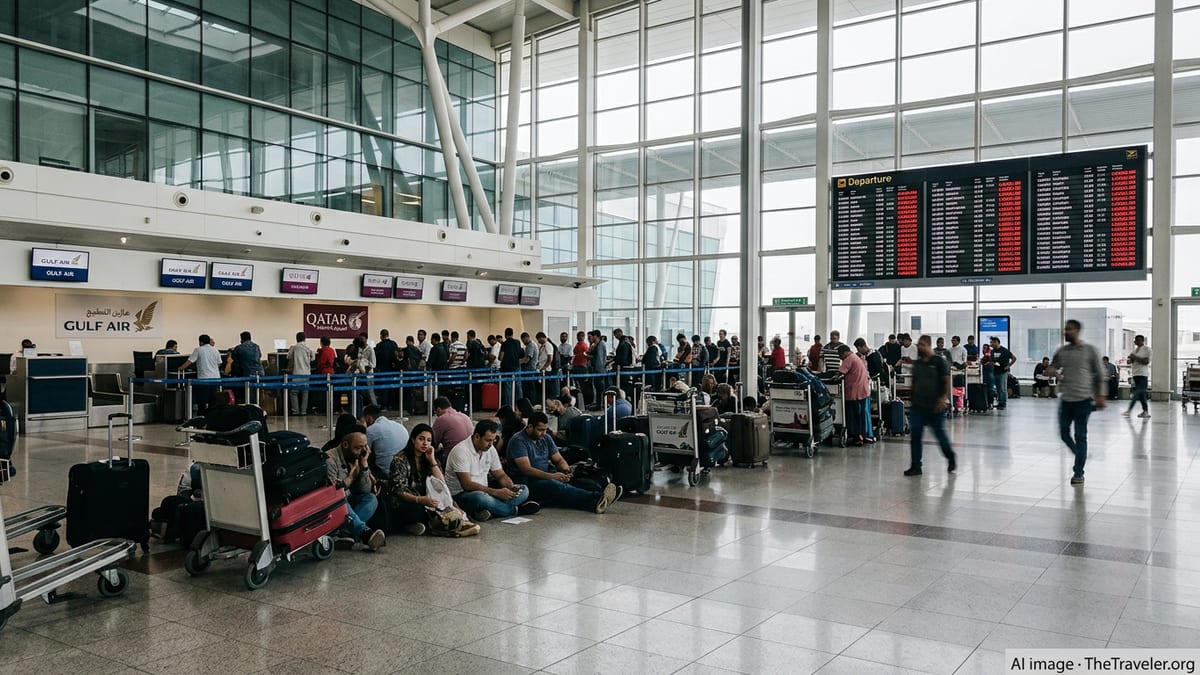
Airspace Shutdown Ripples Across Bahrain and the Gulf
The closure or severe restriction of airspace in Bahrain, Qatar and several neighboring states since late February 2026 has created a cascading aviation crisis. According to published coverage on the regional conflict, airspace restrictions introduced around 28 February led to thousands of daily cancellations across the Gulf, affecting both regional and international carriers and paralyzing normal hub operations.
Publicly available information on the broader conflict shows that missile and drone activity around key hubs such as Doha and major airports in the United Arab Emirates prompted authorities to shut or tightly constrict flight corridors for safety. As a result, Bahrain International Airport, which serves as Gulf Air’s primary hub, has seen scheduled services repeatedly suspended or rerouted, with only sporadic relief or diversion flights reported in recent days.
Industry advisories tracking Gulf transport operations indicate that most Gulf airspace remains either officially closed or effectively unusable for commercial traffic because of heightened military risk and airline-level safety decisions. This has pushed airlines to park aircraft, reposition fleets to airports in Saudi Arabia and elsewhere, and suspend regular passenger operations while they await clearer security conditions.
Across the region, the combination of airspace closures and conflict-related threats has left passengers stranded in transit hubs, on stopovers, or still at origin airports with no clear sense of when standard schedules might resume. Travel forums and social media posts from early and mid March describe crowded terminals, rolling delays, and repeated last-minute cancellations.
Gulf Air Operations Frozen as Fleet Moves out of Bahrain
For Bahrain’s flag carrier Gulf Air, the shutdown has been particularly acute. Open-source reporting on the conflict in Bahrain notes that the airline has moved much of its fleet out of Bahrain International Airport to airports in neighboring Saudi Arabia, a step that underscores how constrained operations from its home base have become.
Travelers sharing their experiences online in early March describe multiple Gulf Air flights canceled at short notice, including services that were initially shown as operating before being scrubbed closer to departure. Some passengers recount attempting to connect via Bahrain from Dubai or other regional gateways only to find that transiting through the kingdom was no longer viable because of the suspended operations.
Reports circulating in aviation discussion channels suggest that, over several days, dozens of Gulf Air flights touching Bahrain were removed from schedules, contributing to a tally of more than 90 cancellations when combined with suspended Qatar Airways services in the same time frame. While exact day-by-day breakdowns differ between tracking sources and traveler accounts, the pattern points consistently to sustained disruption rather than a short, isolated closure.
With Bahrain’s airspace still heavily constrained, Gulf Air has been trying to manage a mounting backlog of passengers needing rebooking. Some travelers report being shifted onto future dates once the airline can operate limited services from alternative airports, particularly in Saudi Arabia, but many remain in limbo pending clearer guidance on when flying via Bahrain will again be possible at scale.
Qatar Airways Cancellations Add to the Regional Strain
Qatar Airways, one of the largest long-haul carriers in the region, has also been forced into sweeping schedule cuts as Qatari airspace remains closed. Publicly available accounts of the crisis indicate that the airline initially suspended regular operations at the end of February, with a notice window covering travel dates from 28 February to early March and offering refunds or complimentary date changes for affected customers.
Online travel updates shared around 5 to 7 March describe Qatar Airways operating only a narrow set of repatriation or relief flights from Doha to a handful of major European cities under special air traffic approvals. At the same time, travelers with tickets to other destinations report seeing their flights repeatedly canceled or pushed back, sometimes with aircraft still displayed as "scheduled" in reservation systems until shortly before departure.
Discussion threads dedicated to Qatar Airways disruptions highlight how the carrier’s usual hub-and-spoke role has been dramatically curtailed. Passengers connecting from North America, Europe, Asia and Africa through Doha report being unable to secure new dates within their original travel window, with some considering alternative routings through airports that retain more stable operations.
When these Qatar Airways cancellations are considered alongside Gulf Air’s halted services at Bahrain, the combined impact totals at least 93 scrapped flights in the space of several days, based on tallies compiled from airline advisories, schedule-tracking screenshots and traveler testimonies. That figure likely represents only a portion of the wider disruption affecting the Gulf’s aviation network.
Passengers Face Stranded Journeys and Rising Costs
For individual travelers, the operational picture translates into intense uncertainty. Accounts shared on social platforms since late February describe passengers arriving at airports in Toronto, London, Dubai and other cities for Qatar Airways or Gulf Air departures that appeared active on apps and websites, only to encounter cancellations at the check in desk or after hours-long rolling delays.
Some travelers to and from Bahrain report being advised to remain at home or in their hotels unless they receive direct confirmation that their flights are operating, because airport terminals are congested and options to reroute are extremely limited. Others recount driving across borders into Saudi Arabia in search of flights on carriers whose hubs lie outside the most heavily restricted airspace.
Frequent flyers contributing to community travel threads note that alternative routes on airlines still running partial schedules have grown rapidly more expensive, with last-minute fares climbing as capacity tightens. At the same time, uncertainty about how long the closures will last has made it difficult for passengers to commit to new dates or itineraries, especially for complex multi segment journeys.
There are also reports of travelers struggling to reach airline contact centers in the days immediately after the closures, with long call waits and limited success in securing immediate refunds. Over time, however, airlines have begun to clarify eligibility windows for refunds and free rebooking, often tied to travel dates that fall during the core closure period that started on 28 February.
Uncertain Timeline for Reopening and Recovery
As of mid March 2026, publicly available updates indicate that large sections of Gulf airspace remain partially or fully closed, with security conditions still dictating tight restrictions on civilian aviation. Some carriers have begun to test limited operations on alternative routings or through secondary airports, but comprehensive timetables for restoring normal service have yet to emerge.
Forum posts and informal updates from travelers in Bahrain and Qatar suggest that any reopening is likely to be staggered, starting with narrow operating corridors and a small number of priority routes. Even once airspace technically reopens, airlines will need time to move aircraft back into position, realign crew schedules and rebuild complex wave patterns at their hubs in Bahrain and Doha.
Aviation analysts quoted across open-source commentary on the conflict note that the economic impact of prolonged closures will be significant for both airlines and the tourism-dependent economies of the Gulf. Bahrain in particular relies on its role as a regional connection point, and the continuing shutdown of Gulf Air’s core network is expected to weigh on hotels, hospitality providers and ancillary travel services.
For now, travelers booked on Gulf Air, Qatar Airways or other regional carriers are being urged in public advisories and travel alerts to monitor their flight status frequently, avoid unnecessary trips to airports without confirmed departures and remain prepared for further short-notice schedule changes. With conflict dynamics still evolving, the timeline for full recovery of Bahrain’s air links and broader Gulf connectivity remains difficult to predict.