

More news on this day
Bahrain is moving in lockstep with Saudi Arabia and its Gulf neighbors to upgrade aviation infrastructure, aligning new investments in safety, technology and passenger experience with a wider regional push to modernize Jeddah’s King Abdulaziz International Airport and meet surging global travel demand.
GCC Aviation Boom Puts Jeddah in the Spotlight
Passenger growth across the Gulf is reshaping global air corridors, and Jeddah’s King Abdulaziz International Airport has emerged as one of the region’s fastest-rising hubs. Recent industry data shows the airport handled around 49 million passengers in 2024, placing it just behind Dubai and Doha among the Gulf’s busiest gateways and underscoring its central role in Saudi Arabia’s Vision 2030 tourism and logistics ambitions.
This surge is being driven by a mix of expanding national carriers, rising religious tourism to nearby Makkah and Madinah, and growing point-to-point traffic between Asia, Europe and Africa routed via the Red Sea coast. Airlines and regulators say that without continuous investment in terminal capacity, airfield efficiency and smarter security, the region’s aviation boom would quickly encounter bottlenecks.
Gulf governments have responded with multi-decade infrastructure pipelines, from Saudi Arabia’s new King Salman International Airport project in Riyadh to major expansions in Abu Dhabi, Doha, Kuwait City, Muscat and Bahrain. Together, these programs are designed to ensure that key nodes like Jeddah can absorb record traffic levels while maintaining high service standards.
New E-Gates and Smart Security at Jeddah Airport
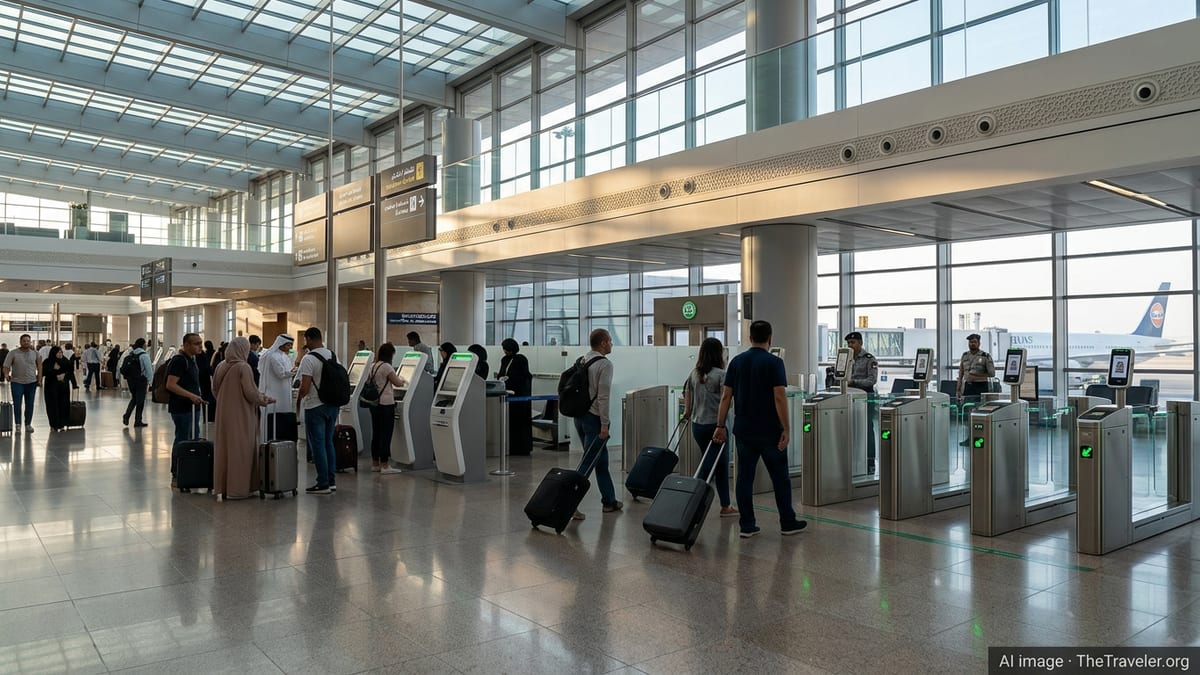
At Jeddah’s King Abdulaziz International Airport, authorities have rolled out 70 advanced electronic gates that automate key stages of the passenger journey using biometric verification and facial recognition technology. The system, unveiled in 2025, is intended to cut queues at immigration and boarding, while maintaining strict identity checks that align with global aviation security benchmarks.
Officials involved in the rollout say each gate is capable of processing thousands of travelers per day, reducing average processing times by around 40 percent compared with traditional counters. The technology is integrated with national databases and border-control systems, enabling real-time risk assessments and minimizing manual document handling.
The innovation at Jeddah forms part of a broader Saudi strategy to harness automation, artificial intelligence and data analytics to manage peak volumes, particularly during Hajj and Umrah seasons. Alongside the e-gates, authorities are testing advanced crowd-monitoring tools, including drones and sensor networks, to track passenger flows and respond quickly to safety incidents in the wider Jeddah and Makkah region.
Bahrain Steps Up Airport Modernization and Security
Bahrain’s decision to accelerate its own airport upgrades is closely linked to these developments in Saudi Arabia. Bahrain International Airport has recently completed a multibillion-dollar modernization of its passenger terminal, quadrupling capacity to around 14 million travelers per year. The terminal features streamlined security screening, automated baggage systems and expanded lounges and retail, positioning Bahrain as a convenient access point to Saudi Arabia’s Eastern Province via the King Fahd Causeway.
In parallel, Bahrain Airport Company has launched a 2025 runway maintenance and safety program that includes resurfacing, friction testing, airfield ground lighting upgrades and new LED approach systems. Executives say the work is designed to uphold stringent safety standards as traffic grows and to ensure that Bahrain can act as a reliable secondary gateway for travelers bound for or connecting through Saudi airports such as Jeddah.
Bahrain has also invested in next-generation security operations. A recent partnership between Bahrain Airport Services and local digital firm Beyon Solutions aims to introduce a unified security management platform that leverages internet-of-things sensors and data analytics for faster incident response and more precise monitoring of critical facilities, from cargo terminals to catering and engineering complexes.
These hard and soft infrastructure upgrades enable Bahrain to participate more actively in the regional aviation network centered on Saudi Arabia. They strengthen Bahrain’s role as both a feeder and partner hub for flows of passengers heading to Jeddah for religious tourism, business and leisure, while helping to balance capacity across the Gulf’s closely connected airspace.
Regional Cooperation on Passenger Services and Border Technology
Bahrain’s closer coordination with Saudi Arabia is not limited to bricks-and-mortar investments. The two kingdoms have agreed to phase in an electronic integration system for the King Fahd Causeway and to activate e-gates for passport holders at airports on both sides of the border. This move is intended to reduce processing times for frequent travelers and to harmonize data-sharing and security checks between the neighboring states.
Officials from both countries have framed these measures as part of a wider Gulf Cooperation Council trend toward interoperable border technologies and shared standards for passenger services. Similar initiatives are visible across the United Arab Emirates, Qatar, Kuwait and Oman, where airports are deploying biometric corridors, digital identity solutions and self-service touchpoints to handle growing volumes without proportional increases in staff.
For Jeddah, these regional linkages mean that many passengers arriving from or transiting through Bahrain and other Gulf hubs will encounter consistent service levels and compatible digital systems. Industry analysts argue that this cohesion is crucial if the GCC is to market itself as a seamless aviation super-region capable of competing with established hubs in Europe and Asia.
Gulf States Align Strategies to Meet Surging Demand
Saudi Arabia’s Vision 2030 program has catalyzed a wave of aviation-related reforms and capital spending across the Gulf, with policymakers viewing airports as engines for tourism, logistics and non-oil economic growth. The United Arab Emirates is pursuing its own long-term vision centered on technology and financial services, supported by major expansions at Dubai and Abu Dhabi airports. Qatar continues to invest in Hamad International Airport as a global connector, while Kuwait and Oman push ahead with large-scale terminal and runway projects.
Bahrain’s Economic Vision 2030, which emphasizes services and high-value manufacturing, increasingly incorporates aviation as a pillar for connectivity and investment attraction. Upgrades to Bahrain International Airport, and its emerging status as a convenient gateway for Saudi-bound travelers, align with Saudi Arabia’s efforts to lift annual passenger volumes at Jeddah and other airports to new records.
Experts say that as these national strategies converge, the Gulf’s aviation system is evolving into a network of complementary hubs rather than isolated competitors. Bahrain’s latest infrastructure and security upgrades allow it to join Saudi Arabia, the United Arab Emirates, Qatar, Kuwait and Oman in offering modernized facilities, advanced screening technologies and upgraded passenger services that collectively support Jeddah’s ascent as a global travel crossroads.