

More news on this day
Bahrain has joined a growing list of Middle Eastern countries offering automatic visit visa extensions and fee waivers to stranded travelers, as unprecedented airspace closures across the Gulf leave tens of thousands of visitors unable to leave the region.
Get the latest news straight to your inbox!
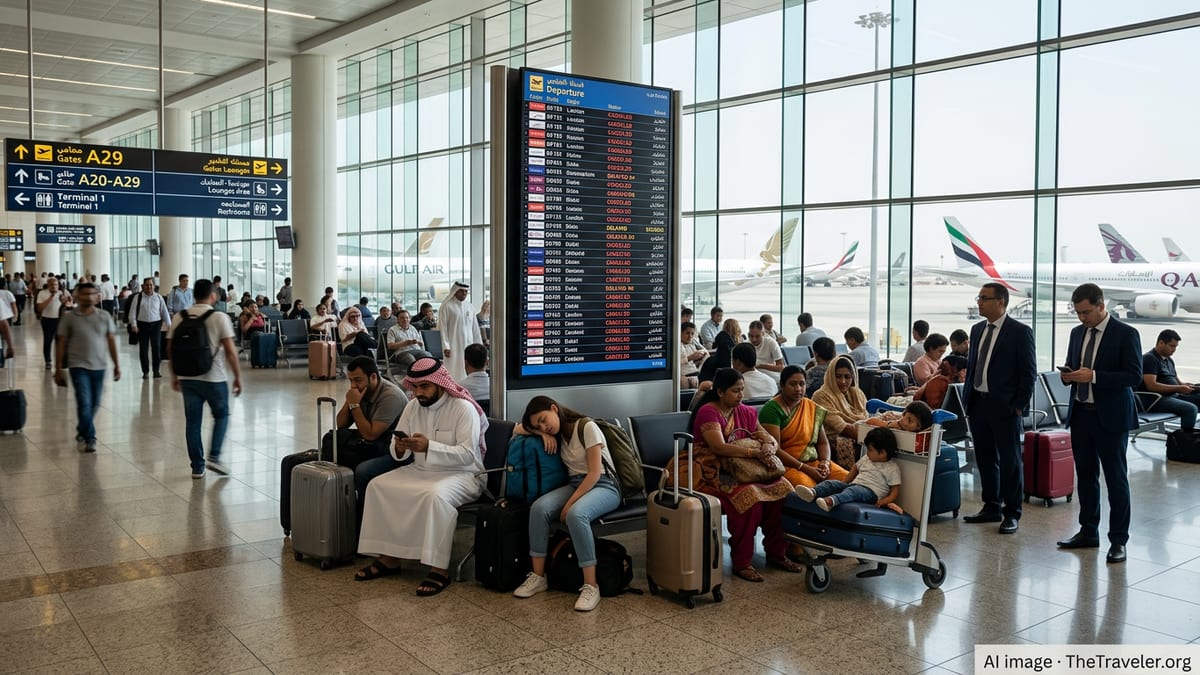
Bahrain Confirms Visa Relief as Airspace Closes
Bahrain is granting temporary extensions on visit visas for foreign nationals caught in the country by the shutdown of its airspace, according to regional aviation and travel advisories issued in recent days. The move follows the total closure of Bahraini airspace reported on March 10, which forced the national carrier Gulf Air to suspend regular operations and left Bahrain International Airport largely at a standstill.
Officials have not published a full public decree, but airlines, corporate travel managers and consular briefings are advising that visitors whose visas expired or are due to expire during the current disruption will not be penalized, and that overstay fines will be paused for the duration of the emergency. Immigration desks at Bahrain’s airport and land borders are understood to be recording exit dates based on the date of actual departure, not on the original visa expiry.
Travel industry bulletins indicate that Gulf Air and ground-handling agents have been instructed to reassure passengers that they will not be considered in breach of immigration rules while they remain stuck in the kingdom. That reassurance is particularly important for expatriate families and short-term business travelers who had been transiting through Bahrain when the airspace closure took effect and suddenly found their return flights canceled.
The announcement places Bahrain in line with neighboring Gulf states that have already introduced similar measures, aiming to reduce anxiety for stranded tourists and to avoid sudden surges of applications at immigration offices while movements around airports are still restricted.
Qatar and Gulf Neighbors Lead Wave of Automatic Extensions
Qatar was among the first to offer an across-the-board solution when authorities confirmed an automatic one‑month extension on all entry visas earlier this month, directly linked to the temporary closure of Qatari airspace. That policy applies without any action by visa holders, sparing them from having to visit government service centers or use online portals at a time when many travelers have limited connectivity and are juggling constant flight changes.
Travel advisories and airline notices show that Saudi Arabia, the United Arab Emirates, Oman and Kuwait have each introduced variants of the same principle. In these cases, visitors whose stay is disrupted by canceled flights or closed airspace are being granted grace periods, with immigration authorities either extending the legal stay window or waiving overstay penalties until commercial operations stabilize.
Jordan and Lebanon, which sit at the northern edge of the current disruption zone, have not fully closed their airspace but have been forced to adjust flight schedules, particularly at night. Civil aviation regulators there have advised that visitors who are unable to depart on their original dates because of regional re‑routing will be accommodated by short administrative extensions, often coordinated directly through airlines and local sponsors.
This patchwork of national responses is converging on the same practical outcome: foreign visitors whose return journeys are disrupted by the cascading airspace closures will not be punished for circumstances beyond their control. For travelers, that reduces the risk of immigration complications on future trips and avoids the need to pay fines simply to leave.
Visa Fees Waived to Ease Pressure on Stranded Travelers
Alongside deadline relief, several Gulf and Levant governments are temporarily waiving or refunding key visa fees. In some countries, this applies to renewal charges for short visit visas and tourist visas; in others it covers the cost of emergency exit permits or special transit authorizations required to route passengers through alternative hubs.
In Bahrain, tour operators and corporate travel managers report that visitors are being allowed to remain on their existing status without paying additional extension fees as long as they depart on the first reasonably available flight once services resume. Similar approaches have been communicated informally in Saudi Arabia and the United Arab Emirates, where authorities are focusing resources on security screening and traffic management rather than on routine fee collection.
Qatari policy documents reviewed by immigration advisors confirm that the one‑month automatic extension on entry visas is being granted free of charge, and that travelers will not be asked to pay retroactive overstay fines tied to the period of enforced immobility. Kuwait and Oman have issued guidance through local agents indicating that stranded visitors can regularize their stay at no cost, provided they can show evidence of canceled or repeatedly rescheduled flights out of the region.
For many families and small businesses, the waiving of visa fees is more than a symbolic gesture. Travelers already face mounting hotel bills, higher last‑minute airfares and the cost of rebooking complex itineraries that once relied on Gulf hubs for smooth connections between Europe, Asia and Africa. Removing the additional burden of visa charges helps limit the financial shock of an unexpectedly extended stay.
Gulf Airspace Closures Ripple Across the Region
The visa measures come against the backdrop of an extraordinary aviation crisis triggered by widening conflict involving Iran and strikes across the Gulf. Since late February, authorities in Qatar, the United Arab Emirates, Kuwait and Bahrain have either fully closed their airspace or imposed severe restrictions, forcing airlines to suspend thousands of flights. Major hubs in Dubai, Abu Dhabi and Doha have seen passenger traffic evaporate almost overnight as aircraft are grounded or diverted.
Security briefs compiled by risk consultancies describe Bahrain and Kuwait as under total airspace closure as of March 10, with the UAE operating only narrow emergency corridors and Saudi Arabia limiting traffic over parts of its territory. While Oman’s skies remain formally open, the sultanate has become the main exit point for many travelers trying to leave the wider region, placing heavy pressure on Muscat International Airport and on overland routes from the UAE.
The result is a complex web of diversions and delays stretching far beyond the Middle East. Flight status trackers show knock‑on disruptions at major airports in Asia and Europe as carriers re‑route widebody aircraft around restricted zones, add hours to flight times and burn more fuel to avoid conflict airspace. For stranded travelers, that translates into long waits in hotel lobbies, crowded check‑in halls and rapidly changing boarding times that often evaporate as quickly as they appear on departure boards.
In Lebanon and Jordan, where airspace remains technically open, airlines are still recalculating routings and crew schedules on a daily basis. Beirut and Amman have emerged as important alternative gateways for some national repatriation efforts, yet both are constrained by regional overflight limits and by heightened security concerns. Authorities there have quietly adopted more flexible visa handling for overstaying tourists, in line with approaches now seen in the Gulf.
What International Travelers Should Expect Next
For foreign visitors currently in Bahrain, Qatar, Saudi Arabia, the United Arab Emirates, Oman, Kuwait, Jordan, Lebanon and neighboring states, the immediate message is that immigration rules are being applied with unusual flexibility. Automatic extensions, waived fees and grace periods are designed to allow travelers to focus on finding safe routes home rather than worrying about visa stamps.
Travel experts caution, however, that the situation remains fluid. Airspace restrictions can tighten or ease with little notice, and the pattern of emergency repatriation flights changes day by day. Passengers are being advised to stay in close contact with their airlines, to monitor official government and airport communications, and to avoid traveling to airports without a confirmed booking, as terminals in affected hubs quickly become overcrowded.
Those planning future trips through the Gulf are being encouraged to build extra buffers into itineraries, consider routing through alternative hubs and check the latest transit and visa policies before departure. Even once airspace restrictions begin to lift, immigration authorities may take time to unwind temporary concessions and return to standard fee structures, particularly if backlogs of overstays need to be regularized.
For now, the coordinated decision by Bahrain and its regional neighbors to extend visit visas and waive related fees is a rare point of reassurance in an otherwise volatile travel landscape. It signals a recognition that keeping stranded travelers in legal status is not only humane but also essential to managing one of the most far‑reaching aviation disruptions the modern Gulf has seen.