

More news on this day
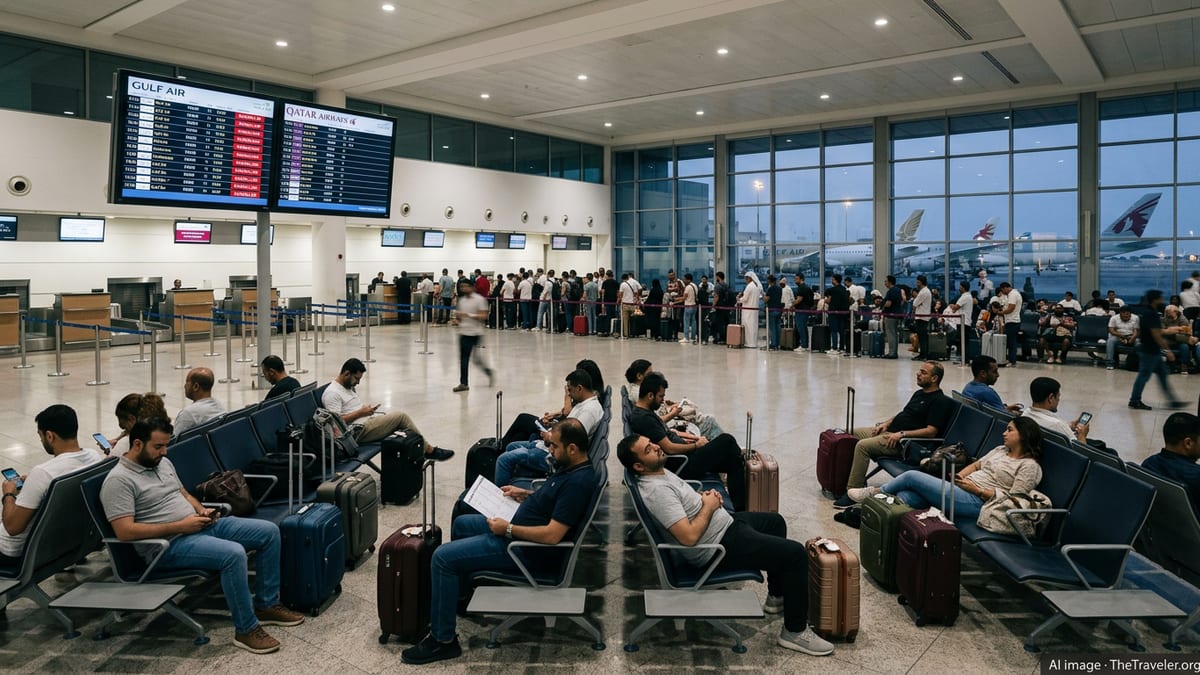
Travel disruption across the Gulf shows little sign of easing as Bahrain’s ongoing airspace closure forces carriers including Gulf Air and Qatar Airways to cancel and reroute flights, with reports indicating more than 90 services scrapped in recent days and thousands of passengers facing extended delays and diversions.
Get the latest news straight to your inbox!
Airspace Closure Keeps Pressure on Bahrain Hub
The closure of Bahrain’s airspace, imposed amid a wider regional security crisis linked to the Iran conflict, has effectively frozen normal operations at Bahrain International Airport. Publicly available aviation notices and travel advisories indicate that restrictions remain in place across several Gulf states, complicating routing options for airlines that typically depend on the tightly interconnected region for short-haul and long-haul links.
Bahrain’s national carrier, Gulf Air, has been among the hardest hit. Information shared in airline updates and traveler advisories suggests that the airline has suspended regular scheduled services to and from its Manama hub, with aircraft repositioned to neighboring airports in Saudi Arabia to maintain at least limited connectivity. In parallel, Qatar Airways is contending with its own airspace restrictions, as Qatari skies have also been intermittently closed, forcing cancellations and last-minute operational changes.
Across the region, industry assessments describe a pattern of rolling disruption, with carriers cutting frequencies, consolidating services and, in some cases, pausing entire route networks while awaiting clearer safety guidance. While some countries have reported partial reopenings or controlled corridors, commercial schedules remain far from normal, keeping Bahrain’s hub function severely constrained.
Against this backdrop, travel industry briefings estimate that Bahrain-linked cancellations by Gulf Air and Qatar Airways have climbed into the dozens, with about 93 flights scrapped or heavily altered over a short window as airlines react to shifting airspace conditions.
Gulf Air and Qatar Airways Cancel, Consolidate and Reroute
Gulf Air’s response has centered on suspending direct operations through Bahrain while attempting to preserve essential links via nearby airports. Travel alerts from corporate travel managers and passenger accounts indicate that the carrier has funneled a portion of its schedule through King Fahd International Airport in Dammam, Saudi Arabia, effectively turning it into a temporary gateway for some Bahrain-origin or Bahrain-bound travelers.
Qatar Airways is facing parallel constraints. With Qatari airspace restricted, the Doha-based airline has cancelled large numbers of flights and, according to publicly accessible updates, has begun operating a limited series of relief and repatriation services aimed at clearing backlogs of stranded passengers. These flights are typically prioritized for travelers whose original services were cancelled and who have been waiting in transit hubs across the region.
Combined, the two Gulf carriers account for a significant share of regional connectivity, so the cancellation of roughly 93 services tied to Bahrain and Qatar in a compressed period has had an outsized impact. The cuts affect not only point-to-point journeys but also long-haul itineraries that rely on Manama and Doha as transfer points between Europe, Asia and Africa.
Operationally, both airlines are reportedly adjusting on a near-daily basis, pushing out rolling schedule changes as airspace notices evolve. Passengers have described sudden switches from confirmed bookings to cancelled status, followed by rebookings on alternative routings or different carriers when possible.
Passengers Face Long Delays, Sudden Changes and Limited Alternatives
For travelers, the immediate effect has been a wave of uncertainty. Social media posts, online forums and media coverage highlight cases of passengers stuck for days in airports such as Doha, Dubai and Riyadh after onward flights via Bahrain were cancelled. Some have reported overnight stays in crowded terminals, while others have opted to arrange overland travel to alternative airports where flights are still operating.
In Bahrain’s case, the closure has left many residents and visitors exploring road links to Saudi Arabia and Kuwait in search of available seats on other airlines. Reports from the region describe full or near-full departures on carriers that continue to operate around the restricted airspace, as well as sharp increases in one-way fares on remaining routes.
Communication has emerged as a particular pain point. Travelers recount challenges reaching call centers and securing timely confirmation of new itineraries. In several instances, people have described receiving cancellation notices only hours before scheduled departure, followed by long waits for rebooking details. Travel management firms are advising clients to monitor booking tools frequently and to avoid heading to the airport without explicit confirmation that a flight is operating.
Some passengers have turned to alternative hubs beyond the core Gulf region, seeking seats via Istanbul, Cairo or European gateways instead of the traditional Manama and Doha connections. However, these options are limited by aircraft availability and by the wider pattern of flight reductions across the Middle East prompted by the conflict.
Wider Middle East Network Feels the Strain
The turbulence around Bahrain’s airspace closure is part of a broader shock to Middle East aviation. Analyses of the conflict’s economic impact and airline operations note that multiple Gulf states, including the United Arab Emirates, Qatar, Kuwait and Bahrain, have introduced restrictions that significantly narrow the air corridors available to commercial carriers. The result has been thousands of daily cancellations and diversions, affecting both regional and intercontinental traffic flows.
Major international airlines have temporarily suspended services to parts of the Gulf or rerouted flights to skirt restricted zones, adding hours to journey times and driving up fuel and crew costs. At the same time, regionally based airlines such as Kuwait Airways and others have cut or consolidated services. This tightening of capacity is filtering through to passengers in the form of reduced choice, higher fares and more complex routings.
Air cargo networks are also feeling the strain. Industry briefings describe reduced belly-hold capacity on passenger aircraft and the loss of key overnight connections through Bahrain and Qatar. Logistics operators are scrambling to reconfigure supply chains, diverting freight through secondary airports or shifting some volume to maritime routes, with knock-on effects for delivery times and costs across the wider region.
With the situation still fluid, aviation analysts caution that network recovery is likely to be uneven, with some hubs restoring partial operations more quickly than others depending on security assessments and infrastructure conditions.
Advice for Travelers Holding Tickets via Bahrain or Doha
Travel organizations and risk consultants are urging passengers with upcoming itineraries involving Bahrain or Doha to adopt a proactive approach. Publicly available guidance recommends checking booking status repeatedly in the days and hours before departure, as last-minute changes remain common while airspace restrictions are in effect.
Where possible, travelers are being advised to keep original tickets active until the operating carrier cancels, as this can preserve entitlement to complimentary rebooking or refunds under airline policies. Voluntary cancellations, by contrast, may trigger standard change fees or fare differences. Passengers are also encouraged to ensure that contact details in their reservations are up to date so that airlines and travel agents can push real-time notifications when schedules shift.
For those already stranded, reports suggest that options vary widely by airport and airline. Some carriers are arranging hotel accommodation or meal vouchers in line with their usual disruption policies, while others are providing basic assistance and focusing resources on clearing backlogs as airspace windows allow. Travelers are frequently reminded to retain receipts for necessary expenses, which may be relevant for future insurance or claims.
Looking ahead, regional air travel is expected to remain volatile as long as airspace closures persist. For Bahrain in particular, the combination of a grounded national carrier and a closed airspace corridor means its traditional role as a convenient Gulf transit point has been sharply curtailed, at least in the short term, leaving Gulf Air, Qatar Airways and their passengers to navigate an extended period of uncertainty.