

More news on this day
Bahrain and the United Arab Emirates have switched on a first-of-its-kind one-stop air border system between the two countries, marking a pivotal moment in the Gulf’s push to create a seamless travel area and raising expectations of a tourism boom across the wider GCC.
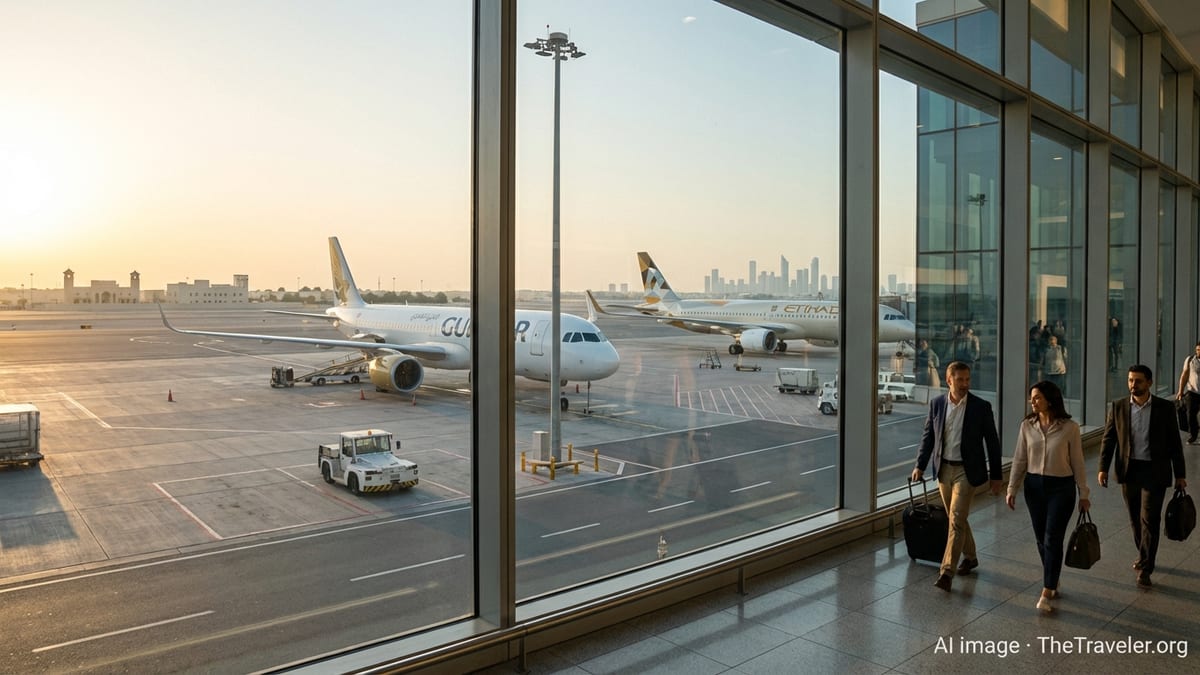
How the One-Stop Air System Works
The new one-stop system allows eligible passengers flying between Bahrain and the UAE to complete all immigration, customs and security checks at a single point before departure, rather than undergoing repeat procedures on arrival. In practice, that means travellers clear both countries’ formalities at the airport they depart from and then arrive at their destination as if on a domestic flight.
Instead of queuing twice, passengers pass through a dedicated channel staffed and monitored under a joint arrangement between the two states’ authorities. Once cleared, they can walk straight to baggage claim or onward connections, bypassing traditional arrival checkpoints. Officials say the model is inspired by successful pre-clearance and shared-border examples in other regions, adapted for the Gulf’s fast-growing aviation hubs.
The pilot currently applies on selected routes between Bahrain International Airport and major UAE gateways, including Abu Dhabi and Dubai, and is being closely tracked by aviation regulators and interior ministries across the Gulf. Systems have been upgraded to recognise a single clearance decision, with electronic records instantly shared between both countries’ border agencies.
Operationally, airlines have been instructed to flag one-stop passengers through special boarding passes and lane signage, helping airport teams separate them from travellers who still need to undergo regular arrival checks. Authorities expect the model to cut processing times significantly during peak travel periods such as national holidays and major events.
Bahrain and UAE as Testbed for GCC Integration
The decision to start with Bahrain and the UAE reflects both countries’ status as aviation and tourism pioneers within the GCC. The UAE’s mega-hubs in Dubai and Abu Dhabi already serve as global connectors, while Bahrain has positioned itself as a nimble regional gateway with a strong business travel base. Together, they offer an ideal proving ground for a technically complex border innovation that needs high passenger volumes and efficient airport operations.
The one-stop initiative follows an endorsement by GCC interior ministers, who agreed that a shared clearance model is a logical next step in the bloc’s long-term economic integration agenda. By design, the Bahrain–UAE corridor is the first link in what officials ultimately envisage as a web of interconnected air routes across all six Gulf states, each operating with harmonised procedures and data-sharing standards.
For now, participation is limited to citizens of GCC member states flying between the two pilot countries, allowing authorities to test systems with a relatively well-understood traveller segment before widening the scheme. Even within those limits, however, the project is being treated as a live laboratory for policy, technology and joint staffing, with lessons expected to inform later land and sea border experiments.
Tourism strategists say the symbolism is almost as important as the operational impact. By publicly entrusting each other with shared border responsibilities, Bahrain and the UAE are signalling a new level of confidence in their security cooperation and a shared bet that easier people movement will pay dividends in trade, tourism and investment.
Tourism Gains: From Weekend Breaks to Multi-City Gulf Itineraries
The immediate tourism impact is expected to be most visible in short-haul leisure and business trips. With airport formalities reduced to a single checkpoint, weekend getaways between Manama, Abu Dhabi and Dubai become quicker and less stressful, encouraging residents to treat neighbouring cities as extensions of their own leisure landscape.
Travel agents report early interest in bundled Bahrain–UAE packages built around events, sports fixtures and shopping festivals, particularly for Gulf nationals who already move frequently within the region. The simplified airport experience is seen as a key selling point for families and older travellers who are often deterred by long queues and repeated checks.
On the corporate side, companies that shuttle staff between the two markets expect to save both time and money. Shorter airport processing translates into tighter itineraries, fewer nights of accommodation and reduced downtime for executives and technical crews. Sectors such as finance, energy, professional services and aviation itself stand to benefit from smoother cross-border commuting.
Longer term, the one-stop model is expected to feed into more ambitious multi-city tourism products that treat the Gulf as a single, varied destination. Once replicated across additional GCC routes, visitors could fly into a primary hub such as Dubai or Riyadh, then hop between Bahrain’s heritage sites, Oman’s coastline, Saudi Arabia’s giga-projects and Qatar’s museums with near-domestic ease.
The Unified GCC Tourist Visa: A Parallel Revolution
Running in parallel to the one-stop air system is another game-changing reform for Gulf tourism: the Unified GCC Tourist Visa. Often described as a Schengen-style permit, the single visa will eventually allow eligible visitors to enter any of the six GCC states and travel throughout the bloc without reapplying for separate entry documents in each country.
The unified visa has already been politically approved and is in advanced technical preparation, with authorities now working toward a launch timeline that has shifted into 2026. Officials describe the project as a strategic milestone that could reshape how the region markets itself, enabling multi-country Gulf itineraries under a single administrative umbrella.
Where the one-stop air system primarily targets Gulf citizens and, in later phases, residents, the unified visa is designed with international tourists in mind. Prospective visitors would apply through a digital portal, submit biometric and travel data once, and then gain the freedom to travel across multiple GCC destinations within a defined validity period, likely ranging between 30 and 90 days.
Tourism boards across the region are already planning joint campaigns built around this new reality. Instead of choosing between Dubai or Doha, or Riyadh or Muscat, long-haul travellers from Europe, Asia and the Americas could be encouraged to sample several cities and landscapes in a single trip, all under one visa and, eventually, through a network of streamlined intra-GCC flights.
Digital Backbones and Security Safeguards
Behind the scenes, both the one-stop system and the unified visa rely on a sophisticated digital backbone being stitched together across the six Gulf states. Interior ministries and border agencies are building a shared electronic platform capable of exchanging real-time data on traveller histories, visa status, entry and exit records, and border-related violations.
This integrated infrastructure is essential to the success of a model where one country effectively carries out checks on behalf of another. For the one-stop air system, it means that when a passenger is cleared at departure, that decision appears instantly in the arrival airport’s systems, allowing the traveller to move through as if they had passed local immigration.
Authorities stress that the drive for easier travel will not come at the expense of security. The shared platform is being designed to accommodate each state’s risk thresholds and watchlists, with joint protocols for how to handle alerts and exceptional cases. Officials also highlight that digitalisation can increase, rather than reduce, oversight by replacing manual checks with automated, data-driven screening.
Privacy and data protection standards are another pillar of the new regime. Governments are negotiating common frameworks to govern how long records can be stored, who can access them, and how information is used across different agencies and jurisdictions. These rules will be critical to building public trust in a system that moves large volumes of personal data across borders.
Economic Stakes for Aviation and Hospitality
The stakes for airlines, airports and the wider visitor economy are considerable. Gulf carriers have spent years building dense short-haul networks across the region, but friction at borders has remained a bottleneck to fully integrated travel. By trimming the time passengers spend in queues, the one-stop system promises to make intra-GCC routes more attractive and competitive.
Airlines operating between Bahrain and the UAE are already adjusting schedules and ground operations to leverage the new model. Faster passenger processing opens the possibility of tighter turnarounds, more convenient departure times and improved on-time performance. As the scheme expands, carriers could re-optimise their Gulf networks around higher-frequency shuttle services linking key business and leisure markets.
For hotels, tour operators and attractions, the combination of border innovation and a forthcoming unified visa could significantly widen the pool of potential guests. Regional tourism planners have long argued that the Gulf’s diverse offerings are best experienced as a circuit rather than stand-alone stops; a traveller who might spend five nights in a single city could instead be persuaded to take a ten-night multi-destination journey.
Local economies also stand to gain from increased spending by repeat visitors who find it easier to return. If travel between Gulf capitals begins to feel genuinely border-light, a new class of frequent regional leisure traveller could emerge, mirroring patterns seen in Europe’s single market and North America’s cross-border city pairs.
What Travellers Need to Know Right Now
Despite the scale of the vision, the new system is rolling out in carefully controlled phases, and travellers still need to pay close attention to eligibility rules. At this stage, the one-stop air system between Bahrain and the UAE is limited to citizens of GCC countries on participating flights. Expatriate residents and international visitors will continue to use existing immigration lanes and must still comply with current visa regulations.
Passengers using the new one-stop route are advised to arrive at the airport in good time, as missing the joint clearance step at departure could mean undergoing full processing on arrival and, in some cases, facing penalties. Authorities emphasise that travellers must continue to carry valid passports even when the process feels more like a domestic journey.
For non-GCC tourists planning trips to the region in 2026 and beyond, the most important development to watch is the unified tourist visa timeline. Until it is fully operational, visitors will still need to secure individual visas or e-visas for each Gulf country they intend to visit, subject to existing exemptions and bilateral arrangements.
Travel advisers recommend that both regional residents and incoming tourists consult up-to-date official guidance when booking itineraries, particularly during the transition period when one-stop corridors and the unified visa may coexist with older procedures. As with any major systems change, there may be short-term inconsistencies as airports, airlines and border posts adjust.
A Template for a Seamless Gulf Travel Area
For policymakers, the Bahrain–UAE experiment is about far more than shaving minutes off airport queues. It is seen as a template for how the GCC could knit together its skies, borders and tourism sectors into a single, competitive travel area that can stand alongside established regions in Europe and Asia.
If the pilot proves successful and is replicated across other routes and border types, the Gulf could move closer to a reality where citizens, residents and visitors experience travel between member states as a largely internal journey, underpinned by shared standards but respecting national sovereignty. That prospect carries implications not only for tourism but also for labour mobility, education, healthcare and culture.
Industry observers note that the timing is significant. As global travel patterns continue to evolve, the Gulf is racing to capture a larger share of long-haul tourism, high-value business events and transit traffic. A reputation for friction-free movement within the bloc could become a powerful differentiator, particularly for travellers comparing the Gulf with other multi-country regions.
For now, the most tangible change is felt in the departure halls of Bahrain and the UAE, where selected passengers are discovering that a cross-border flight can feel almost as straightforward as a domestic hop. If the vision holds, their experience may soon be the norm across a new, seamlessly connected Gulf travel landscape.