

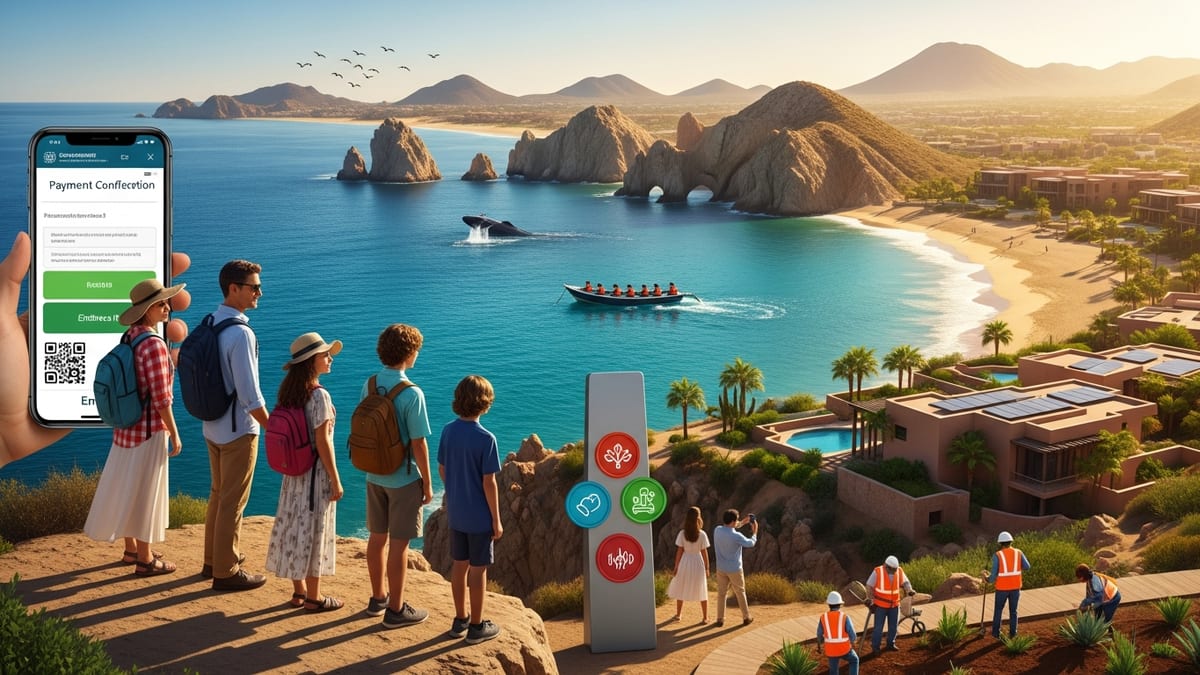
International travelers heading to one of Mexico’s most popular sun and sea destinations will face slightly higher costs in 2026, as the Pacific state of Baja California Sur has increased its mandatory “Embrace It” tourist tax for foreign visitors.
The hike affects marquee resort areas including Los Cabos, Cabo San Lucas, La Paz and Loreto, and is part of a broader push to tie booming tourism more directly to environmental protection and local development.
More News
- Canada Tightens Travel Warnings as Extreme Weather Claims 83 Lives
- Snowstorm Chaos in Manali: Tourists Stranded as Himachal Issues Urgent Travel Alert
- Cyclone Harry Keeps Silver Muse in Valletta, Turning Disruption Into Deeper Malta Discovery
Tourist tax rises for 2026 in Baja California Sur
As of January 1, 2026, Baja California Sur has raised its Embrace It fee from 470 to 488 Mexican pesos per person for international visitors. The increase of 18 pesos, roughly an adjustment of less than one U.S. dollar at current exchange rates, might seem modest on an individual level but is expected to generate millions of pesos in additional revenue when spread across the state’s growing influx of visitors.
The tourist tax applies per stay, not per night, and remains a flat amount regardless of the type of accommodation or length of visit, as long as travelers remain in the state for more than 24 hours. Authorities say the update respects the framework already laid out in the state’s Finance Law and is intended to keep funding levels in line with inflation and rising demand on local infrastructure and natural resources.
Baja California Sur has framed the fee as a strategic tool to secure long term resources for conservation and community development. With foreign arrivals climbing and international tourism back at or above pre pandemic levels, state officials argue that the modest surcharge paid by each traveler can have an outsized impact on preserving the fragile desert and marine ecosystems that underpin the destination’s appeal.
Who pays the Embrace It fee and where it applies
The Embrace It contribution is mandatory for international travelers aged 12 and older who enter Baja California Sur by air or land and stay in the state for more than 24 hours. That means most vacationers flying into Los Cabos International Airport for a beach holiday, or road trippers crossing into the peninsula from the United States and spending at least one night, will be required to pay the fee.
The tax applies across the state, including headline destinations such as Los Cabos, Cabo San Lucas, La Paz and Loreto, as well as smaller communities that rely heavily on tourism. Day visitors who remain fewer than 24 hours are exempt, which is expected to limit the impact on brief cruise excursions and cross border hops, although local officials have separately highlighted a national level move to increase taxes on cruise passengers calling at Mexican ports.
Mexican citizens and residents are not targeted by the Embrace It fee, which is structured specifically around foreign visitors. Families traveling with children under 12 will see only the older members of their party charged. The state government stresses that the requirement is universal for eligible visitors, irrespective of nationality, travel purpose or accommodation budget.
How and when travelers must pay
Baja California Sur’s tourist tax is collected entirely through a digital platform rather than on arrival at a counter or hotel front desk. International visitors are expected to pay the 488 peso fee either before their trip or upon entering the state using the official Embrace It payment system, which includes online and mobile options administered by a private technology provider under contract with the government.
Once payment is completed, the system generates an electronic certificate containing a unique QR code that serves as proof of compliance. Travelers are advised to keep a digital or printed copy of the code accessible, as authorities may request it at random checks in airports, ports or other points of entry and exit. The state emphasizes that paying the tax is a legal obligation, not an optional donation, and that the centralized digital setup is meant to simplify the process for visitors while boosting collection rates.
The shift to a mandatory, fully digital model marks a change from earlier iterations of the program, which began as a voluntary contribution when first floated several years ago. Since mid 2025, however, payment has been compulsory for eligible visitors, and officials say the system has matured enough to handle the volume of foreign arrivals expected in 2026 and beyond.
From voluntary fee to cornerstone of sustainable tourism policy
Baja California Sur first introduced the concept of a tourist contribution as part of its sustainability agenda earlier in the decade, initially positioning it as an optional way for visitors to “give back” to the places they enjoyed. In 2025, the state moved to formalize and enforce the charge under the name Embrace It, citing the need for a stable, predictable income stream to support environmental and social projects at the local level.
The 2025 rollout set the fee at 470 pesos per person and focused on building awareness among travelers and the tourism industry through a public private campaign branded around a “One Voice” message. That initiative sought to align hoteliers, tour operators, transport companies and government agencies behind a single explanation of why the tax existed, who had to pay it and how the money would be used, in order to minimize confusion and resistance.
Data released by state authorities and airport operators for the second half of 2025 show that the vast majority of payments were made by visitors from the United States and Canada, reflecting the peninsula’s heavy reliance on North American tourism. Officials have highlighted this early experience as proof that the system can function at scale and that travelers are willing to accept a clearly defined, earmarked fee when they understand its purpose.
Where the money goes: conservation, infrastructure and communities
The central justification for raising and maintaining the tourist tax is its role in funding projects that, according to officials, would otherwise struggle to secure consistent financing. Revenue from Embrace It is earmarked for environmental protection, tourism infrastructure improvements, and social and cultural initiatives across Baja California Sur’s municipalities.
Specific uses include conservation programs in marine protected areas that are home to whales, sea turtles and other iconic species, as well as measures to protect reefs, dunes and desert landscapes that face growing pressure from development and visitor traffic. Investments in wastewater treatment, solid waste management and coastal restoration have also been flagged as priorities in public statements surrounding the tax.
On the community side, part of the income is directed to cultural projects and social programs designed to ensure that tourism growth translates into tangible benefits for residents, particularly in smaller towns and rural areas that serve as gateways to nature based attractions. Local authorities argue that these investments help maintain the authenticity and quality of the visitor experience by supporting livable communities, not just beachfront resorts.
Reactions from the tourism industry and travelers
Reactions to the increased fee have been relatively measured compared with controversies over tourism taxes in some European and U.S. destinations. Many hotel and resort operators in Los Cabos and La Paz have publicly aligned themselves with the state’s sustainability narrative, presenting the Embrace It contribution as part of the cost of doing business in a region whose economy and environment are deeply intertwined.
Some tour companies and travel agents, however, have expressed concern that any new charge risks adding to a perception that Mexico’s top vacation destinations are becoming more expensive, particularly once combined with fluctuating airfares and global inflation. They warn that price sensitive travelers may look to other Mexican states without similar fees, or to Caribbean competitors that do not levy a separate per stay tourist tax.
Feedback from visitors has been mixed but not overwhelmingly negative. Travel forums and agencies report that most guests accept the tax once it is explained as a one time, per person charge of roughly the equivalent of a few coffees or cocktails. Confusion and frustration appear to arise mainly when travelers learn about the requirement late in the booking process, or are unaware they must complete an online payment and obtain a QR code before departure.
Baja California Sur in a global wave of visitor levies
The move to increase the Embrace It fee places Baja California Sur firmly in line with a global trend of destinations using targeted visitor charges to manage the impacts of tourism. Regions from southern Europe to Pacific islands have rolled out or expanded tourist taxes in recent years, often linking them explicitly to environmental conservation and housing or infrastructure pressures.
Within Mexico, the Baja California Sur model builds on experience from other states that have experimented with visitor levies, and on a broader national conversation about how much tourists should contribute to the costs of public services and environmental stewardship. The state has also drawn on international tax collection technology, using a digital platform previously adopted in markets such as Quintana Roo to handle online payments and compliance.
For policy makers, the attraction of such fees lies in their relative transparency and the ability to dedicate funds directly to tourism related challenges. Critics counter that governments must be rigorous in reporting how money is spent and in avoiding a patchwork of overlapping charges that could confuse visitors or erode competitiveness. Baja California Sur’s public commitment to earmarking the proceeds and communicating their use will likely remain under scrutiny as collections increase.
What 2026 visitors to Los Cabos and beyond should expect
For travelers planning trips to Baja California Sur in 2026, the practical impact of the tax increase is modest but real. A family of four with two teenagers, for example, can expect to pay close to 2,000 pesos in Embrace It fees on top of airfare, accommodation and other expenses. Budget conscious visitors will want to factor this into their planning, particularly as part of a wider set of rising travel costs.
Travel professionals recommend that visitors check with airlines, tour operators or accommodation providers during the booking process to confirm how and when to pay the tax, and to complete the online payment well ahead of arrival if possible. Keeping the QR code on a smartphone and in an email account, and perhaps printing a backup copy, can help avoid delays at checkpoints or during spot inspections.
Despite the added cost, Baja California Sur’s tourism authorities are betting that the state’s mix of luxury resorts, desert landscapes and world class marine life will keep demand strong. By explicitly tying the Embrace It increase to conservation and community benefits, they hope to persuade visitors that the small tax is part of preserving the very experiences that draw millions to this stretch of Mexican coastline each year.