

More news on this day
Baku’s Heydar Aliyev International Airport is facing a fresh wave of disruption, with multiple flights to major Middle Eastern hubs and European cities cancelled or rerouted as regional conflict continues to reshape air corridors and airline schedules.
Get the latest news straight to your inbox!
Regional Conflict Triggers Fresh Wave of Disruptions
The latest cancellations at Baku come amid a wider aviation crisis linked to the ongoing Iran war and associated missile and drone activity across the Middle East. Since late February 2026, airspace closures and rapidly changing security assessments have forced airlines to repeatedly adjust or suspend routes, particularly those transiting Gulf hubs and nearby corridors.
Publicly available information on regional air traffic shows that airspace over parts of Iran and neighboring states has been intermittently restricted, prompting widespread rerouting. Major Middle Eastern hubs, including Doha and Dubai, have reported days of significant disruption as traffic is funneled through narrower, constantly shifting corridors. Flights from Baku that would normally connect through these cities to destinations in Europe, the Gulf, and beyond have been among those affected.
Analysts note that Baku’s strategic position between Europe, the Middle East, and Central Asia leaves it especially exposed when regional aviation networks come under strain. When one or more Gulf hubs reduce capacity or temporarily suspend services, ripple effects are quickly felt at feeder airports such as Heydar Aliyev International.
The current situation follows earlier warnings from risk advisories that highlighted the potential for sudden airspace closures and flight interruptions affecting travelers across the broader region. Those cautions are now playing out in real time for passengers who had counted on Baku as a reliable transit point between Europe and the Middle East.
Key Links to Middle East and Europe Cut or Rerouted
In recent days, travelers at Baku have reported cancellations and last minute changes on services to major Middle Eastern hubs, including Doha, Dubai, Abu Dhabi, and other Gulf transit points. These routes typically serve as critical connectors for onward journeys to cities across Asia, Africa, and the Americas, meaning a single cancellation in Baku can derail complex multi leg itineraries.
Europe bound passengers are also experiencing significant disruption. Routes that normally operate via Middle Eastern hubs or depend on clear passage through affected airspace are being cancelled or adjusted with little notice. Some carriers are choosing longer, fuel intensive detours that avoid higher risk areas, while others are consolidating or suspending flights altogether when detours are not commercially viable.
Reports shared by affected travelers indicate that rebooking options often involve routing via alternative hubs such as Istanbul or other European airports that still have available capacity. In practice, this has meant extended travel times, overnight layovers, and in some cases complete trip cancellations for passengers unable to secure new connections.
Airlines operating at Baku have been publishing rolling updates to their schedules, but the pace of change means that departures and arrivals boards can shift multiple times over the course of a single day. For many passengers, the uncertainty has translated into long hours spent in terminals waiting for clarity on whether flights will depart, be delayed, or disappear from the roster altogether.
Long Queues, Confusion and Stranded Passengers
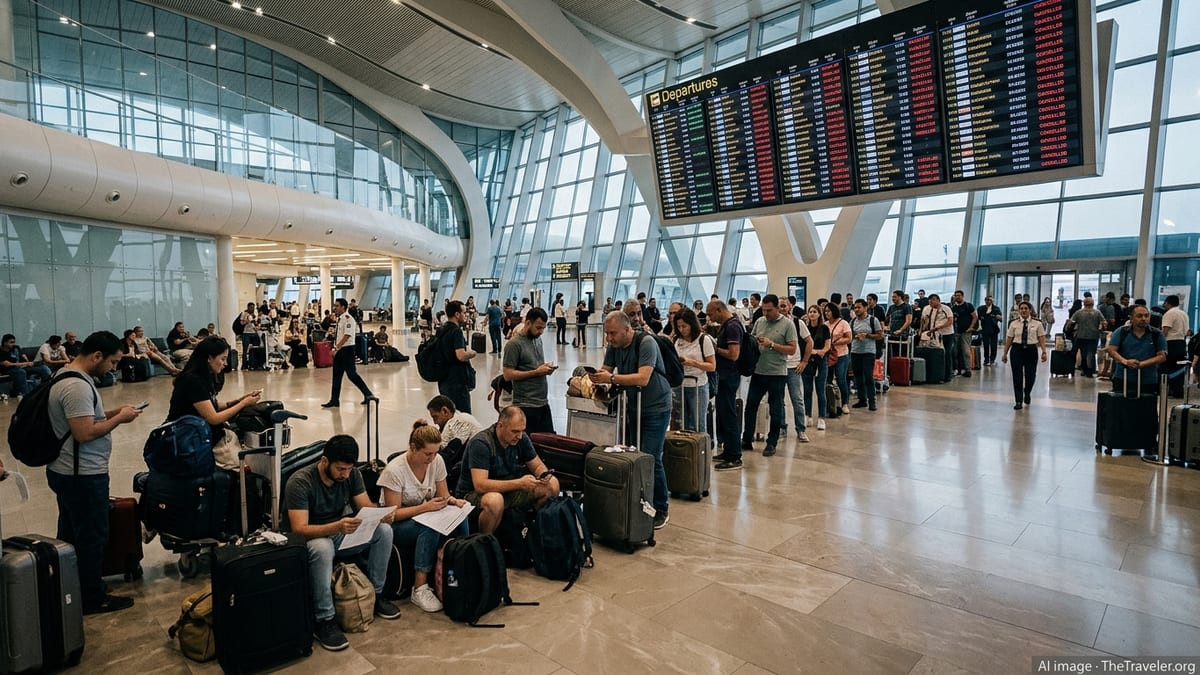
Scenes described by passengers at Heydar Aliyev International Airport point to mounting frustration as the disruption drags on. Travelers have reported long queues at check in counters and service desks as people attempt to rebook itineraries, secure accommodation, or obtain written confirmation of cancellations needed for insurance and refund claims.
Social media posts and traveler forums describe families with children sleeping on terminal floors, business travelers attempting to work from crowded departure lounges, and international visitors worried about overstaying visas if they cannot leave on time. While some airlines are providing hotel vouchers and meal support in line with their policies, others are offering only minimal assistance, leaving passengers to make their own arrangements in an unfamiliar city.
The fast changing situation has also created confusion between what is shown online and what is happening in the terminal. Some passengers report flights still marked as active on booking platforms and apps even after airport departure boards indicate cancellation. This mismatch has led to travelers proceeding to the airport for services that are no longer operating, adding further pressure to already crowded facilities.
Travel industry observers suggest that the strain on customer service centers is unlikely to ease quickly, as demand for call center support, airline chat functions, and in person assistance has surged. Many travelers are being advised to expect long wait times and to prepare clear requests and alternative routing options before reaching out for help.
Why Checking Your Flight Status Matters Now
With conditions evolving hour by hour, checking live flight status before leaving for the airport is now essential for anyone traveling via Baku. Published schedules can no longer be treated as fixed, especially for flights connecting to or overflying affected parts of the Middle East. Even services that operated on time the previous day may be disrupted if airspace conditions or operational assessments change.
Travel experts recommend monitoring multiple sources, including the operating airline’s official channels and the latest airport departure and arrival boards, to build as clear a picture as possible. Given that some third party booking platforms may update more slowly, relying solely on email confirmations or initial itineraries can be risky in the current environment.
Passengers with flexible tickets or those offered voluntary rebooking windows may wish to move travel to later dates or choose routings that avoid heavily affected hubs. For those who must travel now, having backup plans, such as alternative connection points or nearby airports, can reduce the risk of becoming stranded if a key flight from Baku is cancelled at short notice.
Travel insurance policies should also be reviewed carefully. Many insurers distinguish between unforeseen disruptions and those linked to declared conflicts or known events. Understanding what is covered before travel can help set realistic expectations about refunds, accommodation costs, and compensation for missed connections.
What Travelers Through Baku Should Do Next
For anyone scheduled to depart from or connect through Heydar Aliyev International Airport in the coming days, preparation is crucial. Travelers are being encouraged to reconfirm their flights repeatedly in the 24 hours leading up to departure, not just once. If a flight is cancelled or significantly delayed, contacting the airline promptly and, where possible, using digital channels can sometimes secure alternative options before they are exhausted.
Arriving at the airport earlier than usual may also be advisable, particularly for long haul or multi segment itineraries. Extended check in and security lines, combined with the need to resolve ticketing issues, can consume far more time than on a normal travel day. Having essential items, medications, and a change of clothes in carry on luggage can provide a margin of comfort if an unexpected overnight stay in the terminal or a nearby hotel becomes unavoidable.
Travelers already in Baku or transiting through the city may find it helpful to stay updated via local news outlets and official airport announcements, which can provide context on whether the disruption is easing or intensifying. While the situation remains fluid, the pattern of repeated cancellations and reroutings suggests that volatility in flight operations is likely to continue as long as the regional conflict affects key airspace corridors.
For now, Baku’s role as a bridge between Europe and the Middle East has become a pressure point in a wider aviation crisis. Until security conditions stabilize and airspace restrictions are eased, passengers using the Azerbaijani capital as a gateway should be prepared for sudden changes, extended journeys, and the persistent need to check their flight status right up to the moment they head to the gate.