

More news on this day
Travelers passing through Baku’s Heydar Aliyev International Airport are facing mounting disruption as regional airspace closures and security tensions trigger rolling cancellations on key routes to the Middle East and Europe, prompting airlines to urge passengers to check their flight status before leaving for the airport.
Get the latest news straight to your inbox!
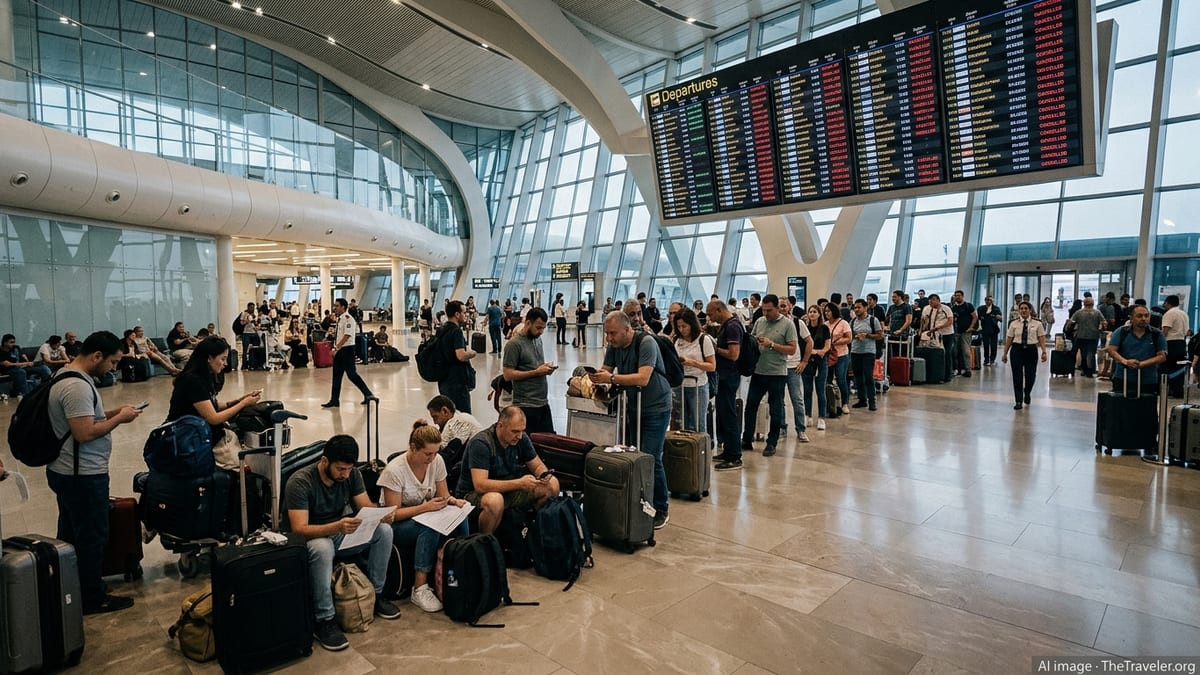
Regional Turmoil Hits a Key Caucasus Hub
Heydar Aliyev International Airport, a fast-growing transit point between Europe, the Gulf and Central Asia, has been pulled into the wider wave of aviation disruption sweeping the Middle East and surrounding region. In recent weeks, heightened military tensions and airspace restrictions linked to the Iran conflict have forced airlines to cut or reroute services, with Baku now experiencing its own concentrated bout of schedule chaos.
Published coverage of the 2026 Iran war and associated airspace closures shows that thousands of flights across the wider region have been cancelled or diverted as carriers avoid sensitive corridors and temporarily shut down routes. As traffic patterns are redrawn around closed or restricted skies, Baku’s role as a connector between the Gulf, Turkey, Europe and the post-Soviet space has left it particularly exposed to knock-on effects.
While Azerbaijan’s domestic aviation infrastructure remains intact, the volatility in neighboring airspace has translated into last minute timetable changes, longer routings and capacity cuts. Passengers who just weeks ago could count on relatively reliable links between Baku and major hubs such as Istanbul, Dubai, Doha and various European capitals are now confronting a much less predictable landscape.
Airlines operating through Baku are adjusting schedules on short notice as flight plans are refiled to skirt closed skies or congestion hotspots. This operational reshuffling is contributing to rolling delays and clusters of cancellations, particularly on high-frequency international routes.
Key Middle East Routes Among the Hardest Hit
According to publicly available airline notices and aviation advisories, connections between Baku and several major Gulf and Levant hubs have been some of the most affected. Routes that typically rely on stable overflight permissions and dense connecting traffic, including services to the United Arab Emirates, Qatar and other Middle Eastern gateways, have seen repeated timetable changes as carriers respond to evolving risk assessments.
Travel industry analysis of the current airspace situation in the Middle East and North Africa indicates that airports such as Dubai, Abu Dhabi and Doha have been operating under severe strain as a result of partial closures, missile risk corridors and crowding in remaining open airspace. Baku’s flights into and out of these hubs are consequently subject to cascading schedule adjustments, with banks of departures sometimes cancelled or consolidated at short notice.
Passengers booked on itineraries that use Baku as a stepping stone between the Middle East and Europe are especially vulnerable. A cancellation on a Gulf sector can unravel an entire multi-leg journey, leaving travelers scrambling for alternatives via Istanbul, Tbilisi or other regional airports that still have available seats. This has been particularly challenging for those on time-sensitive business or family trips who suddenly find their onward connections unavailable.
Reports from passenger forums and airline customer updates suggest that some carriers have opted to suspend specific Baku services on select days, replacing them with reduced frequencies or alternative routings through third-country hubs. In practical terms, this means that even if Baku’s runways and terminals remain open, the number of viable daily departure options to the Gulf has temporarily shrunk.
European Links Disrupted by Reroutes and Capacity Cuts
The disruptions are not limited to southbound and eastbound traffic. Baku’s links with Europe are also feeling the impact as airlines recalculate fuel, crew duty times and aircraft availability for flights that can no longer use their most efficient paths. With flight times stretching on some corridors due to detours around conflict-affected skies, carriers are trimming schedules and, in some cases, cancelling rotations that have become uneconomical or operationally complex.
Published network updates from European and regional airlines show sporadic cancellations and reductions on routes connecting Baku with key cities such as Istanbul, Warsaw, Berlin and other onward European gateways. While some of these services continue to operate, they may do so with altered departure times, downgraded aircraft types or reduced weekly frequency, all of which can disrupt carefully planned connections.
The strain is especially visible on days when weather or technical issues coincide with the broader airspace crunch. When this happens, carriers have fewer spare aircraft and crew to absorb the shock of an unexpected delay, resulting in a higher likelihood that marginal flights to secondary European cities will be the first to be cut from the schedule.
For travelers relying on Baku as a starting point for long haul journeys via European hubs, this means more missed connections, overnight layovers and rebookings. Travel agents and online booking platforms are flagging that inventory on alternative routes can disappear quickly once a wave of cancellations hits, leading to higher fares and limited choice for those forced to replan at the last minute.
What Passengers Should Do Before Leaving for the Airport
With conditions changing from day to day, the most consistent message from travel experts and aviation analysts is straightforward: verify your flight status as close to departure as possible. Publicly available airline guidance stresses that passengers should rely on official airline websites, mobile apps and direct notifications, rather than third party trackers or static timetables, to understand whether their flight is operating and under what conditions.
Travelers are advised to pay particular attention to multi-leg itineraries, even if the first segment originates in Baku and appears unaffected. A flight from Baku to a hub such as Istanbul or Dubai may depart on time, but the onward connection to Europe or another Middle Eastern destination could already be cancelled or substantially delayed, making the overall journey impractical.
Specialists in travel risk management recommend arriving at the airport earlier than usual, as check in and customer service desks may be busy handling rebookings and complex cases. Passengers should also keep digital or printed copies of their booking confirmations, insurance details and any emails about schedule changes, as these can be useful when negotiating alternative arrangements at the counter.
Those with flexible plans might consider proactively moving their trip to a later date or choosing routings that avoid the most volatile airspace corridors where possible. However, any such changes should be weighed against fare rules and potential penalties, and ideally confirmed directly with airlines or reputable travel intermediaries.
Uncertain Outlook as Regional Situation Evolves
The outlook for a swift normalization of traffic through Baku remains uncertain. Analysts monitoring the aviation impact of the Iran conflict note that the pattern of closures and reopenings in regional airspace has been fluid, with short-lived resumptions sometimes followed by renewed restrictions. This has made it difficult for airlines to publish stable schedules more than a few days ahead.
Economic assessments of the 2026 Iran war highlight the heavy toll on regional connectivity, with several thousand daily cancellations reported across the broader Middle East and neighboring regions. As long as key air corridors remain constrained, hubs like Baku that sit on the crossroads between Europe and Asia are likely to see recurring pockets of disruption, even if local infrastructure is not directly targeted.
For now, travelers passing through Heydar Aliyev International Airport can expect an environment defined by rolling changes rather than complete shutdown. Many flights are still operating, but often at different times, on altered routings, or with tighter capacity than usual. In this context, closely monitoring flight status and remaining as flexible as possible has become a core part of travel planning.
Until regional skies fully stabilize and airlines are able to lock in their schedules with greater confidence, those using Baku as a gateway to the Middle East and Europe will need to plan for contingencies, build in extra time and be prepared for last minute adjustments to their journeys.