

More news on this day
Indonesia’s resort island of Bali has begun issuing emergency stay permits to hundreds of foreign tourists stranded by severe air travel disruptions linked to the escalating conflict in the Middle East, allowing visitors to remain legally on the island while they wait for replacement flights and safe transit routes.
Get the latest news straight to your inbox!
Middle East Conflict Ripples Into Southeast Asia’s Top Beach Destination
Spillover from the latest phase of the Iran war and related regional tensions has severely disrupted commercial aviation corridors across the Middle East, a key transit hub for long-haul flights between Europe, Africa and Asia. Airspace closures and widespread cancellations have rippled through global networks, trapping travelers far from home and forcing tourism-dependent destinations such as Bali to improvise fast.
Recent regional coverage indicates that thousands of holidaymakers have been left in limbo on the Indonesian island after routes via Gulf and Levantine hubs were suspended or sharply reduced. In some cases, travelers who expected simple one-stop connections home have found themselves facing days or weeks of uncertainty as airlines scramble to reroute aircraft and secure alternative overflight permissions.
Among those affected are package tourists, independent backpackers and digital nomads whose onward journeys typically pass through major Middle East hubs. With peak-season occupancy still high across Bali’s main resort areas, the sudden inability to leave on schedule has turned routine visa timelines into a pressing legal concern for many stranded visitors.
The resulting logjam has pushed Indonesia’s immigration system to respond rapidly on the ground in Bali, where officials have a long history of dealing with natural disasters, volcanic ash clouds and global shocks that interrupt outbound flights.
Emergency Stay Permits Activated to Prevent Accidental Overstays
To manage the sudden influx of tourists whose visas or visit permits are expiring through no fault of their own, Bali’s immigration offices have activated emergency stay mechanisms designed for what Indonesian regulations describe as “forced circumstances.” These provisions, used previously during major disruptions, allow foreign visitors to remain in Indonesia temporarily without triggering standard overstay penalties.
Local media reports and publicly available immigration guidance describe a same-day emergency stay permit process now in effect for stranded travelers. In practice, this typically involves issuing a short-term extension or special stay status that acknowledges the lack of viable outbound flights and protects visitors from fines that can otherwise accrue on a daily basis once a visa or visit permit has lapsed.
Indonesia’s broader immigration framework has tightened over the past two years, with higher overstay fines, stepped-up enforcement and new in-person requirements for extending visas and stay permits. Against that backdrop, the emergency measures in Bali are being framed as a humanitarian and practical response to an extraordinary disruption, aimed at distinguishing between deliberate violations and tourists caught out by events beyond their control.
For visitors, the emergency permits offer crucial breathing room. Travelers whose return routes rely on carriers based in the Gulf or who must normally transit Middle Eastern hubs now have a legal pathway to remain in Bali while airlines rebuild schedules or arrange alternative routings through other parts of Asia or Europe.
Hundreds Queue at Ngurah Rai as Airlines Rework Global Schedules
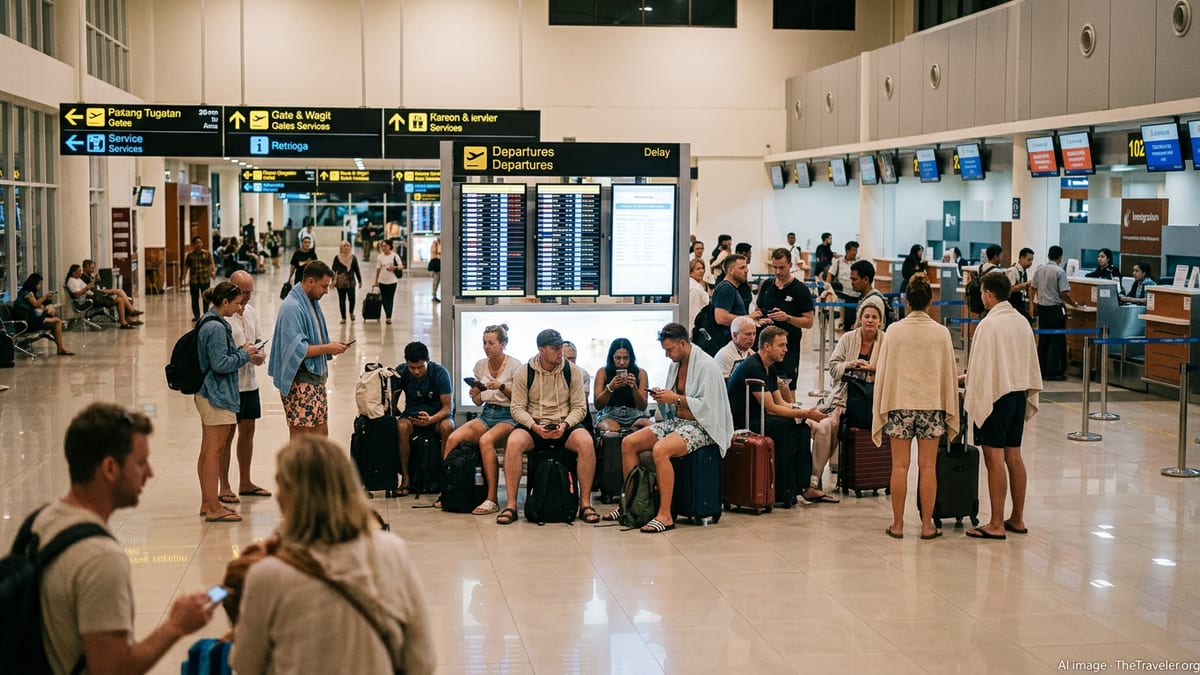
The impact of the Middle East turmoil has been particularly visible at Bali’s I Gusti Ngurah Rai International Airport, where a wave of long-haul cancellations and diversions has left departure boards in flux. Regional newspaper reports and on-the-ground accounts describe hundreds of stranded passengers seeking rebooking assistance at airline counters while simultaneously trying to understand their immigration options.
Many of those affected are travelers whose itineraries relied on one-stop or two-stop journeys via the United Arab Emirates, Qatar, Saudi Arabia or other regional connecting points. With parts of the Middle East airspace effectively off-limits or heavily restricted for civilian traffic, carriers have been forced to suspend some routes altogether and reroute others along longer paths that reduce overall network capacity.
As a result, seats out of Bali on remaining services have become scarce, and travelers whose original tickets were canceled have found themselves assigned to waiting lists or offered departures days after their original visa expiry dates. This has driven demand for rapid immigration guidance, particularly among tourists holding short-stay visas on arrival or electronic visit permits that were never intended to accommodate extended stays during a geopolitical crisis.
Travel advisories circulating in aviation and consular channels now encourage passengers with upcoming Bali trips to check routing details carefully, verify that their itineraries avoid restricted Middle East corridors, and ensure they have sufficient flexibility in their travel documents should further disruptions occur.
Balancing Humanitarian Flexibility With a Tougher Immigration Climate
The emergency stay permits in Bali are being introduced against a backdrop of steadily tougher immigration enforcement across Indonesia. In recent years, the Directorate General of Immigration has launched high-profile crackdowns on foreign nationals who violate stay rules, undertake unauthorized work or misuse business structures, with Bali often at the center of these efforts.
Policy changes have included higher daily overstay fines, more frequent spot checks in popular tourist districts and the deployment of special patrol task forces in areas such as Canggu, Seminyak and Ubud. New regulations also require in-person visits for many visa extensions and make accommodation providers more accountable for reporting foreign guests to immigration databases.
Within this context, the decision to streamline emergency permits for stranded tourists highlights the tension between strict rule enforcement and the need for flexibility in exceptional circumstances. Publicly available information on Indonesia’s immigration rules emphasizes that visitors remain responsible for maintaining valid status, yet the current Bali measures underscore an acknowledgement that airline cancellations and airspace closures fall outside a traveler’s control.
For destination managers in Bali, the situation is a reminder that a resilient tourism strategy increasingly needs to account not only for local shocks such as volcanic activity or extreme weather, but also for geopolitical crises thousands of kilometers away that can suddenly sever the air links on which the island’s economy depends.
What Stranded Tourists in Bali Are Being Advised to Do
Current guidance shared through local travel advisories and immigration-focused channels suggests that stranded tourists in Bali should act quickly if their permitted stay is approaching its end. Visitors are being urged to keep all boarding passes, cancellation notices and airline communications, as these documents can help demonstrate that their inability to depart is directly tied to the Middle East travel disruptions.
Travelers are generally advised to visit a local immigration office or official service counter before their visa or visit permit expires, bring their passport and proof of disrupted travel, and request an emergency stay solution tailored to their situation. In some cases, this may involve a short-term extension of an existing visit permit, while in others it may take the form of a special stay permit linked explicitly to the current crisis.
Tourism operators and hotel staff across Bali’s main resort zones are increasingly stepping in to help guests navigate procedures, sharing information about required documents and office locations. Online forums and community groups popular with long-stay visitors have also become informal clearinghouses for experiences and practical tips on how to manage appointments, paperwork and timing.
At the same time, prospective visitors planning trips to Bali in the coming weeks are being encouraged to monitor airline announcements closely, check transit points listed on their itineraries and consider more flexible routing options that bypass the most affected Middle East corridors. For both current and future travelers, the evolving situation illustrates how quickly global tensions can reshape even the most familiar holiday routes and underscores the value of understanding local immigration safeguards before departure.