

More news on this day
A sudden airspace disruption affecting Baltimore/Washington International Thurgood Marshall Airport has sparked a wave of cancellations and multi-hour delays, stranding passengers on busy leisure routes to Miami, Orlando and other major hubs across the United States.
Get the latest news straight to your inbox!
What Triggered the Baltimore Airport Crisis
Published coverage in recent days describes a rare ground stop across the Washington-Baltimore airspace that temporarily halted flights at multiple airports, including Baltimore/Washington International Thurgood Marshall Airport (BWI). Reports indicate the stoppage was linked to an equipment issue at an air traffic control facility that manages approach and departure flows for the wider region, rather than a problem with airport terminals themselves.
The disruption, which unfolded on the evening of March 13, 2026, affected dozens of departures and arrivals in a short window. Air traffic across BWI, Washington Reagan National and Washington Dulles slowed dramatically, with some aircraft held on the ground, others circling or diverted, and many flights ultimately canceled as schedules unraveled into the night.
Because the incident struck during a peak travel period for weekend getaways and spring trips, the ripple effect was immediate. Southbound leisure routes to Florida, including Baltimore to Miami and Baltimore to Orlando, were heavily exposed, as were connections through major hubs such as Atlanta, Charlotte, Dallas and Chicago that feed traffic to and from BWI.
According to airline status boards and flight-tracking platforms, the initial one to two hour delays quickly escalated as aircraft and crews fell out of position. Once rotations slipped beyond legal duty-time limits for flight crews, airlines had little choice but to cancel or significantly retime further departures.
How the Disruption Hit Flights to Miami, Orlando and Beyond
Florida-bound travelers felt the impact sharply. BWI is a key origin for both full-service and low-cost carriers operating to Miami, Fort Lauderdale, Orlando and Tampa, routes that are often tightly scheduled with quick turnarounds. When departures from Baltimore were paused, aircraft expected to make same-day round trips could no longer keep to their timelines.
By late evening on March 13, publicly available flight data showed multiple cancellations and extended delays on Baltimore to Miami and Baltimore to Orlando services, including both nonstops and one-stop itineraries via East Coast hubs. Some Miami-bound flights were pushed back by several hours before being scrubbed altogether, leaving passengers to rebook on limited remaining options for the weekend.
Orlando services, popular with families heading to theme parks, were similarly hit. With aircraft stranded out of place and crew schedules maxed out, some flights from BWI to central Florida were retimed into the following morning or combined with other services, reducing overall capacity. Travelers arriving into BWI on delayed inbound flights also missed onward connections to Florida, further swelling the number of stranded passengers.
The impact stretched well beyond Florida. Routes from BWI to Midwest and West Coast cities experienced rolling disruption as carriers attempted to reconstruct networks on the fly. Aircraft that should have returned from Florida for late-night departures to other destinations were unavailable, leading to knock-on delays across the country.
Passenger Experience: Long Lines, Uncertain Information and Diversions
For passengers on the ground, the situation quickly turned into a test of patience. Social media posts and traveler accounts described aircraft that taxied for departure only to be held in place, then instructed to return to gates. In several cases, travelers reported deplaning after extended waits, only to learn that their flights were postponed indefinitely or canceled.
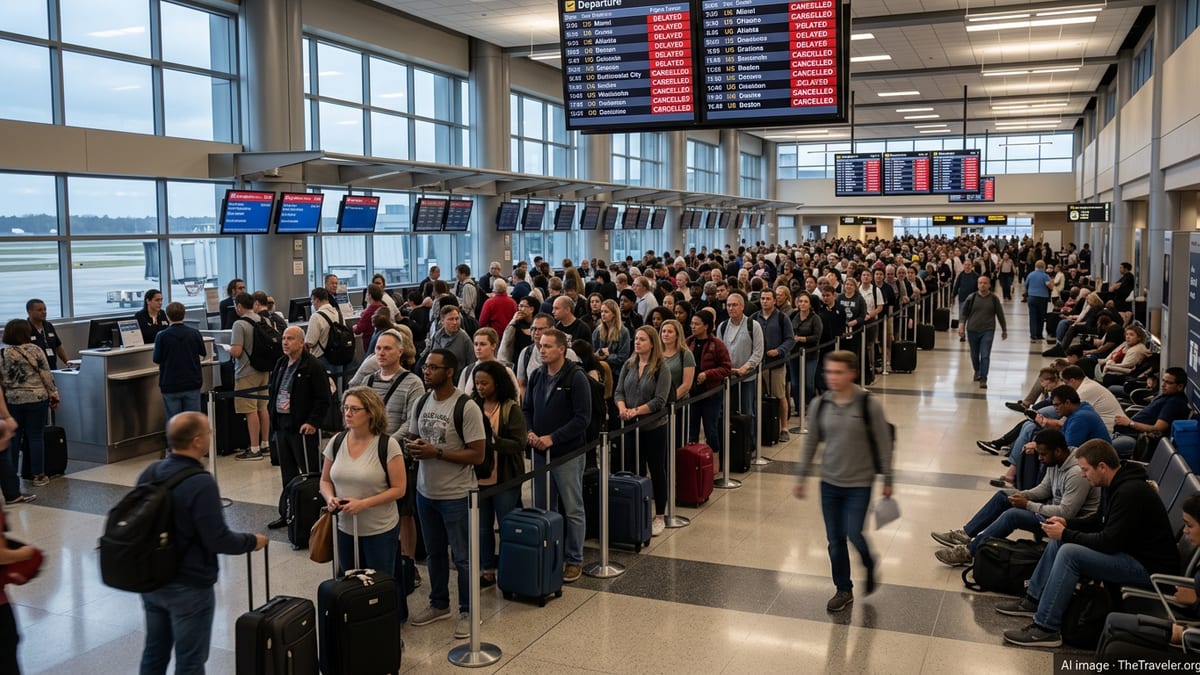
Inside the terminal at BWI, the ground stop translated into swelling lines at customer service counters as passengers sought rebooking options, meal vouchers and hotel accommodations. With so many flights simultaneously delayed or canceled, re-accommodation options on same-day departures were limited, particularly on popular leisure routes. Families heading to Florida for tightly scheduled holidays, cruises or events were among those facing the toughest choices on whether to delay or reroute.
The disruption was not limited to Baltimore’s terminal. Travelers already in the air on routes headed for BWI reported diversions to other airports while the ground stop was in effect. Flight-tracking data showed aircraft diverting to nearby hubs such as Pittsburgh and other regional airports, where passengers faced additional waiting while airlines arranged onward travel plans.
As is typical in rapidly evolving airspace events, information on the cause and expected duration filtered out gradually. Publicly available feeds from aviation agencies and airline status tools confirmed the existence of a ground stop, while individual carriers updated their customers via mobile apps and email alerts, often revising times multiple minutes or hours at a stretch as the situation developed.
Is Your Upcoming Flight From Baltimore at Risk?
While the most acute phase of the disruption occurred on March 13, the effects can linger into subsequent days as airlines work to realign aircraft and crew resources. Travelers booked on upcoming flights from BWI, especially to Florida gateways such as Miami and Orlando, may continue to see schedule adjustments until networks fully stabilize.
Publicly available operational bulletins and performance reports show that Baltimore/Washington International has been highlighted for reduced capacity and higher delay vulnerability during certain construction and infrastructure periods. That context means any regional airspace disturbance, even one lasting only an hour or two, can trigger disproportionate knock-on effects compared with a fully unconstrained airport.
Passengers with near-term departures should treat departure times as fluid and build in additional buffer, particularly if they are connecting onward from Miami, Orlando or another hub. Early-morning flights the day after a major disruption often operate more reliably, but residual aircraft imbalances or overnight crew rest requirements can still result in last-minute changes.
Because situations like the recent ground stop can evolve quickly, the most reliable view of whether a specific flight is affected remains the real-time status provided directly by the operating airline through its app, website, text alerts or automated phone systems. Third-party flight-tracking tools can offer additional visibility into where an inbound aircraft is coming from and whether it appears to be running on time.
What Travelers Can Do Now
For those currently stranded or facing significant delays at BWI or at downline airports such as Miami and Orlando, the immediate priority is confirming rebooking options. Airlines typically reaccommodate disrupted passengers on the next available flights in the same cabin, but during a widespread event, seats may be scarce on popular routes for 24 hours or more.
Travelers whose trips are flexible may find better options by accepting alternate airports or different routings, such as flying into Fort Lauderdale instead of Miami, or Tampa instead of Orlando, and then continuing overland. In some cases, airlines may open up these alternatives as standard options when a specific city pair is heavily constrained.
Those yet to travel in the coming days should monitor their reservations closely rather than waiting to arrive at the airport. Same-day schedule changes, aircraft swaps and proactive cancellations can appear with little warning as airlines adjust. Checking in as early as permitted and enabling app notifications can provide critical early signals if plans begin to shift.
The recent disruption in the Baltimore region is a reminder that even brief outages at key air traffic facilities can cascade into extensive delays hundreds of miles away. For travelers heading to Miami, Orlando and other high-demand destinations, staying informed and building extra time into itineraries remains the best defense against an unexpected airport crisis turning into a full-scale travel nightmare.