

More news on this day
Bangkok’s Suvarnabhumi Airport and London Gatwick are rapidly emerging as a powerful new axis for Europe–Asia travel, as a wave of direct services and added frequencies opens fresh options for leisure and business flyers navigating around disrupted Middle East hubs.
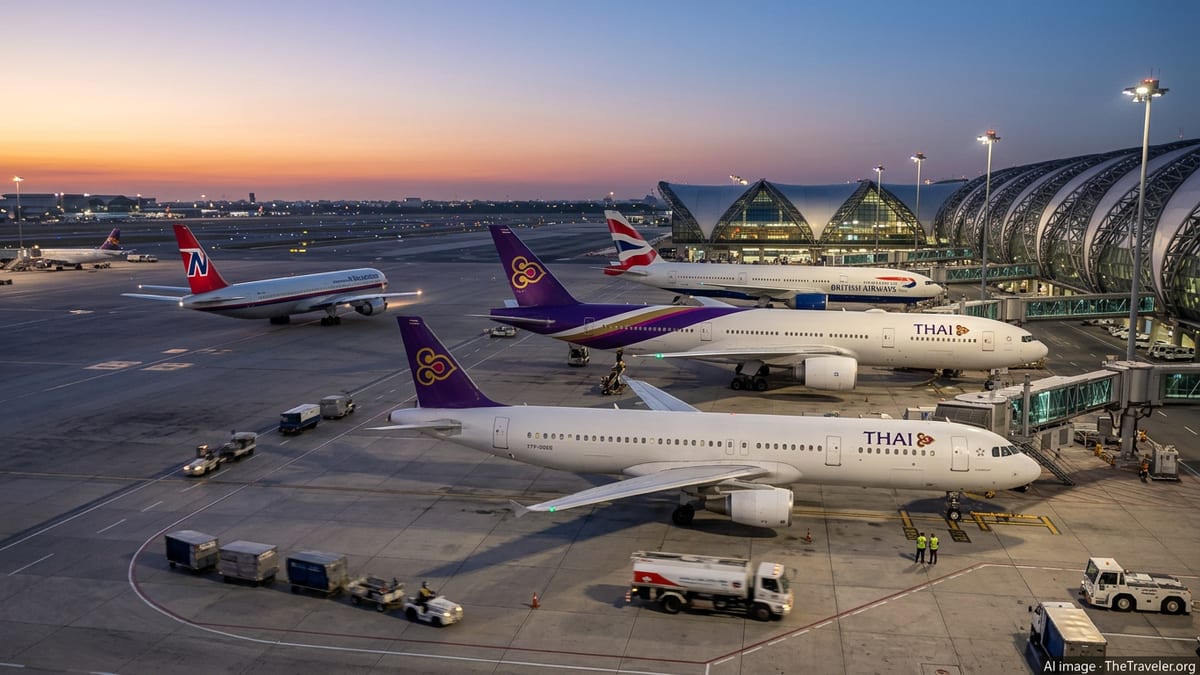
New Nonstops Cement a Revived Bangkok–Gatwick Corridor
The air bridge between Bangkok Suvarnabhumi and London Gatwick is undergoing a significant revival, led by a mix of full-service and low-cost long haul carriers. Norse Atlantic Airways will inaugurate nonstops between the Thai capital and Gatwick from late October 2025, positioning Bangkok as the airline’s first Asian destination from its London base and initially operating a winter-focused schedule on Boeing 787 Dreamliners.
British Airways is set to deepen this connection further. The carrier, which brought back its Bangkok operation after a hiatus, is expanding its Gatwick–Suvarnabhumi route from a winter-only service to a year-round operation from the start of the summer 2026 season. Its schedule calls for three weekly flights in the northern summer and up to six weekly frequencies in winter, reflecting strong demand for direct links to Thailand’s main gateway.
Schedule data now highlights Bangkok–Gatwick as a genuine two-airline nonstop market. Travellers comparing itineraries see both British Airways and Norse Atlantic listed on the route, with the low-cost long haul entrant expected to stimulate price-sensitive leisure traffic while the UK flag carrier targets premium and connecting passengers through its Gatwick base.
For Bangkok, the revival of multiple nonstops to Gatwick reinforces Suvarnabhumi’s role as a Southeast Asian superhub at a time when some travellers are actively looking to avoid routings via the Middle East. For Gatwick, Bangkok becomes a cornerstone of a broader push to add more long haul connectivity into Asia.
Gatwick Builds Out Asia Network as London’s Second Hub
London Gatwick has been steadily repositioning itself as a serious long haul competitor to Heathrow, with Bangkok playing an increasingly high-profile role in that strategy. Airport officials have hailed the Norse Atlantic launch as a “landmark” step in building direct Asia connectivity, noting that the Thai capital is among the most requested long haul leisure destinations from the airport’s catchment area.
The new Bangkok services arrive alongside a flurry of long haul additions from carriers including Air India and AirAsia X, which are bringing more South and Southeast Asian traffic into Gatwick via their respective hubs. Although these flights do not operate nonstop to Bangkok, they expand one-stop choices between Europe and Thailand that bypass more congested or disrupted hubs and feed into Suvarnabhumi and other Thai airports.
British Airways, meanwhile, is using its Gatwick-based subsidiary to rebuild a complementary long haul portfolio to its Heathrow operation. Bangkok’s elevation to a year-round route from Gatwick in 2026 underlines the airport’s growing importance for leisure-heavy, price-sensitive markets where passengers are willing to depart from London’s second hub in return for more competitive fares or better schedule options.
For UK travellers, especially those south of London, Gatwick’s expanded Asia network can mean shorter surface journeys to the airport and a greater chance of securing nonstops without transiting via Heathrow. For Thai tourism officials, Gatwick represents an additional funnel of visitors into Bangkok and onward to the country’s resort destinations.
New Options for European Travellers Navigating a Shifting Sky
The timing of Bangkok–Gatwick growth coincides with a period of volatility in traditional Europe–Asia routing patterns. Temporary closures and restrictions affecting parts of Middle Eastern airspace have pushed some carriers onto longer routings and tightened capacity on popular one-stop corridors via Gulf hubs. As a result, demand for point-to-point and non-Gulf connecting options between Europe and Southeast Asia has risen sharply.
Direct flights between Bangkok and London have seen notable fare increases in early 2026 as airlines capitalize on surging demand from both European holidaymakers and Asian outbound travellers. Reports from travel agents in Bangkok describe economy-class return tickets to Europe surpassing previous price norms, even as added capacity from Norse Atlantic and the expanded British Airways schedule begins to filter into the market outlook for late 2025 and 2026.
The addition of Gatwick as a viable London entry point creates fresh itinerary choices for travellers from across continental Europe. Many can now combine low cost or regional flights into Gatwick with long haul sectors to Bangkok operated by Norse Atlantic or British Airways, avoiding the need to connect through Heathrow or more distant hubs. That flexibility is particularly attractive for younger, budget-conscious travellers and digital nomads heading to Thailand for extended stays.
For corporate travel managers, the growing range of routings provides a useful hedge against disruption. Having both Heathrow and Gatwick options into Bangkok, plus a blend of full-service and low cost long haul offerings, makes it easier to reroute staff at short notice if specific hubs or corridors become congested or constrained.
Tourism and Trade Stand to Benefit From Stronger Links
The reinforced corridor between Bangkok and Gatwick is expected to deliver tangible benefits to tourism and trade flows. Thailand’s tourism authorities have set ambitious targets for visitor arrivals in 2026, and the United Kingdom remains one of the country’s most important long haul source markets. Extra direct seats into Suvarnabhumi should support hotel occupancies not only in Bangkok but also in key beach destinations reachable via domestic or regional connections.
British outbound tourism to Thailand is heavily concentrated in the northern winter months, when sun-seekers flock to Phuket, Krabi and the Gulf islands. Both Norse Atlantic’s winter-focused timetable and British Airways’ increased cold-season frequencies from Gatwick are aligned with this pattern, providing added capacity just as demand peaks. Tour operators are already marketing package holidays that combine Gatwick departures with onward connections on Thai domestic carriers.
On the trade side, the strengthened air bridge facilitates faster movement of high-value and time-sensitive cargo between the UK and Thailand. Bellyhold capacity on long haul passenger flights is a critical component of supply chains for sectors such as automotive parts, electronics and fashion. Additional widebody services on the Bangkok–Gatwick route should bring more flexibility for shippers, particularly small and medium-sized exporters who rely on scheduled services rather than bespoke freighter operations.
Diplomatically, the growth in air services also reflects deepening economic ties between the United Kingdom and Thailand. Aviation agreements and expanded traffic rights have underpinned the launch and expansion of these routes, and officials on both sides are likely to view the busy Bangkok–Gatwick corridor as a visible symbol of a broader trade and investment relationship.
A Competitive Market Poised for Further Change
While Bangkok–Gatwick is enjoying renewed momentum, the market remains highly competitive and sensitive to external shocks. Airlines have learned hard lessons from the rapid swings in demand experienced over recent years, and both Norse Atlantic and British Airways are likely to keep a close eye on load factors, yields and operating conditions as the expanded schedules bed in through 2025 and 2026.
Low cost long haul operations, such as those planned by Norse Atlantic, must balance attractive headline fares with the realities of fuel costs, aircraft utilization and seasonality on such a long sector. British Airways, for its part, is positioning Gatwick as a complementary leisure hub to its more premium-focused Heathrow operation, but will face ongoing competition from Asian and Middle Eastern carriers offering one-stop alternatives into Bangkok and beyond.
For passengers, the immediate impact is clear: more options, more competition and a broader choice of departure points and onboard products when traveling between Europe and Thailand. As airlines fine-tune schedules, add capacity or adjust frequencies in response to demand, Bangkok’s Suvarnabhumi and London Gatwick are set to remain at the heart of a newly configured Europe–Asia air bridge.
Industry analysts expect that, if current demand trends hold and geopolitical risks ease, further refinements to the Bangkok–Gatwick offering are likely, from schedule tweaks to potential partnerships and codeshares. For now, however, the opening of extra direct flights between the two airports marks a significant milestone in the reshaping of long haul travel between Europe and Asia.