

More news on this day
Bangkok is enduring another blistering hot season with the heat index repeatedly surging into the danger zone above 50°C, as Thailand’s capital grapples with stifling humidity, expanding health advisories, and new emergency cooling measures for residents and visitors.
Get the latest news straight to your inbox!
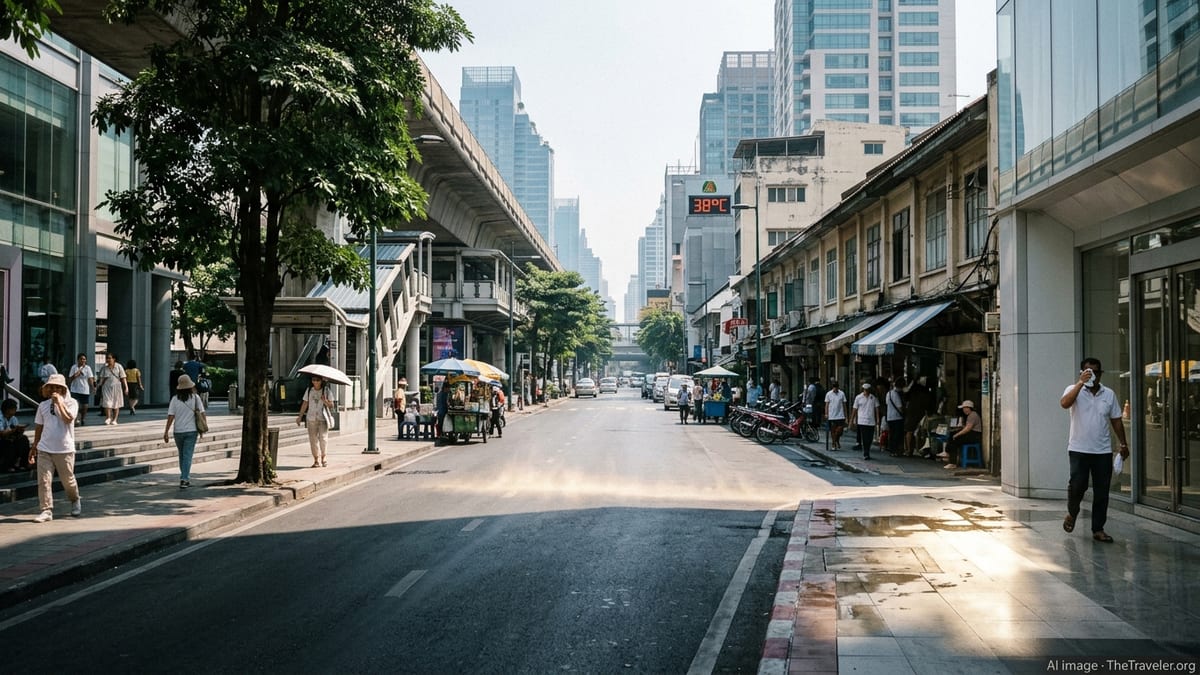
Heat Index Pushes Bangkok Into “Extreme Danger” Territory
Recent hot-season conditions in Bangkok have pushed the city’s heat index into what local risk scales describe as a red, or extreme danger, category, where prolonged exposure can rapidly lead to heat exhaustion and heatstroke. Publicly available information from Bangkok’s environmental and health agencies shows that when air temperatures near 38 to 40°C combine with very high humidity, feels-like readings can exceed 52°C, far above thresholds considered safe for extended outdoor activity.
The heat index, sometimes referred to as the apparent or feels-like temperature, blends air temperature and humidity to reflect how hot it actually feels to the human body. Reports from April 2024 documented multiple days when Bangkok’s heat index climbed into the very dangerous range above 52°C, and current seasonal outlooks for 2026 indicate that similarly oppressive conditions are increasingly likely as hot seasons lengthen and intensify.
Climate assessments by the World Meteorological Organization and other scientific bodies describe Asia as warming nearly twice as fast as the global average, with Southeast Asia singled out as a region where high humidity magnifies heat stress. Studies on future heat projections for the region indicate that periods of dangerous heat index values will become more frequent, particularly in densely built megacities such as Bangkok, where concrete, asphalt, and limited shade trap warmth well into the night.
For Bangkok’s roughly 11 million residents and large tourist population, these extreme feels-like temperatures are no longer isolated spikes. Instead, they are increasingly appearing as multi-day stretches of hazardous heat, straining public health systems, urban infrastructure, and the city’s reputation as a year-round travel hub.
Emergency Cooling Centers and New Safety Guidance
In response to recurrent bouts of oppressive heat, municipal agencies in Bangkok have expanded a network of cooling centers and refuge rooms across the capital. Local media coverage in March 2026 indicates that more than 100 publicly accessible air-conditioned spaces, including district offices, health centers, and selected schools, are being opened during the hottest hours of late morning and afternoon, with drinking water and basic first aid available.
These facilities are designed to provide immediate relief for people who lack access to effective cooling at home or who are caught outdoors during peak heat. The rollout reflects growing recognition that high heat index conditions, rather than air temperature alone, are driving health risks, particularly for older adults, outdoor workers, low-income residents, and those with chronic medical conditions.
Alongside physical shelters, Bangkok authorities have introduced a color-coded heat index warning system, with green for monitoring, yellow for caution, orange for danger, and red for extreme danger. Public advisories highlighted by local outlets explain that red-level days correspond to feels-like temperatures often exceeding 52°C, when limiting strenuous activity, staying indoors in cooled environments when possible, hydrating frequently, and checking on vulnerable neighbors are strongly encouraged.
Publicly available information from health agencies and international organizations stresses that symptoms such as dizziness, confusion, rapid heartbeat, or cessation of sweating in the heat require urgent medical attention. Educational campaigns, including social media infographics and neighborhood announcements, aim to familiarize residents and visitors with early warning signs of heat-related illness and simple steps to reduce risk.
Risks for Residents, Outdoor Workers, and Travelers
The combination of high humidity, intense sun, and limited overnight cooling poses particular challenges for people who must spend long hours outside. Reports on recent Southeast Asian heatwaves note that outdoor laborers, street vendors, delivery riders, and construction workers face some of the highest exposure levels, often with limited shade or access to air conditioning.
Urban climatology research focusing on Southeast Asia indicates that heat stress in megacities can persist well into the evening as concrete and asphalt slowly release stored heat, reducing the body’s opportunity to recover overnight. Studies on heatwaves in global South cities further suggest that people often shift activities to later hours to escape daytime extremes, which can alter work, commuting, and leisure patterns and place additional pressure on already crowded evening transport systems.
For travelers, Bangkok’s extreme heat index readings complicate the typical hot-season itinerary of temple visits, market tours, and street food exploration. Travel advisories and tourism forums increasingly emphasize that March and April, traditionally popular months leading into regional holidays, now come with higher medical risks for heat-sensitive individuals. Guidance commonly includes avoiding midday sightseeing, choosing accommodations with reliable air conditioning, planning outdoor activities in the early morning or after sunset, and carrying water and sun protection at all times.
Medical experts cited in regional health and climate reports stress that children, pregnant people, and older adults are more vulnerable to heat stress, while some medications can reduce the body’s ability to cool itself. Publicly available health information therefore encourages families and tour groups to factor heat conditions into daily planning, and to watch for early signs of discomfort in more vulnerable companions.
Climate Change Drives Longer and More Intense Hot Seasons
The blistering heat currently affecting Bangkok forms part of a broader climate pattern that is reshaping weather across Asia. Global and regional climate assessments show that 2024 ranked among the warmest years on record, with prolonged and widespread heatwaves across much of the continent. Thailand experienced particularly intense conditions in 2024, with northern provinces recording air temperatures above 44°C and the wider region dealing with a powerful El Niño event that amplified baseline warming.
Recent peer-reviewed studies focused on Southeast Asia project that both the frequency and duration of heatwaves will continue to climb under all major emissions scenarios, with the greatest increases expected if global greenhouse gas emissions remain high. These analyses do not only track maximum air temperature; they also consider compounded indicators such as the Universal Thermal Climate Index and wet-bulb globe temperature, which capture the combined effects of heat, humidity, wind, and solar radiation on the human body.
Findings from these studies indicate that periods of very strong to extreme heat stress, similar to or worse than Bangkok’s current red-level heat index days, are likely to become more common in coming decades. The research also highlights urbanization as a key factor, noting that densely built environments with limited green space tend to amplify dangerous heat, making heat adaptation a central challenge for city planners.
International agencies tracking climate and health interactions emphasize that extreme heat already carries significant economic costs, including lost labor hours, reduced productivity, and increased healthcare spending. As hot seasons intensify, megacities like Bangkok are increasingly viewed as frontline locations where decisions on shading, ventilation, building codes, and emergency services will determine how well populations can cope.
Adapting Bangkok for a Hotter Future
Faced with rising heat stress, Bangkok is beginning to experiment with a mix of short-term emergency responses and longer-term urban planning measures. Publicly available municipal documents and local reporting describe initiatives such as expanding tree cover, testing reflective or permeable paving, encouraging building designs that improve natural ventilation, and increasing access to public drinking fountains and shaded waiting areas at transit hubs.
Some district-level programs are mapping neighborhoods with high concentrations of older residents or informal housing to prioritize outreach during extreme heat. Efforts include distributing information on recognizing heat illness, coordinating volunteer check-ins during red-level heat index days, and aligning social services, health centers, and cooling rooms within easy reach of the most vulnerable households.
For the travel sector, adapting to Bangkok’s hotter future may mean reshaping marketing and itineraries around cooler seasons, expanding indoor cultural offerings, and integrating heat-safety messaging into booking confirmations, airline announcements, and hotel check-in materials. Tourism operators are increasingly encouraged by public health guidance to schedule outdoor excursions during lower-risk hours and to ensure that guides are trained to identify and respond to signs of heat stress among guests.
Experts contributing to recent climate and disaster risk reports for the Asia-Pacific region argue that early warning systems, tailored public communication, and climate-aware urban design can significantly reduce the toll of extreme heat, even as global temperatures continue to rise. For Bangkok, where the feels-like temperature is already pushing well beyond 50°C on the hottest days, the urgency of translating that guidance into everyday practice is becoming impossible to ignore.