

More news on this day
Hundreds of Canada, US and UK holidaymakers were caught in an unexpected aviation meltdown on Saturday as a sudden air traffic control walkout in Barbados forced multiple transatlantic and North American flights to turn back mid‑journey, triggering a cascade of cancellations and diversions at the height of the winter sun season.
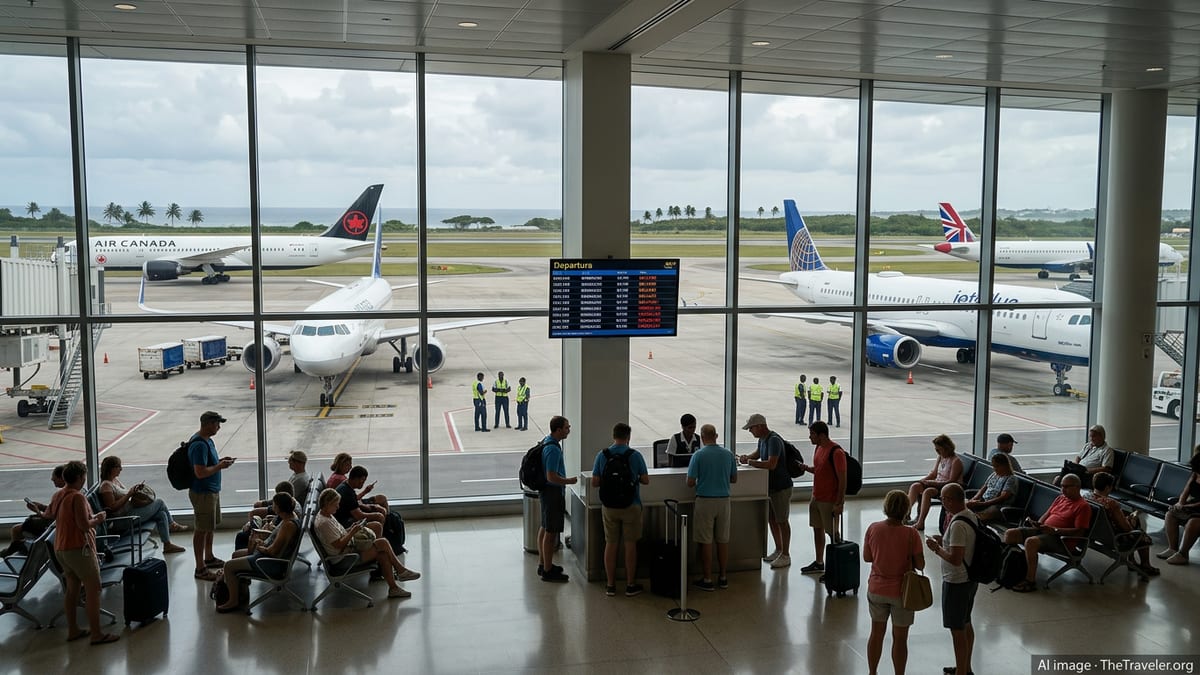
Shock ATC Action Shutters Barbados Airspace for Hours
Barbados’ normally busy airspace was effectively shut for around seven and a half hours on Saturday 7 March, after what authorities described as an “operational disruption” in Air Navigation Services led to a sudden suspension of arrivals and departures at Grantley Adams International Airport. While officials later framed the shutdown as a staffing issue, aviation sources and passenger accounts pointed to an unannounced walkout by air traffic controllers over long‑running workplace grievances.
The disruption began early on Saturday, freezing movements across one of the eastern Caribbean’s key aviation hubs just as peak-season leisure traffic from North America and Europe was streaming in. With radar screens in the island’s control centre effectively going dark to commercial traffic, inbound jets were ordered to hold or divert, while departures from Bridgetown were halted, leaving aircraft and crews out of position as schedules quickly unraveled.
Barbados’ Minister of Tourism and International Transport Ian Gooding‑Edghill later confirmed that the island’s airspace had been only partially available, characterising the shutdown as a consequence of staffing shortfalls within the Air Navigation Services department. Normal operations were gradually restored from around 2:30 p.m. local time following an emergency meeting between government officials and trade union representatives, but not before the knock‑on effects rippled far beyond the Caribbean.
Industry insiders said the episode underscored how vulnerable Caribbean connectivity is to labour unrest in small island states, where a single control facility can oversee vast swathes of regional airspace and where contingency options for rerouting traffic are limited.
Canada, US and UK Flights Forced Into Mid‑Air U‑Turns
Among the most dramatic consequences of the Barbados disruption were a series of so‑called “flights to nowhere,” as long‑haul services from Canada, the United States and the United Kingdom were forced to abandon their routes and return their passengers to their points of origin. One packed Air Canada Boeing 787 Dreamliner operating a Toronto–Barbados service had already been in the air for close to four hours when its crew received word that they would not be permitted to enter Barbadian airspace, obliging them to execute a wide U‑turn over the Atlantic and retrace their route back to Canada.
On the US East Coast, services operated by United Airlines from Newark to Bridgetown, along with flights by JetBlue and Delta from New York, were also diverted back to their departure airports after it became clear that the Barbados control centre would remain unavailable for an extended period. Passengers reported that onboard announcements initially cited “operational issues” before crews explained that air traffic control in Barbados was unavailable and that the aircraft could not legally continue.
UK carriers were also caught in the fallout. While some afternoon services from London were eventually able to land once partial operations resumed, morning departures faced delays and equipment swaps as airlines recalculated crew duty times and fuel requirements in light of the uncertainty around the island’s airspace status. Travelers posting on social media from both Heathrow and regional UK airports described check‑in queues halted for hours while ground staff waited for clearance from operations centres and updated guidance from Barbados.
Aviation analysts noted that for airlines crossing the Atlantic, the decision to turn back mid‑flight, while costly, is often the only viable option when a destination airspace closure appears likely to outlast the aircraft’s fuel reserves or when suitable alternates in the region are already congested or lack the capacity to absorb diverted wide‑body jets and hundreds of extra passengers.
Stranded Passengers Confront Uncertainty and Extra Costs
For travellers expecting to step into the Caribbean sunshine at Bridgetown, the sudden reversals were emotionally and financially bruising. Passengers arriving back in Toronto, Newark and New York after round‑trip flights that delivered them right back where they started described children in tears, exhausted elderly travellers, and a general sense of disbelief that a staffing dispute thousands of kilometres away could derail carefully planned holidays and cruise departures.
Many reported confusion over their rights to rebooking and compensation. Several Canadian passengers said they were initially informed that because the disruption stemmed from an air traffic control issue outside the airline’s control, carriers were not obliged to cover hotel stays or incidental expenses. In the United States, some travellers complained of long waits to speak with agents, with rebooking options constrained by packed March break flights and limited spare capacity into Barbados and neighbouring islands.
In the UK, where consumer protection rules for flight disruption departing from British airports are more robust, some Barbados‑bound passengers were told to expect duty‑of‑care support including accommodation and meals, although concrete arrangements varied by airline and by the timing of cancellations versus delays. Travel insurers meanwhile fielded a spike in claims queries as customers sought clarity on whether industrial action by foreign air traffic controllers qualified as a covered event.
Local tourism operators in Barbados warned that the temporary closure could have outsized effects on cruise and resort bookings if confidence in the island’s air connectivity is shaken. With some travellers already re‑routing future Caribbean trips through alternative hubs such as Antigua, Saint Lucia or Puerto Rico, hoteliers called for swift communication and reassurance from authorities that contingency plans will prevent a repeat scenario.
Government and Unions Scramble to Defuse Labour Dispute
Behind the dramatic images of jets turning back over the Atlantic lies a deeper labour dispute that has been simmering for months. Representatives of Barbados’ air traffic controllers have long warned of chronic staff shortages, mounting workloads and an expanding list of responsibilities that, they say, have not been matched by commensurate pay or improved working conditions. Saturday’s walkout, while unofficial, appears to have been a flashpoint after a series of failed negotiations.
The emergency meeting convened by the Barbados government on Saturday involved senior officials from the Ministry of Tourism and International Transport, the Ministry of the Public Service, and leaders from the Barbados Workers’ Union and the National Union of Public Workers. Following the talks, officials insisted that “several outstanding issues” had been addressed and confirmed that a follow‑up meeting is scheduled for mid‑March, a sign that the dispute is far from fully resolved.
Union sources, however, suggested that their members remained frustrated by what they see as years of incremental promises and slow implementation. They argue that the island’s rising profile as a leisure and remote‑work destination has dramatically increased traffic volumes through Grantley Adams International Airport, even as the ATC workforce has barely grown. That, they contend, has raised fatigue and safety concerns well beyond acceptable thresholds.
Regional aviation experts say that Barbados is not alone in facing such pressures. Across the Caribbean, small island administrations are grappling with how to retain skilled controllers who are increasingly tempted by better‑paid roles in North America and Europe. Unless governments can offer competitive salaries and modernised working conditions, they warn, more flashpoints that destabilise international travel could lie ahead.
What Travelers Should Do If They Are Booked to Barbados
With operations at Grantley Adams International Airport now restored but labour talks still fluid, airlines and travel advisers are urging anyone booked to or through Barbados in the coming days and weeks to stay alert and flexible. Passengers are advised to monitor their flight status closely via airline apps and airport information screens, as schedules may continue to shift while carriers reposition aircraft and crews that were displaced by Saturday’s disruption.
Where possible, travellers are being encouraged to build in additional buffer time when connecting to cruises or onward island‑hopping flights that depend on punctual arrivals into Bridgetown. Those with flexible tickets or travel insurance that permits date changes without penalties may wish to consider avoiding the busiest weekend peaks, when any renewed disruption would be most painful.
Consumer advocates say it is essential that travellers familiarise themselves with the passenger rights regimes that apply in their country of departure, whether that is Canada, the United States or the United Kingdom. Rules governing compensation, hotel coverage and refunds can differ significantly, and understanding the fine print in advance can help passengers make informed choices if their flight is delayed, diverted or cancelled.
For now, Barbados remains open for business, and the majority of flights have resumed. But the events of 7 March will linger in the minds of both airlines and travellers as a reminder that the smooth functioning of modern air travel can hinge on a relatively small group of highly specialised professionals in control towers and radar rooms, and that when they down tools, the world’s leisure routes can grind to an abrupt and very expensive halt.