

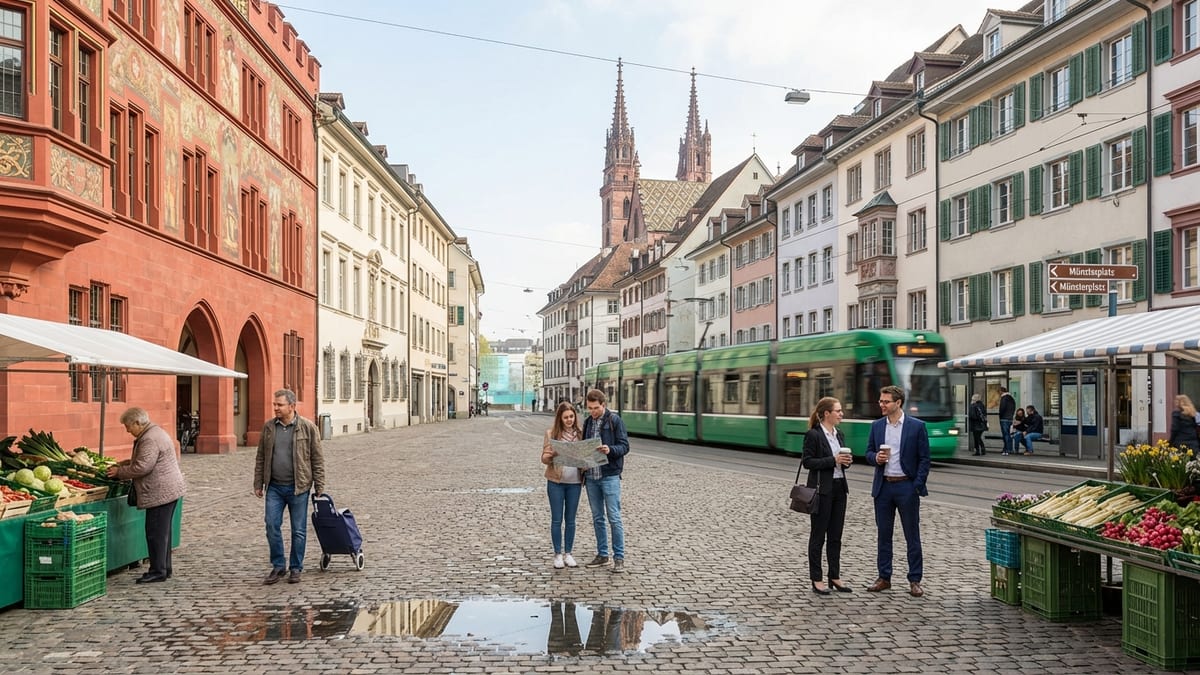
Basel’s Old Town feels purpose-built for walking. A compact tangle of cobbled lanes, stepped alleyways and river viewpoints, it rewards unhurried wandering more than rigid itineraries. Yet if you follow the natural thread that runs from the red Rathaus on Marktplatz up to the Münster and down again through the quieter backstreets, you can experience both Basel’s headline sights and its most atmospheric hidden corners in a single day.
Understanding Basel’s Old Town
Basel’s historic core stretches along the Rhine on both banks, but the most evocative section for a first-time walk lies on the Grossbasel, or south bank. Here, medieval merchants, guilds and bishops once competed for influence, leaving a dense patchwork of guild houses, churches and steep alleys that still read like a stone chronicle of the city. The Old Town is not a museum piece. Trams glide over centuries-old routes, markets still animate the squares and students rush between lectures in buildings that predate the printing press.
Unlike some European centers where traffic dominates, Basel’s Old Town is remarkably pedestrian friendly. Many of the key streets are car free or limited to local access, and the city’s fast, quiet tram system keeps most through-traffic at the edges. This gives walkers space to pause in narrow alleys, examine carved doorways or linger over river views without constantly dodging vehicles. Wayfinding is easy, too. Green and brown signposts point to major sights and hilltop towers, and the Rhine is never far away as a natural compass line.
Today, Basel positions its Old Town as a living stage for culture. Major museums sit just beyond the medieval core, but within the historic streets you will find small galleries, independent bookshops and intimate concert venues tucked behind heavy wooden doors. Seasonal events from Fasnacht carnival in late winter to the Christmas market in late November and December spill directly into squares like Barfüsserplatz and Münsterplatz, turning a classic walking circuit into a moving piece of theater.
Planning Your Walk: When to Go and How Long to Stay
A leisurely Old Town circuit that takes in Marktplatz, the Münster and a handful of hidden corners works well as a half-day walk. Allow three to five hours if you want to go inside the cathedral, climb a tower, pause for coffee on a square and detour into side streets such as Spalenberg. With museums and a long lunch, the route can easily expand into a full day. The distances themselves are short. From Marktplatz up to Münsterplatz is less than ten minutes on foot, and many of the most rewarding side streets are strung between these two points.
Timing matters if you want to experience the Old Town at its most atmospheric. Market days bring Marktplatz to life with vegetable stands, flower stalls and local dairy products. The main Basel City Market takes place from Tuesday to Friday in the morning and early afternoon, and on Saturdays it runs into late afternoon, with no market on Sundays or public holidays. If your schedule allows, aim to reach Marktplatz between about 9 a.m. and noon on a weekday or Saturday to see the square animated by stalls and locals doing their weekly shopping.
Seasonally, Basel is walkable year-round. Spring and early autumn offer the most comfortable temperatures, but winter has its own appeal when the Christmas market fills Münsterplatz and Barfüsserplatz with lights and wooden chalets from late November to late December. Summer can be warm, yet the Old Town’s narrow lanes and tree-shaded terraces create pockets of shade, and the Rhine provides a constant breeze. Whenever you visit, comfortable shoes are essential. Cobblestones, short flights of steps and sloping streets are part of the charm but can be tiring if you are not prepared.
From Marktplatz to the Rathaus: Basel’s Beating Heart
Begin your walk on Marktplatz, the city’s historic marketplace and one of the best orientation points in Basel. Trams intersect here, and the square’s edges are lined with a mix of historic houses and more contemporary facades. Yet the dominant presence is the Rathaus, the richly decorated town hall with its vivid red sandstone walls, towers and painted arcades. Even among European town halls, Basel’s stands out for its color and elaborate murals, which celebrate the city’s political traditions and civic pride.
On a typical weekday morning, Marktplatz balances daily life and tourism in equal measure. Office workers cross the square with coffee, residents browse market stands for fruit and vegetables, and visitors photograph the Rathaus facade between tram arrivals. If you are here during market hours, take a few minutes to walk through the stalls. The Basel City Market is known for its regional produce and local specialties, and it functions as a living reminder that these squares have always been places of exchange rather than static monuments.
From Marktplatz, several paths fan out into the Old Town. Freie Strasse leads south as a main shopping artery while cobbled lanes like Rümelinsplatz and Sattelgasse invite more intimate exploration. For this walk, look for the rising streets that point toward the Münster hill. Signs toward the cathedral or Münsterplatz will guide you gently uphill past a mix of patrician townhouses, discreet boutiques and small cafes that hint at Basel’s long history of trade, learning and craftsmanship.
Climbing to Basel Münster and the Pfalz Terrace
As you climb toward the ridge above the Rhine, the streets narrow and then suddenly open onto Münsterplatz, one of Basel’s most impressive squares. Paved in cobblestones and framed by historic houses and former canons’ residences, the square is dominated by the twin-towered Basel Münster. Constructed largely between the 12th and 15th centuries in red sandstone with patterned roof tiles, the cathedral is both a religious landmark and a visual anchor for the city’s skyline.
The interior of Basel Münster blends Romanesque and Gothic elements, with high vaults, carved capitals and quiet side chapels. Visitors can usually enter freely during daytime opening hours, although access may be restricted during services and special events. Those willing to tackle approximately 250 steps up one of the towers are rewarded with a far-reaching view over the Old Town, the Rhine, Kleinbasel on the opposite bank and, on clear days, the distant Black Forest and Vosges mountains. Tower access is ticketed and subject to opening schedules, so check the current times locally before you climb.
Do not miss the cloister on the south side of the cathedral, a peaceful quadrangle where weathered tombstones line the arcades and stone tracery frames small glimpses of the city beyond. From the cloister area, or by following signs around the cathedral, you reach the Pfalz, the panoramic terrace directly behind the Münster. This platform, perched high above the Rhine, is one of Basel’s essential viewpoints. From here you can watch ferries drift across the current, trace the line of the Mittlere Brücke and see how tightly the Old Town clusters along the river’s bend.
The mood on the Pfalz changes throughout the day. Early mornings are quiet, with locals cutting through on their way to work and a few dog walkers pausing at the railings. At midday, office workers appear with sandwiches and students spread out on the stone steps. In the early evening, especially in summer, the terrace becomes one of the most sociable places in the city, with people gathering to watch the changing light on the river. It is an ideal spot to pause on your walking route, whether for photographs, a rest or simply to absorb Basel’s layered geography.
Down to the Rhine: Rheinsprung, Ferries and Riverside Life
From the Pfalz, several stepped alleys and narrow streets lead you down toward the river. Rheinsprung is among the most atmospheric routes, dropping in a zigzag of stone steps between tall houses with recessed doorways and small oriel windows. Walking here gives a sense of how close the relationship has always been between the hilltop power centers and the working life of the river. In centuries past, merchants, scholars and craftsmen would have trodden these same paths between waterfront warehouses, printing shops and the cathedral precinct.
At the bottom, the riverfront promenade reveals a different aspect of the Old Town. On the Grossbasel side, the embankment offers a broad walkway where Basel residents stroll, jog or sit on the steps that descend to the water. Look upstream and downstream to appreciate how the Rhine frames the city. The Mittlere Brücke, whose predecessor dates back to the early 13th century, occupies a central position, linking Grossbasel with Kleinbasel and functioning as both a traffic route and a symbolic bridge between older and newer neighborhoods.
One of Basel’s distinctive experiences is crossing the river using the small fixed-cable ferries that shuttle between the banks without engines, powered only by the Rhine’s current. While not strictly necessary for following this Old Town route, taking one of these ferries adds a memorable perspective on the city’s silhouette and its riverside architecture. Landings near the Old Town let you step briefly into Kleinbasel for a different view back toward the Münster and the terraced houses clinging to the hill above.
After exploring the riverfront, return toward the interior of Grossbasel by looping back up via quiet streets such as Augustinergasse or via the stepped alleys near the Münster. This transition from the broad sweep of the Rhine to the intimate scale of Old Town courtyards is one of the pleasures of walking in Basel. Within a few minutes, the river’s wide horizon narrows again to stone walls, hanging lanterns and the muted echo of footsteps on cobbles.
Hidden Corners: Spalenberg, Leonhardsgraben and Quiet Courtyards
No walking guide to Basel’s Old Town is complete without Spalenberg, one of the most characterful streets climbing the western flank of the historic center. From the lower end, near Schneidergasse, Spalenberg rises in gentle curves between closely packed houses that host small fashion boutiques, artisan workshops and cafes. Decorative shop signs project into the street, and the irregular rhythm of the facades preserves the feel of a pre-modern trading lane adapted over centuries.
As you work your way up Spalenberg and its side lanes, look for connecting alleys such as Nadelberg and Gemsberg, each with its own mix of stepped passages and tucked-away courtyards. These streets once held the homes of wealthy merchants and guild leaders, and even today their carved doorways and inner courtyards hint at a time when business and domestic life intertwined. Some courtyards remain private, yet others reveal themselves momentarily when a gate is open, offering glimpses of vines, fountains and quiet stone benches hidden from the main thoroughfares.
To the south, streets like Leonhardsgraben and Leonhardsberg trace the line of former fortifications and link the core of the Old Town with Barfüsserplatz. Walking here reveals another layer of Basel’s history in the form of preserved fragments of the old city wall and the silhouettes of churches such as Leonhardskirche. The mood tends to be calmer than on Marktplatz or Freie Strasse, with more residential buildings and fewer large stores. It is an ideal area to wander without a fixed route, letting the curve of each street lead you to the next small discovery.
One of the pleasures of exploring these hidden corners is how quickly you can move from urban bustle to near silence. A few steps off a main route might bring you to a secluded stairway, an arched passage or a small square with a fountain and a single tree. Basel has preserved many of these micro spaces, and their human scale is what gives the Old Town its particular charm. Set aside time in your walk simply to follow whichever archway or side alley catches your eye, with the knowledge that trams, main squares and clear signposts are never far away if you need to reorient.
Barfüsserplatz, Museums and Evening Atmosphere
Eventually, many Old Town routes thread their way toward Barfüsserplatz, a large square that acts as both a transport hub and a cultural focal point. Trams converge here, and the space is ringed by shops, cafes and the imposing Barfüsserkirche, a former Franciscan church that now houses the city’s historical museum. The square hosts flea markets, fairs and seasonal events, notably a section of the Christmas market from late November until just before Christmas, when wooden stalls, food stands and festive decorations transform the atmosphere.
Architecturally, Barfüsserplatz captures Basel’s habit of layering periods without erasing the past. Tram lines curve past medieval stonework, and contemporary commercial buildings sit beside centuries-old facades. For walkers, this is a practical place to pause. Take stock of the routes you have already covered, rest at a cafe terrace or step into the historical museum to deepen your understanding of the city’s development from a medieval trade center to a modern cultural hub.
If time and interest allow, this is also a convenient point to detour slightly beyond the strict Old Town boundary to visit major institutions such as the Kunstmuseum Basel or the Museum der Kulturen. Both sit within a short walk and operate with regular daytime opening hours, typically from Tuesday through Sunday, with closures or adjusted times on Mondays and specific public holidays. Checking the latest schedules when you arrive in Basel is advisable, as hours can change around carnival, national holidays and special events.
As evening approaches, the character of the Old Town shifts again. Office workers leave, lights come on in upper-story apartments and the soundscape softens. Streets like Spalenberg and the lanes near the Rhine host intimate wine bars and restaurants, many of them small-scale and independently run. A satisfying way to end your walking day is to choose a spot with a view, perhaps near the river or on a square, and watch the trams glide past as the illuminated towers of the Münster and the Rathaus stand as constant reference points against the darkening sky.
The Takeaway
Walking Basel’s Old Town is less about ticking off a list of monuments and more about inhabiting a compact urban landscape that has been lived in for centuries. From the color-splashed Rathaus on Marktplatz to the sober stone of the Münster and the quiet courtyards of Spalenberg, each section of the route tells a different chapter in the same story. The city’s thoughtful balance of preservation and daily life keeps the area from feeling staged, and the short distances between major sights mean you can slow down without worrying about covering ground.
By structuring your walk around a loose spine from Marktplatz up to Münsterplatz, down to the Rhine and back through the western lanes to Barfüsserplatz, you gain an intuitive sense of Basel’s topography and history. Marktplatz introduces the civic heart, the Münster hill reveals the city’s religious and political past along with sweeping views, the riverside underlines the importance of the Rhine, and the hidden streets demonstrate how ordinary life and trade have always filled the spaces between landmarks.
Ultimately, what stays with many visitors is the contrast between Basel’s global cultural reputation and the almost village-like scale of its Old Town. You can stand in a world-class museum in the morning and be drinking coffee in a centuries-old alley ten minutes later. The city invites you to wander at walking pace, to look up at carved doorways and tiled roofs, to lean on the Pfalz balustrade above the river and to let the tram bells and church chimes form the soundtrack to your exploration.
FAQ
Q1: How long does a typical Basel Old Town walking route take?
Most visitors can cover a core route from Marktplatz to Münsterplatz, down to the Rhine and through Spalenberg and Barfüsserplatz in three to four hours at a relaxed pace, allowing time for short breaks and a visit inside the cathedral.
Q2: When is the best time of day to start an Old Town walk?
Starting around 9 or 10 a.m. lets you experience Marktplatz while the city market is active on its main days and still leaves time to visit interiors like Basel Münster and museums before they close in the late afternoon.
Q3: Are the Old Town streets suitable for people with limited mobility?
Many main squares and some streets are level and paved, but steep cobbled lanes and stairways are common between the river, Marktplatz and the Münster hill, so travelers with limited mobility may need to plan gentler routes or use trams for some sections.
Q4: Can you visit the interior and towers of Basel Münster every day?
The cathedral is generally open to visitors on most days, with access restricted during services and special events, while tower access depends on specific opening hours and weather, so it is wise to confirm the current schedule locally on arrival.
Q5: Is the Basel City Market on Marktplatz open every day?
The main fresh produce market operates from Tuesday to Saturday with varying hours, typically from early morning into early or mid-afternoon, and does not take place on Sundays or on major public holidays.
Q6: Do you need a guided tour to explore Basel’s Old Town?
A guided tour can add depth and stories to what you are seeing, but the Old Town is compact and well signposted, so confident travelers can comfortably explore on their own using basic maps or a city app.
Q7: Are there good viewpoints over Basel besides the Münster towers?
Yes, the Pfalz terrace behind the cathedral offers expansive views over the Rhine and Kleinbasel without climbing the tower, and various points along the riverbank and on bridges like the Mittlere Brücke provide striking perspectives of the skyline.
Q8: How safe is the Old Town to walk around in the evening?
Basel’s Old Town is generally considered safe, with people out and about around main squares and tram stops into the evening, though normal urban precautions such as staying aware of your surroundings and keeping valuables secure still apply.
Q9: Can I easily combine the Old Town walk with a museum visit?
Yes, major museums such as the Kunstmuseum Basel and the historical museum at Barfüsserkirche sit on the edge of the Old Town, making it straightforward to integrate a one to two hour gallery visit into a half-day or full-day walking route.
Q10: What should I wear and bring for an Old Town walk in Basel?
Comfortable shoes with good grip are essential for cobblestones and slopes, and depending on the season it is sensible to carry a light waterproof layer, a refillable water bottle and, in summer, sun protection for more exposed stretches by the river.