

More news on this day
Indonesia’s busy domestic air network was thrown into fresh turmoil this week as Batik Air canceled 29 flights and delayed 37 more across the archipelago, disrupting crucial links between Jakarta, Yogyakarta, Lombok, Makassar’s Sultan Hasanuddin Airport, Palembang’s Sultan Mahmud Badaruddin II Airport and other key cities.
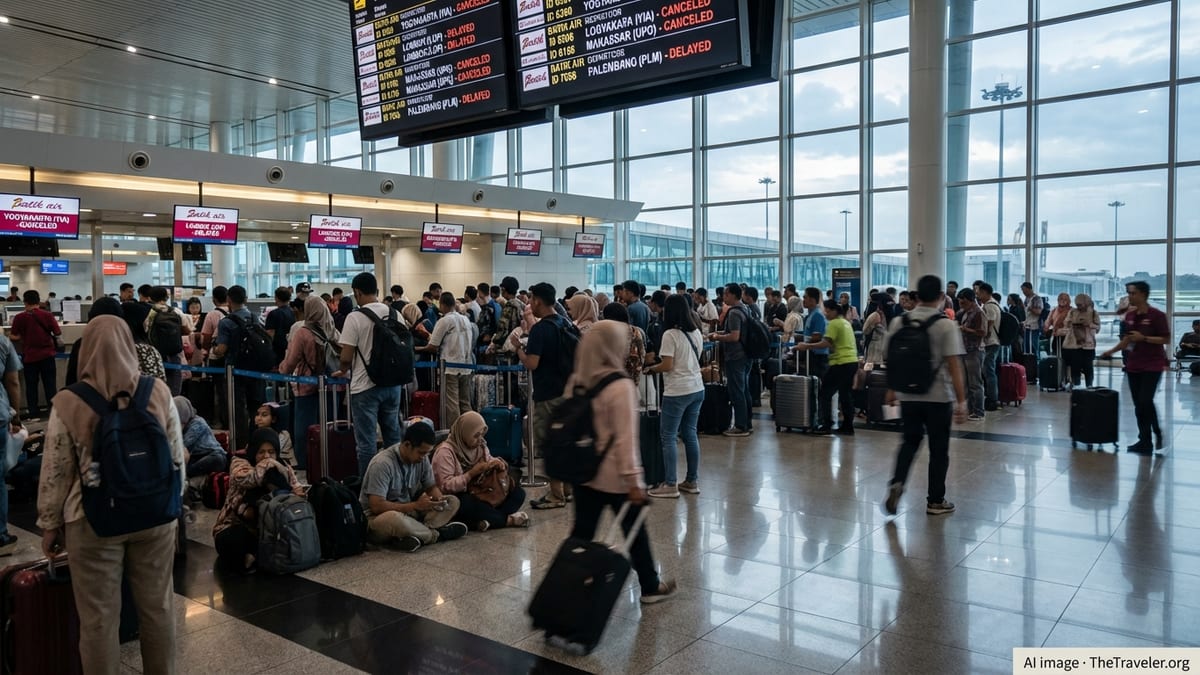
Wave of Disruptions Across Indonesia’s Domestic Network
The latest operational meltdown for Batik Air comes on the heels of a month marked by mounting reliability concerns across Indonesia’s aviation sector. Fresh data from flight-tracking and passenger-compensation services shows the carrier again leading the country’s disruption tables, with dozens of cancellations and long delays concentrated on high-demand domestic routes.
The 29 cancellations and 37 delays recorded in the most recent 24 hour period hit some of Indonesia’s most vital air corridors, including Jakarta connections to Yogyakarta, Lombok, Makassar, Palembang, Pontianak, Jambi and other secondary hubs. Many of these routes serve as lifelines for education, business, government travel and tourism, amplifying the impact of each grounded aircraft or late departure.
At Jakarta’s Soekarno Hatta International Airport, long lines quickly formed at Batik Air check in counters as passengers scrambled to rebook trips or secure refunds. Similar scenes were reported at Sultan Hasanuddin International Airport in South Sulawesi and at Sultan Mahmud Badaruddin II in South Sumatra, where travelers faced hours of uncertainty over whether they would be able to reach Jakarta or connect onward the same day.
For many, the latest wave of cancellations felt like a continuation rather than an isolated incident. In late January, independent aviation tallies showed Batik Air already registering one of the highest concentrations of cancellations and delays among Indonesian carriers operating from Jakarta, Makassar and Pontianak, signaling deeper structural challenges behind the current disruption.
Key Routes to Yogyakarta, Lombok, Jakarta and Regional Hubs Affected
The impact of the latest Batik Air disruptions has been uneven but significant across Indonesia’s sprawling archipelago. On the island of Java, flights serving Yogyakarta a major center for culture, education and tourism were among those affected, with passengers bound for the city reporting last minute cancellations and rolling departure-time changes from Jakarta.
On the tourism focused island of Lombok, travelers arriving at the airport found screens suddenly displaying “canceled” beside several Batik Air services to and from the capital and other cities. The disruptions are especially worrying for local businesses that depend on steady tourist arrivals and for residents using Lombok’s air links for medical treatment, education or work travel in other parts of Indonesia.
Jakarta, as the country’s primary aviation hub, once again absorbed the brunt of the chaos. Soekarno Hatta serves as the origin or destination for the majority of Batik Air’s domestic operations, so cancellations there ripple outward, stranding travelers not only in the capital but also in secondary cities whose flights depend on aircraft and crew rotations through Jakarta.
Regional airports such as Sultan Hasanuddin in Makassar and Sultan Mahmud Badaruddin II in Palembang, which connect Indonesia’s outer islands and provincial capitals to the national capital, also saw flight after flight either delayed past their scheduled departure times or scrubbed entirely. Such disruptions can quickly cascade, leaving aircraft and crew out of position and forcing the airline to trim its schedule to recover its network.
Weather, Congestion and Operational Strain Behind the Numbers
While Batik Air has not released a detailed public breakdown of the root causes for each of the 29 cancellations and 37 delays, a combination of factors appears to be at work, mirroring wider trends in Indonesian aviation. Seasonal heavy rains, poor visibility and thunderstorms continue to disrupt operations in parts of the country, with meteorological officials repeatedly flagging extreme weather around major airports such as Sultan Hasanuddin in South Sulawesi in recent weeks.
Bad weather can force pilots to divert to alternate airports, delay departures from origin points, or cancel flights altogether when visibility or wind conditions fall below safety thresholds. Earlier this year, flights at Sultan Hasanuddin were already being diverted or delayed because of storms and drastically reduced visibility, underscoring the vulnerability of tightly scheduled domestic operations to sudden meteorological shifts.
Operational constraints within Batik Air’s own network may also be amplifying the impact of weather and congestion. Flight performance data for selected Jakarta bound routes from Makassar suggests that a significant share of services have recorded late arrivals, cancellations or excessive delays over the past two months. Such statistics point to a system already operating near its limits, where relatively small external shocks can trigger widespread knock on effects.
Air traffic congestion around Jakarta and several provincial hubs adds another layer of complexity. When departure and arrival slots tighten, any delay on one leg can throw off aircraft rotations and crew duty schedules. In a network like Batik Air’s, where aircraft often operate multiple short haul domestic sectors per day, these disruptions can quickly multiply, turning a weather related delay in one region into a series of cancellations and missed connections elsewhere.
Passengers Stranded, Missed Connections and Mounting Costs
For passengers, the statistics translate into very personal stories of missed obligations and unexpected expenses. At Soekarno Hatta, travelers reported being informed of cancellations only after arriving at the airport, leaving them scrambling to find alternate tickets on rival carriers in an already busy domestic market. Some were forced to stay overnight in Jakarta, Makassar or Palembang as later flights filled up or were themselves delayed.
Business travelers heading to Yogyakarta for meetings, students returning to university campuses at the start of a new term, and families on long planned holidays to Lombok all described similar experiences: hours at departure gates with shifting departure times, queues at service counters and limited information on when new flights might become available.
Travel industry analysts note that the financial burden of such disruptions can be considerable. Beyond ticket changes or fare differences when switching airlines, passengers often face unplanned hotel stays, meals, local transport and lost income or leave days. For those connecting from domestic Batik Air services to international flights on other carriers, a missed connection can mean the loss of an entire long haul ticket or the need to purchase a last minute replacement at premium prices.
Consumer advocates argue that the repeated disruptions are eroding confidence in Indonesia’s domestic air market at a time when demand remains robust. They warn that frequent cancellations and chronic delays will push more travelers with flexible budgets to gravitate toward carriers perceived as more reliable, putting additional commercial pressure on airlines that already operate on thin margins.
Compensation Rights and What Stranded Travelers Can Do
The latest travel chaos has renewed attention on what rights passengers actually have when their flights are canceled or severely delayed. While Indonesia does not mirror European style compensation rules in full, international frameworks and airline specific policies still give travelers some avenues to seek redress, particularly when disruptions are not caused by extraordinary circumstances such as severe weather or airspace closures.
Specialist air passenger rights organizations tracking Batik Air’s global operations report unusually high levels of cancellations and disruptions in recent days, and actively encourage affected travelers to document their itineraries, receipts and all communication with the airline. They note that passengers may be entitled to refunds, rerouting at the earliest opportunity, or in some cases fixed compensation where regulations apply.
Legal experts advise travelers to insist on written confirmation of the reason for a cancellation or long delay. When airlines attribute disruptions to “operational reasons” without further detail, it can be difficult for passengers to determine whether they qualify for compensation. Securing a clear explanation and keeping boarding passes, booking confirmations and time stamped photos of airport departure boards can strengthen any subsequent claim.
Travel agents and online booking platforms also play a key role. Many customers buy Batik Air tickets through major regional platforms rather than directly from the airline, and these intermediaries are often responsible for handling rebookings and refund requests. Industry insiders suggest that passengers pressure both the airline and their agent simultaneously to avoid being passed back and forth when seeking solutions.
Pressure Mounts on Batik Air and Regulators
The clustering of cancellations and delays around Batik Air in particular is likely to attract closer scrutiny from Indonesian aviation regulators, especially as the disruptions now touch multiple major airports on the same day. Officials at the Transport Ministry have previously reminded carriers that safety cannot be compromised, but they have also emphasized the importance of clear communication and proper treatment of affected passengers.
Analysts say regulators could push Batik Air to improve scheduling resilience, invest in additional spare aircraft capacity, or adjust its route network to better match resources to demand. There may also be pressure for more stringent reporting requirements so authorities can distinguish between disruptions caused by unavoidable factors such as weather and those stemming from maintenance, staffing or scheduling issues within the airline’s control.
Rival carriers, including Lion Air, Garuda Indonesia, Citilink and Indonesia AirAsia, are watching closely. Recent disruption data shows that while other airlines have also faced weather related delays and occasional cancellations, Batik Air has shouldered a particularly heavy share of grounded flights on some days, especially at Jakarta, Sultan Hasanuddin and Supadio airports. This pattern could influence future route competition and passenger loyalty within Indonesia’s domestic market.
Consumer groups are calling for more transparent public reporting of each airline’s on time performance, cancellation rates and average delay durations, arguing that travelers should be able to compare carriers based on reliability as well as price and schedule. Such moves, they contend, would reward airlines that invest in punctuality and penalize those that regularly leave passengers stranded.
Wider Asian Aviation Turbulence Raises Stakes
The upheaval in Indonesia is unfolding against a backdrop of broader aviation turbulence across Asia. Regional data from this week shows dozens of cancellations and more than a thousand delays spread across major hubs in Japan, China, Indonesia, the Philippines and other markets, affecting airlines from ANA and United to Garuda Indonesia, Batik Air and various low cost carriers.
Jakarta’s Soekarno Hatta and Makassar’s Sultan Hasanuddin are among the airports identified as experiencing significant operational stress, alongside Tokyo, Shanghai, Manila, Bali’s Ngurah Rai, Fukuoka and others. Seasonal weather, air traffic constraints and the rapid post pandemic rebound in travel demand are stretching infrastructure and operational planning across the region.
For Batik Air, this means it is grappling not only with its own internal challenges but also with an external environment where spare capacity is limited and schedule buffers are thin. When regional disruption spikes, securing replacement aircraft, crew or alternative routing becomes harder, particularly for carriers focused on the domestic and short haul market.
Travel planners advise passengers with upcoming itineraries through Jakarta, Makassar, Palembang, Lombok or Yogyakarta to build in extra time between connections, monitor flight status actively on the day of travel and consider flexible tickets that allow for rebooking without heavy penalties. They also suggest keeping essential items and a change of clothes in carry on luggage in case of unexpected overnight delays.
Tourism and Local Economies Brace for Ongoing Uncertainty
The latest episode of travel chaos is also ringing alarm bells for local tourism boards and business associations in affected regions. Yogyakarta’s heritage tourism sector, Lombok’s resort operators and small businesses in provincial capitals such as Palembang and Makassar all depend heavily on reliable air links to Jakarta and other major cities.
Hoteliers report that last minute cancellations or no shows linked to flight disruptions are becoming more common, complicating staffing and inventory planning. Tour operators who bundle domestic flights with accommodation and experiences are also exposed, as they often must shoulder the cost of rearranging itineraries for clients caught up in airline operational crises.
Economists warn that if reliability problems persist, they could slow investment and tourism growth in some secondary destinations, as both domestic and international visitors might gravitate toward cities with more stable flight operations. This would run counter to Indonesia’s broader development goals, which include spreading tourism benefits beyond established hotspots and strengthening connectivity across the archipelago.
For now, regional leaders are urging airlines and national authorities to treat the current disruption as a wake up call. They argue that maintaining the resilience of domestic air travel is not just about customer satisfaction but is central to economic activity, social mobility and national cohesion in a country where many journeys can only realistically be made by air.