

More news on this day
Passengers across Indonesia have been hit by severe travel disruption after Batik Air recorded 36 flight cancellations and dozens more delays on major routes linking Jakarta, Makassar, and Manado, straining airport operations at the height of the peak travel period.
Wave of Cancellations Hits Jakarta, Makassar, and Manado
The latest disruption has centered on Batik Air’s dense domestic network, with 36 cancellations and a raft of late departures affecting services through Jakarta’s Soekarno Hatta International Airport, Makassar’s Sultan Hasanuddin International Airport, and Sam Ratulangi Airport in Manado. These three hubs form critical links in eastern Indonesia’s air corridor, meaning any operational turbulence rapidly cascades across onward connections.
Data from regional operations over the past several days shows Jakarta acting as the primary pressure point, with heavy congestion, tight turnaround times, and knock-on schedule changes forcing Batik Air to trim flights and consolidate loads. At the same time, a cluster of late-running services through Makassar and Manado has left passengers facing extended waits in terminals and uncertain arrival times at smaller onward destinations in Sulawesi and North Maluku.
The figure of 36 cancellations mirrors broader Asian disruption reported this week, as airports from Jakarta to Bangkok and Beijing wrestle simultaneously with weather, air-traffic management constraints, and post-pandemic capacity challenges. For Batik Air, the turmoil has exposed the vulnerability of high-frequency domestic routes that rely on tightly stitched schedules and limited spare aircraft.
While precise flight numbers have not been publicly itemized, the pattern of disruption reflects a mix of outright cancellations on lower-demand sectors and rolling delays on flagship city pairs, particularly between Jakarta and Makassar. Many of those delayed departures ultimately operated hours behind schedule, reshaping entire days of flying for both crew and customers.
Passengers Stranded as Delays Stretch Into Peak Hours
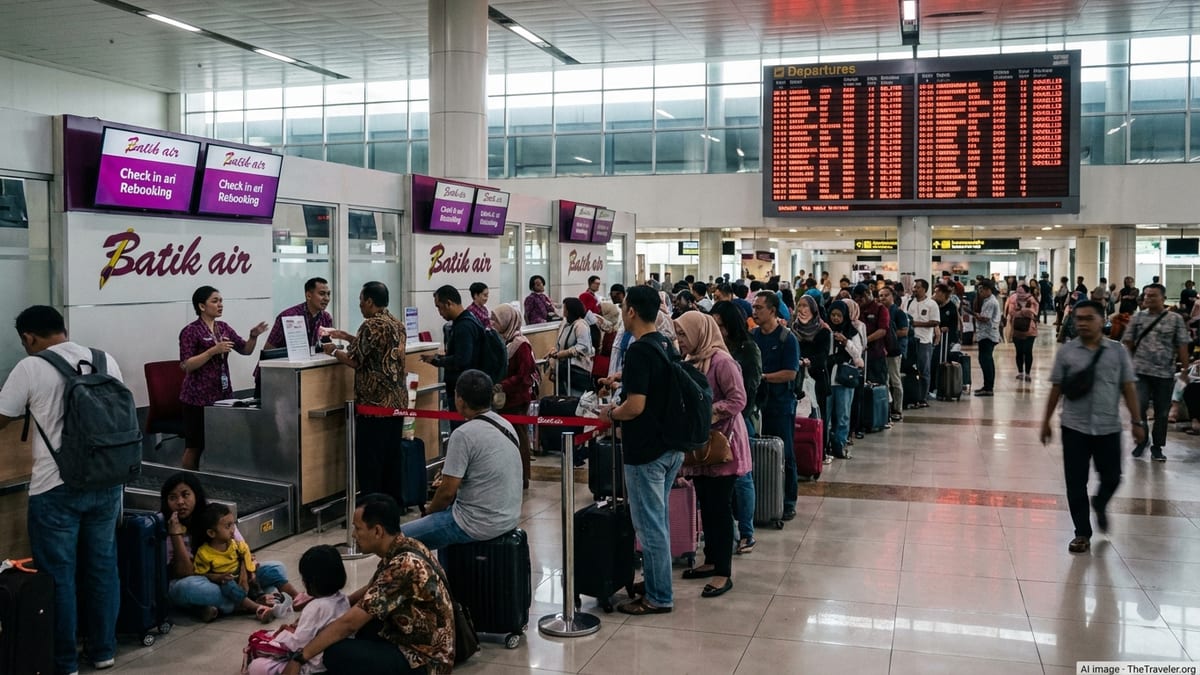
At terminal level, the impact has been immediately visible. Travelers at Soekarno Hatta and Sultan Hasanuddin have described crowded departure halls, long queues at check-in and rebooking counters, and repeated public address announcements advising of “operational reasons” for delays and cancellations. Families returning from holidays and business travelers on tight itineraries have been among the hardest hit.
In Makassar, where the airport doubles as a key transit point for flights further east, even a small number of cancelled or late Batik Air departures can leave entire itineraries unraveling. Passengers heading toward secondary cities such as Luwuk or regional islands often rely on single daily connections; when those flights are pushed back or scrapped, overnight stays and last-minute accommodation searches become unavoidable.
Reports from Manado tell a similar story, with travelers facing long waits as ground staff scramble to secure new routings via other Lion Group carriers or alternative airlines when seats are available. For many, communication has been as much of a frustration as the disruption itself, with frequent changes to estimated departure times complicating efforts to rearrange hotel, ferry, and tour bookings at short notice.
Social media posts from affected passengers highlight a mix of confusion and fatigue, as travelers wait for updates that can shift within minutes. While some customers have praised individual staff efforts to assist with rebooking and meal vouchers, many others have called for clearer information about the root causes of the cascading delays.
Operational Pressures, Weather, and Congested Skies
Behind the scenes, the disruption reflects a complex intersection of weather, airspace congestion, and airline operational constraints. Indonesia’s aviation network is especially sensitive to seasonal storms and rapidly changing visibility, particularly around coastal and mountainous regions in Sulawesi and North Sulawesi. When conditions deteriorate, air-traffic controllers are forced to widen spacing between aircraft and occasionally divert or hold arrivals, quickly backing up already-busy schedules.
Makassar, which functions as a major control and routing point for eastern Indonesian airspace, has seen this pattern repeatedly in recent years. Periods of heavy rain, low clouds, and crosswinds have led to delays and diversions, including for Batik Air flights operating to and from Luwuk and other smaller airports. Even brief windows of poor visibility can disrupt the carefully timed rotations that airlines depend on to keep aircraft and crew in position throughout the day.
On top of weather, the sharp rebound in travel demand across Asia has pushed ground and air-traffic infrastructure to the limit. Recent regional tallies show more than 500 delayed services and dozens of cancellations in a single day across major Asian hubs, with Jakarta among the hardest hit. With limited spare aircraft and crews, carriers like Batik Air can quickly run out of options when an early-morning delay or maintenance issue cascades through subsequent flights.
Industry analysts note that while domestic operators have restored most of their seat capacity since the pandemic, hiring and training for technical staff, pilots, and ground personnel has lagged. That imbalance leaves less margin for error when storms roll through, equipment requires unplanned checks, or airports confront surges of late-arriving flights vying for the same few gates and stands.
Jakarta Soekarno Hatta Emerges as a Critical Bottleneck
Jakarta’s Soekarno Hatta International Airport, Indonesia’s primary gateway, has once again emerged as the focal bottleneck in this latest round of disruption. The airport remains one of Southeast Asia’s busiest, handling dense banks of domestic departures alongside a growing number of international services. When ground movements slow or gate availability tightens, domestic airlines such as Batik Air frequently bear the brunt of schedule reshuffling.
Operational data from recent weeks underscores how fragile on-time performance can be at Soekarno Hatta, especially on key domestic trunk routes. For example, performance metrics for one Batik Air service linking Makassar and Jakarta in December and January show only about half of flights arriving on time, with an average arrival delay of more than 40 minutes and nearly one-third of flights cancelled over the period. That record predates this latest flare-up, suggesting a longer-running struggle with reliability on some of the carrier’s busiest sectors.
The current cancellations, layered on top of already modest punctuality, risk eroding traveler confidence in Jakarta-based connections. Travel agents report an uptick in customer inquiries about buffer times for domestic-to-domestic and domestic-to-international transfers, with some now recommending longer layovers through the capital to hedge against potential slippage in departure times.
Airport authorities have been working with airlines to smooth peaks and encourage more evenly spread schedules, but the sheer volume of morning and evening departures remains difficult to disperse. Without additional runway and terminal capacity coming online quickly, carriers will continue to face difficult choices between maintaining aggressive schedules and building more operational slack into their timetables.
Makassar and Manado Feel the Shockwaves
The effects of Batik Air’s turmoil have been magnified in Makassar and Manado, where the airline and its Lion Group partners function as de facto lifelines for many provincial routes. Sultan Hasanuddin International Airport in Makassar serves as a hub that funnels passengers from Jakarta and Surabaya into eastern Indonesia, while Sam Ratulangi Airport in Manado connects North Sulawesi to both domestic and limited international destinations.
When disruptions arise at these nodes, they reverberate out to smaller communities. A cancelled or heavily delayed Batik Air flight from Jakarta to Makassar can lead to missed onward legs to cities like Kendari, Palu, or Luwuk, where alternatives may not operate again until the following day. In Manado, delays in inbound services can delay onward connections to outlying islands, affecting residents, tourists, and workers alike.
Local tourism operators in North Sulawesi say the latest disruption comes at an awkward time, as they attempt to rebuild international confidence in destinations such as Bunaken National Park and Likupang after several uneven years for arrivals. While most visitors ultimately reach their destinations, the memory of multi-hour airport waits and last-minute schedule changes can color perceptions when travelers later choose where to book dive trips and beach holidays.
Regional business leaders echo those concerns, pointing out that reliable air links are essential for investment and trade. Inconsistent schedules and surprise cancellations can complicate everything from perishable goods logistics to corporate site visits, putting added pressure on airlines to stabilize operations on these critical corridors.
Airline Response and Passenger Rights
In response to the disruption, Batik Air and its parent Lion Group have been working through established protocols for handling irregular operations. These typically include offering passengers rebooking options on the next available flight, rerouting via alternative Lion Group carriers when possible, and providing refunds for cancelled services. At Jakarta and Makassar, ground teams have been tasked with managing queues at customer service counters and coordinating with airport authorities to allocate gates and buses as efficiently as possible.
Indonesian regulations set minimum standards for passenger care when flights are significantly delayed or cancelled for reasons within an airline’s control, such as technical issues or crew scheduling. Depending on the length and cause of the delay, carriers can be required to provide refreshments, meals, hotel accommodation, and ground transport to and from lodging. However, the rules are more limited when disruptions are attributed to weather or air-traffic control restrictions, leaving some travelers frustrated by inconsistencies in what is offered.
Consumer advocates argue that, regardless of regulatory thresholds, airlines must communicate clearly and proactively when things go wrong. That includes providing realistic estimates of departure times, promptly informing passengers of cancellations, and ensuring that staff are empowered to explain compensation options. As this latest episode shows, a lack of transparent information can deepen anger and anxiety, even when the underlying causes of disruption are outside the carrier’s direct control.
For Batik Air, the unfolding situation is an important test of its customer service reputation in a crowded domestic market. How the airline handles stranded passengers, processes refunds, and restores confidence on its core routes will influence traveler choices long after operations return to normal.
Wider Strains on Asia’s Rebounding Aviation Network
The difficulties facing Batik Air are part of a wider pattern of strain across Asia’s aviation network. Fresh data from multiple regional hubs indicates that more than 500 flights were delayed and 36 cancelled across major airports including Jakarta, Bangkok, Beijing, Manila, and Hong Kong in a single recent day, affecting a broad mix of full-service and low-cost carriers. The resurgence in air travel, while welcomed by the industry, has stretched ground handling, maintenance, and air-traffic management systems that are still catching up after the pandemic.
In this environment, localised problems can snowball rapidly. A storm sweeping through one airport may push departures back and force aircraft to arrive late into the next, where tight connection windows and limited gate capacity trigger another wave of disruptions. With many airlines operating lean fleets and busy schedules, there is little idle capacity available to absorb such shocks, making targeted cancellations like those now seen at Batik Air a common response.
Analysts say the situation underscores the need for coordinated planning between airports, regulators, and airlines, including investments in additional ground infrastructure, improved radar and navigation systems, and more resilient staffing models. Without those upgrades, passengers may continue to see periodic flare-ups of “travel chaos” even as airlines refine their internal procedures and technology.
For Indonesia specifically, the challenge is heightened by its geography. As a vast archipelago reliant on air links for both tourism and basic connectivity, any sustained weakness in airline reliability carries social and economic consequences. The current disruption on Batik Air’s Jakarta–Makassar–Manado corridor is a sharp reminder of how quickly those vulnerabilities can surface.
What Travelers Can Do When Schedules Unravel
For passengers caught in the latest wave of cancellations and delays, practical steps can make a difficult situation more manageable. Travel advisors recommend monitoring flight status closely through both airline channels and airport information displays, checking in online as early as possible, and arriving at the airport with extra time during periods of known disruption.
When cancellations occur, travelers are urged to immediately join official rebooking queues while simultaneously exploring options via customer service hotlines or mobile apps, where available. For those with critical onward connections or international flights, speaking with both the affected airline and downstream carriers can help coordinate revised itineraries and protect remaining legs where possible.
In Indonesia, passengers should also familiarize themselves with their entitlements under national aviation consumer protection rules, particularly regarding refreshments, accommodation, and refunds for cancellations. Keeping receipts for meals, local transport, and any emergency hotel stays can be helpful when seeking reimbursement later, whether from the airline or through travel insurance policies that cover delays.
Ultimately, the turbulence currently roiling Batik Air’s operations is a stark illustration of the fragility that still lingers in regional air travel. While most flights will continue to depart and arrive broadly on schedule, travelers on Indonesia’s busiest routes may choose to build in more time, flexibility, and contingency planning as the aviation system works through another period of strain.