

More news on this day
Travel across Indonesia and key international routes has been hit by a wave of cancellations involving Batik Air and Qatar Airways, with more than a dozen flights to and from Jakarta, Bali, Surabaya, Makassar, Doha and other destinations disrupted in recent days, leaving passengers scrambling to rebook and reroute their journeys.
Get the latest news straight to your inbox!
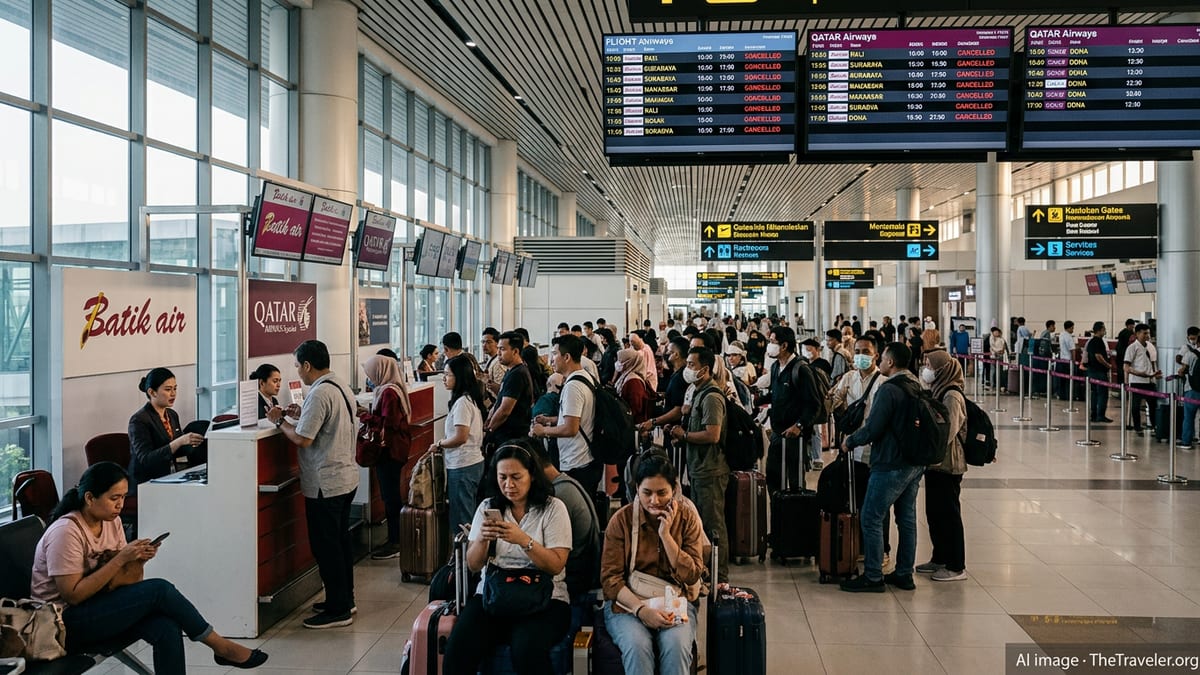
Multiple Routes Disrupted as Schedules Are Pulled
Passengers flying between major Indonesian hubs and the Middle East are reporting abrupt cancellations and schedule changes affecting both domestic and international itineraries. Routes linking Jakarta, Bali, Surabaya and Makassar with Doha and onward long haul destinations have seen a mix of outright cancellations, delayed departures and short-notice rerouting, according to traveler reports and airline advisories.
The disruption has been particularly acute for travelers connecting through Doha on Qatar Airways, with itineraries involving Indonesia often being amended or pulled as the carrier continues to operate a reduced and highly fluid schedule. Several travelers with journeys linking Bali or Jakarta to European cities via Doha have reported that their flights were canceled days before departure, forcing them to seek alternatives on other airlines or accept lengthy rebookings.
On the Indonesian side, Batik Air services connecting secondary cities with Jakarta and key leisure destinations such as Bali and Lombok have come under strain amid shifting aircraft and crew availability. While the majority of the airline’s domestic network is still operating, selective cancellations and extended delays have added further stress on already busy routes, complicating connections for passengers booked onward on international services, including those operated by Qatar Airways.
The combined effect has created a patchwork of operational gaps on some of Indonesia’s most important air corridors, with travelers advised to treat even confirmed itineraries as subject to change up until the day of departure.
What Is Driving the Wave of Cancellations
Behind the latest disruption is a mix of operational and airspace-related constraints that continue to reverberate across the region. Qatar Airways has been navigating a period of elevated schedule volatility, with its Doha hub subject to intermittent capacity, routing or regulatory limitations that have forced the airline to trim or consolidate services at short notice on certain long haul and connecting routes.
These constraints feed directly into the experience of passengers originating in Indonesia, where flights to and from Doha traditionally serve as a key bridge to Europe, the Middle East and Africa. When a Doha leg is withdrawn or retimed, through itineraries from Jakarta, Denpasar, Surabaya and Makassar can become unworkable, triggering automatic cancellations or significant rebookings that cascade across multiple days.
Batik Air, meanwhile, has been contending with its own set of challenges ranging from tight aircraft utilization to the knock-on effects of regional airspace congestion. The carrier has issued precautionary guidance in recent weeks highlighting the potential for schedule adjustments on selected routes, particularly where aircraft are rotated through long domestic chains that leave little margin for recovery when delays occur earlier in the day.
The overlap between these two sets of pressures has proven especially disruptive for passengers whose journeys rely on seamless handoffs between Indonesia’s domestic network and international connectors, illustrating how quickly regional constraints can spill over into global travel plans.
Airports and Passengers Hit Hardest
The airports feeling the greatest impact include Jakarta’s Soekarno-Hatta International Airport, Bali’s Ngurah Rai International Airport in Denpasar, Juanda International Airport in Surabaya and Sultan Hasanuddin International Airport in Makassar. These hubs serve as crucial gateways for both domestic mobility and outbound travel to the Middle East and Europe, amplifying the effect of any disruption.
In Jakarta and Bali, travelers have reported longer queues at airline service desks as they seek rebooking options, along with crowded customer service lines and extended hold times. Some passengers have opted to reposition themselves to alternative gateways, such as Singapore or Kuala Lumpur, in a bid to bypass constrained connections through Doha. Others have switched from Batik Air domestic sectors to competing Indonesian carriers where last minute seats were still available.
For those traveling to or from secondary cities, the impact can be even more pronounced. When a Batik Air link between, for example, Makassar and Jakarta is canceled, passengers may find that the only viable remaining itineraries involve overnight layovers or multi-stop routings. Similarly, when a Qatar Airways leg between Doha and Jakarta or Bali is pulled, rebooking onto later dates can be complicated by limited seat availability during the peak holiday and business travel periods.
The net result is a higher risk of missed connections, disrupted holiday plans and work trips, and greater out-of-pocket expenses as travelers juggle hotel stays, new tickets and other incidental costs associated with extended travel time.
What Affected Travelers Should Do Now
For passengers holding tickets on Batik Air or Qatar Airways involving Jakarta, Bali, Surabaya, Makassar or Doha in the coming days, the most important step is to monitor bookings closely. Itineraries that appear confirmed can still be subject to last minute changes, so checking flight status regularly through official airline channels and apps is essential.
Travelers whose flights have already been canceled are typically being offered a mix of options, including free date changes within a defined period, rebooking on alternative routings and, in some cases, refunds. The exact choices vary by fare type, point of purchase and current airline policy, making it critical to review the conditions attached to each booking and, where necessary, work with the issuing travel agent or online agency.
For those yet to travel, allowing extra time in itineraries, especially when connecting from domestic Batik Air services to long haul Qatar Airways flights, can provide a modest buffer against cascading delays. Where possible, some passengers may also wish to consider alternative routings that avoid heavily constrained corridors or that rely on single-carrier journeys with protected connections under one ticket.
Travel insurance with robust trip interruption and cancellation coverage can help mitigate some of the financial risk, but coverage terms vary significantly. Policyholders are advised to confirm how their insurer defines qualifying disruption and what documentation, such as airline cancellation notices or rebooking confirmations, will be required to support a claim.
Outlook for Indonesian and Doha Connections
Looking ahead, airlines and regulators are working to stabilize operations, though conditions remain fluid. Qatar Airways is gradually adjusting its network planning to reflect the new operating realities at Doha, but industry observers note that it may take time before a more predictable schedule returns on all routes linking the Gulf hub with Southeast Asia.
In Indonesia, carriers such as Batik Air are expected to keep fine tuning capacity on key domestic corridors, moving aircraft between high demand routes like Jakarta to Bali or Surabaya and secondary markets in response to shifting demand and operational limits. This dynamic adjustment process can lead to short-notice timetable changes, particularly on flights scheduled outside peak hours.
For now, travelers planning journeys that involve Batik Air or Qatar Airways on routes touching Jakarta, Bali, Surabaya, Makassar or Doha should continue to build flexibility into their plans. That may mean choosing fares that allow changes without heavy penalties, avoiding tight self-made connections between separate tickets and staying informed about evolving airline advisories before and during travel.
As the situation develops, industry analysts will be watching closely to see how quickly airlines can restore stability to one of Asia’s most important travel corridors, and how passenger confidence responds after a season of heightened uncertainty in the skies between Indonesia and the Middle East.